Evaluation

Accountability | Audit | Investigations | Evaluation

The purpose and role of evaluation in UN Women is to enhance accountability, inform decision-making and contribute to learning on the best ways to achieve women’s empowerment and gender equality through operational and normative work.

UN Women carries out evaluations in the thematic and organizational performance areas outlined in its Strategic Plan and produces reports with their findings. The Evaluation Office also develops guidelines and methodologies to mainstream gender equality and human rights perspectives and approaches in the evaluation practice.

UN-Women promotes coordination and accountability in the UN System through evaluation in three main areas:

  1. by fostering joint evaluations on gender equality and serving as a repository of evaluations in the UN system on gender equality and women’s empowerment;
  2. by drawing on the opportunities offered by UN system wide evaluation processes (i.e. DaO and UNDAFs) for generating evaluative information on UN system contribution to gender equality; and
  3. actively contributing to the work of the UNEG for the inclusion of a gender equality perspective in UN evaluations through the development of guidelines and accountability frameworks.

As a member of the United Nations Evaluation Group (UNEG), UN Women follows its norms and standards. UN Women evaluations are gender equality and rights responsive. This implies that they assess the results of interventions on gender equality, women’s empowerment and women’s human rights.

Please read the UN Women Evaluation Policy here ».

Resources

Gender and Evaluation Consultant Roster. The UN Women Evaluation Office Gender and Evaluation Consultant Roster allows individual experts and firms with experience in both evaluation and gender equality the opportunity to submit a brief profile that will be accessible to all UN Women staff for consideration for evaluation-related consultancy assignments. Working with UN Women on evaluation is an opportunity to contribute to accountability and learning on its mandate for gender equality and women’s empowerment. Individuals/firms who are accepted for inclusion on the Roster will receive Requests for Proposals and Terms of Reference for evaluation-related assignments, and their profiles will also be searchable on the database by keyword and area of expertise.  Profiles can be created in English, French, Spanish, Arabic, Chinese or Russian once you click on the consultant or firm box.  All those with relevant experience are encouraged to create a profile by submitting their information here: https://evaluationroster.unwomen.org/

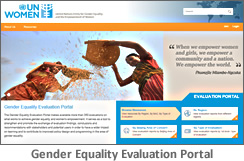
The Gender Equality Evaluation Portal makes available more than 200 evaluations on what works to achieve gender equality and women’s empowerment. The Gender Equality Evaluation Portal aims to establish a widely accessible database of evaluations that will serve as the tools to strengthen and promote the exchange of findings, conclusions and recommendations gleaned from evaluations with stakeholders and potential users, in order to have a wider impact on learning and to contribute to improved policy design and programming in the area of gender equality. The development of this resource is in response to UN Women’s mandate to lead and coordinate the overall efforts of the UN system to support the full realization of women’s rights and opportunities. It serves as a critical step to advance transparency and mutual accountability for development effectiveness through the establishment of strengthened evidence and data for gender equality and women’s empowerment. read more »

A Manager’s Guide to Gender Equality– and Human Rights–Responsive Evaluation

A Manager’s Guide to Gender Equality– and Human Rights–Responsive Evaluation. This practical, online guide aims to help those initiating, managing and/or using gender equality (GE)– and human rights (HR)–responsive evaluations. It provides direction, advice and tools for every step in the evaluation process — from getting started, to preparation, conduct and evaluation use and follow-up. It contains tools to aid in the process and references to provide a greater depth of information on specific topics and issues. read more »

My M&E is a collaborative website to share knowledge on country-led M&E systems worldwide. In addition to being a learning resource, My M&E facilitates the strengthening of a global community, while identifying good practices and lessons learned about program monitoring and evaluation in general, and on country-led M&E systems in particular. While My M&E was founded by IOCE, UNICEF and DevInfo, it is managed by a consortium of partner organizations including IDEAS, IPDET, WHO/PAHO, UN Women, ReLAC, Preval, Agencia brasileira de Avaliacao, SLEvA and IPEN. read more »

Ongoing Strategic Evaluations

This section includes information and interim products of on-going UN Women Strategic Evaluations. Strategic Evaluations are independent assessments of strategic areas of UN Women’s work, including global thematic priorities of the UN Women Strategic Plan, coordination and intergovernmental-support results, institutional performance, programmatic approaches and country programmes. The corporate evaluation agenda deploys a cyclical approach to ensure coverage of the different Strategic Plan focus areas and are managed by the independent Evaluation Office. read more »

Latest Evaluation Reports

Analytical Overview of the UN Joint Gender Programmes PortfolioAnalytical Overview of the UN Joint Gender Programmes Portfolio (2011). This report is a pre-study to support the scoping process for the future Evaluation of Joint Gender Programmes (JPGs) in the UN system, which will evaluate the UN’s joint programmes in the area of gender equality, women’s rights and women’s empowerment. It provides the drafters of the terms of reference for the future JGPs evaluation with qualitative and quantitative analytical overview of the JGP portfolio and reflections on the emerging strategic priorities, evaluability and methodological options. read more »

UNIFEM Strategic Plan (2008–2011) Evaluability AssessmentUNIFEM Strategic Plan (2008–2011) Evaluability Assessment (2011). This study is an analysis of the UNIFEM Strategic Plan (2008–2011), its associated results frameworks and institutional systems. It assesses UNIFEM’s experience of implementing the Strategic Plan, with a view to informing the new strategic planning process of UN Women. It is aimed at all members of UN Women and relevant partners, at headquarters, sub-regional and country levels, plus any interested external partners. read more »

Evaluation Report: UNIFEM’s Work on Gender-Responsive BudgetingEvaluation Report: UNIFEM’s Work on Gender-Responsive Budgeting (2010). The evaluation, split into three sets of reports, provides critical lessons on what conditions and mechanisms enable or hinder UNIFEM’s work in increasing gender equality in budget processes and practices. It also analyses UNIFEM’s overall approach to gender-responsive budget programming. read more »

Evaluation Report: United Nations Trust Fund in Support of Actions to Eliminate Violence against WomenEvaluation Report: United Nations Trust Fund in Support of Actions to Eliminate Violence against Women (2010). This evaluation looks into the implementation and overall effectivness of the 2005-2008 United Nations Trust Fund Strategy in advancing the fund’s work on ending violence against women at country levels. read more »

Evaluation Report: UNIFEM’s Partnerships with Regional Organizations to Advance Gender EqualityEvaluation Report: UNIFEM’s Partnerships with Regional Organizations to Advance Gender Equality (2010). This report assesses UNIFEM’s partnerships with regional organizations in order to affect progress towards gender equality at regional and national levels. It reviews existing partnerships and discusses areas for development, and includes profiles of six partners and the work undertaken by the organizations to promote and enchance gender equality. read more »

Evaluation Report of the UNIFEM Programme Facilitating CEDAW Implementation in Southeast Asia (CEDAW SEAP)Evaluation Report of the UNIFEM Programme Facilitating CEDAW Implementation in Southeast Asia (CEDAW SEAP) (2009). The evaluation of the programme “Facilitating the Implementation of the Convention on the Elimination of All Forms of Discrimination against Women in Southeast Asia” represents the first corporate evaluation completed by UNIFEM within the framework of the organization’s Strategic Plan 2008–2011. It assesses the effectiveness, relevance and sustainability of the programme, and provides recommendations on how it can be further implemented to effectively build on partnerships, experiences and achievements, provide support for ongoing learning and enhance the use of results-based management. read more »

All UN Women evaluation reports are archived in the Evaluation Resource Centre (ERC).

Publications with Evaluation Partners in Countries

Joint Sri Lanka Evaluation Association and UN Women publication on Evaluation

As part of the networking and partnership activities, the EO supported 2011 Sri Lanka Evaluation Association (SLEvA) international conference by providing bursaries to four practitioners/researchers who have been working in the area of gender and evaluation. After the conference, a peer-review of the research topics was undertaken by the group of the four practitioners/researchers in collaboration with the monitoring and evaluation unit of the sub-regional office for South Asia as well as the regional evaluation specialist. This resulted in a joint publication titled “Reflecting on Gender Equality and Human Rights in Evaluation”. Download publication here.

Systematization of evaluations on human rights and gender equality in Latin America – joint research study with UN Women Evaluation Office and Inclusion y Equidad NGO

The report analyses evaluations carried out in the region from a gender equality and human rights responsive evaluation approach looking at their achievements and challenges of design and implementation from the perspective of capacity building and knowledge generation. Main recommendations focus on the need to integrate in depth a gender equality approach in the evaluation; increase investment in capacity development, strengthen monitoring and evaluation systems within programmes and reinforce information systems  as well as knowledge sharing and learning. Download the report here.