

Universal menu

  • Global
  • Regions
    • Africa
    • Americas and the Caribbean
    • Arab States
    • Asia and the Pacific
    • Europe and Central Asia
  • Knowledge
  • Data
  • Training
  • Transparency
UN Women - For all women and girls

Main Navigation-HQ

  • Who we are
    • About us
      • About UN Women
      • Business model
      • Guiding documents
      • Worldwide presence
    • Leadership
      • Governance structure
      • Executive leadership
      • Executive Board
      • Accountability
    • Work with us
      • Employment
      • Procurement
      • Calls for proposals
      • Contact us
      • UN Women Strategic Plan 2026–2029
      • UN Women Strategic Plan 2026–2029 - social media image
        UN Women Strategic Plan 2026–2029
  • What we do
    • Focus areas
      • Ending violence against women
      • Peace and security
      • Humanitarian action
      • Leadership and governance
      • Economic empowerment
      • Innovation and technology
      • Women with disabilities
      • Youth
      • HIV and AIDS
    • How we work
      • 2030 Agenda for Sustainable Development
      • Commission on the Status of Women
      • Gender parity in the UN system
      • Intergovernmental support
      • Partnerships
      • Research and data
      • Training Centre
      • Trust funds
      • UN system coordination
      • Gender Equality Accelerators
      • Gender Equality Accelerators artwork
        Gender Equality Accelerators
  • News and stories
    • Latest
      • News
      • Articles and explainers
      • In focus
    • Media center
      • Press materials
      • Media contacts
      • Explainer: Why are women so exhausted? Care work and the mental load
      • Two adults stand at a table changing diapers on baby dolls, with laundry hanging on a clothesline behind them in a home setting.
        Explainer: Why are women so exhausted? Care work and the mental load
      • Press release: Aid cuts dismantle women’s organizations working in humanitarian crises
      • A young Ugandan woman sits with another local woman to talk
        Press release: Aid cuts dismantle women’s organizations working in humanitarian crises
  • Digital library
    • Resources
      • Publications
      • Annual reports
      • Progress of the world’s women
      • World survey on the role of women in development
      • The gender snapshot
    • GenderTerm
      • GenderTerm
      • Reprint permissions
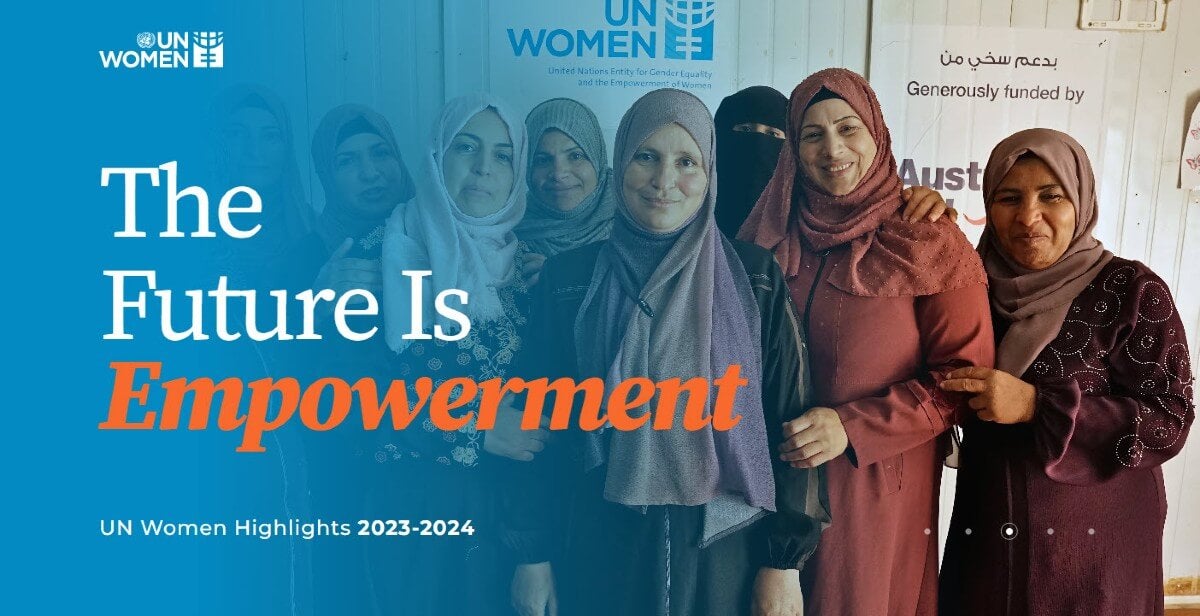
      • UN Women Highlights 2025–2026
      • A smiling woman.
        UN Women Highlights 2025–2026
      • The gender snapshot 2025
      • gender snapshot thumbnail transparent
        The gender snapshot 2025
  • Get involved
    • How to get involved
      • For ALL Women and Girls
      • International Women's Day
      • 16 Days of Activism to End Violence against Women and Girls
      • UNiTE! Campaign to End Violence against Women
      • Generation Equality
      • He for She
Ask AI
https://84e5cfacd5c7e99f9825edf344450c.1b.environment.api.powerplatform.com/powervirtualagents/botsbyschema/crad4_websiteQA/directline/token?api-version=2022-03-01-preview
1
-
Ask your question here
AI website assistant

Hello, how can I assist you?

AI chatbot responses may be incorrect. Always verify important information.

Donate button menu

Donate

Breadcrumb

  1. Home
  2. Publications

Website survey

We want to know how we can improve your experience on this website. Completing this survey takes less than 5 minutes.

TAKE THE SURVEY
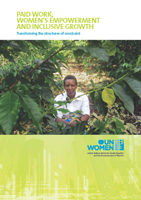
Image
Paid work, women’s empowerment and inclusive growth

Paid work, women’s empowerment and inclusive growth: Transforming the structures of constraint

Publication year 2013
  • Share to Facebook
  • Share to Twitter
  • Share to LinkedIn
  • Share to E-mail
Author(s)/editor(s) Naila Kabeer with Ragui Assaad, Akosua Darkwah, Simeen Mahmud, Hania Sholkamy, Sakiba Tasneem and Dzodzi Tsikata, and with statistical support by Munshi Sulaiman

Drawing on household survey data collected in Egypt, Ghana and Bangladesh as part of the Pathways of Women’s Empowerment Research Partners’ Consortium, this report provides insights into the ‘resource’ pathways that enhance women’s agency and thereby contribute to the inclusiveness of the economic growth process.

Moreover, it looks at the the extent to which the structure of economic opportunities, generated by a country’s growth strategies, translated into positive impacts on women’s lives in these three country contexts.Briefly, the findings suggest that economic growth alone does not promote gender equality. Rather, unless patterns of growth generate reasonable quality jobs for women, the extent to which greater gender equality is achieved will depend on the actions of the state and civil society.

Greater gender equality, in turn, does have the potential to contribute to inclusive growth when it is achieved in education, employment and other valued resources. In particular, women’s access to valued resources, such as decent jobs and higher education, can have positive distributional implications for growth.

The report highlights three broad areas of interventions that are needed to transform the gender-specific constraints that keep women out of the market or trapped in poorly paid activities. Creating a more enabling regulatory environment will, among other things, require action to address discriminatory legislation, such as inheritance laws, and promote legislation that seeks to level the economic playing field for women and men, such as state support for maternity leave. Social protection policies are also important.

They assist women and men to cope with, and recover from, the various kinds of risks and insecurities associated with globalization. The gender transformative potential of an inclusive growth strategy could be enhanced if, for example, provision is made for child care for women participating in these programmes or minimum quotas are put in place to ensure women’s participation.

Last, supporting women’s organizational capacity can give them a greater voice and influence in advancing their own needs, interests and priorities and larger capacity to address barriers to women’s progress. This support can assist women to become strong agents for social transformation.

View Online:

PDF version: Full version

Part I | Part II | Part III

Bibliographic information

Number of pages
108
Resource type(s)
Assessments
Publishing entities
United Nations Entity for Gender Equality and the Empowerment of Women (UN Women)
UN Women office publishing
UN Women Headquarters Office

Tags

Footer menu-HQ

  • News and stories
  • Resources
  • What we do
  • How we work
  • Where we are
  • Partnerships
  • Employment
  • Procurement
  • Contact us
  • Executive Board
  • Commission on the Status of Women

Donate button menu [Footer tablet]

  • Donate

Donate button menu [Footer]

  • Donate

Social media menu

  • Facebook
  • Twitter
  • LinkedIn
  • Flickr
  • YouTube
  • Instagram
UN Women - For all women and girls

Footer bottom [Menu]

  • Copyright
  • Information security
  • Privacy notice
  • Report wrongdoing
  • Terms of use
Share this page
  • Share to Facebook
  • Share to Twitter
  • Share to LinkedIn
  • Share to E-mail

Or copy link