

Universal menu

  • Global
  • Regions
    • Africa
    • Americas and the Caribbean
    • Arab States
    • Asia and the Pacific
    • Europe and Central Asia
  • Knowledge
  • Data
  • Training
  • Transparency
UN Women - For all women and girls

Main Navigation-HQ

  • Who we are
    • About us
      • About UN Women
      • Business model
      • Guiding documents
      • Worldwide presence
    • Leadership
      • Governance structure
      • Executive leadership
      • Executive Board
      • Accountability
    • Work with us
      • Employment
      • Procurement
      • Calls for proposals
      • Contact us
      • UN Women Strategic Plan 2026–2029
      • UN Women Strategic Plan 2026–2029 - social media image
        UN Women Strategic Plan 2026–2029
  • What we do
    • Focus areas
      • Ending violence against women
      • Peace and security
      • Humanitarian action
      • Leadership and governance
      • Economic empowerment
      • Innovation and technology
      • Women with disabilities
      • Youth
      • HIV and AIDS
    • How we work
      • 2030 Agenda for Sustainable Development
      • Commission on the Status of Women
      • Gender parity in the UN system
      • Intergovernmental support
      • Partnerships
      • Research and data
      • Training Centre
      • Trust funds
      • UN system coordination
      • Gender Equality Accelerators
      • Gender Equality Accelerators artwork
        Gender Equality Accelerators
  • News and stories
    • Latest
      • News
      • Articles and explainers
      • In focus
    • Media center
      • Press materials
      • Media contacts
      • Explainer: Why are women so exhausted? Care work and the mental load
      • Two adults stand at a table changing diapers on baby dolls, with laundry hanging on a clothesline behind them in a home setting.
        Explainer: Why are women so exhausted? Care work and the mental load
      • Press release: Aid cuts dismantle women’s organizations working in humanitarian crises
      • A young Ugandan woman sits with another local woman to talk
        Press release: Aid cuts dismantle women’s organizations working in humanitarian crises
  • Digital library
    • Resources
      • Publications
      • Annual reports
      • Progress of the world’s women
      • World survey on the role of women in development
      • The gender snapshot
    • GenderTerm
      • GenderTerm
      • Reprint permissions
      • UN Women Highlights 2025–2026
      • A smiling woman.
        UN Women Highlights 2025–2026
      • The gender snapshot 2025
      • gender snapshot thumbnail transparent
        The gender snapshot 2025
  • Get involved
    • How to get involved
      • For ALL Women and Girls
      • International Women's Day
      • 16 Days of Activism to End Violence against Women and Girls
      • UNiTE! Campaign to End Violence against Women
      • Generation Equality
      • He for She
Ask AI
https://84e5cfacd5c7e99f9825edf344450c.1b.environment.api.powerplatform.com/powervirtualagents/botsbyschema/crad4_websiteQA/directline/token?api-version=2022-03-01-preview
1
-
Ask your question here
AI website assistant

Hello, how can I assist you?

AI chatbot responses may be incorrect. Always verify important information.

Donate button menu

Donate

Breadcrumb

  1. Home
  2. Publications

Website survey

We want to know how we can improve your experience on this website. Completing this survey takes less than 5 minutes.

TAKE THE SURVEY
Image
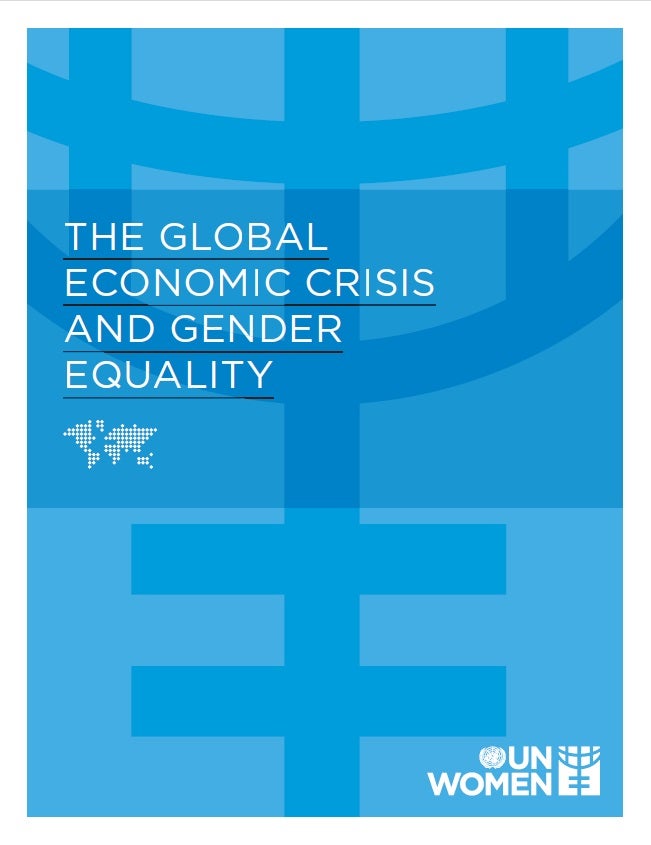
The Global Economic Crisis and Gender Equality coverpage

The Global Economic Crisis and Gender Equality

Publication year 2014
  • Share to Facebook
  • Share to Twitter
  • Share to LinkedIn
  • Share to E-mail
Author(s)/editor(s) UN Women Policy and Programme Bureau

The 2007-2008 global financial crisis and subsequent austerity policies have put the realization of women’s economic and social rights in jeopardy. The resulting job losses, decreased social services and increased economic insecurity have weakened the capacity of people to perform the unpaid care work that is so critical for human well-being and social development.

While most policy responses have focused on bailing out the financial sector and, to a lesser extent, dealing with its implications for economic output and jobs, far less attention has been given to its impact on people’s ability to care for themselves, their families and communities.

This paper suggests that these three spheres—finance, production and unpaid care—are in fact interconnected and overlapping, and undertakes a feminist analysis to draw attention to their interconnections and to make visible what is often left out of mainstream accounts.

UN Women calls on States to take a transformative approach to economic and social policy, and design recovery policies that promote the realization of women’s rights, in order to meet their human rights obligations. UN Women recommends public action on three broad fronts:

  • Job creation and support for social protection policies: such policy approaches will be more effective in reducing debt levels and setting the foundation for sustainable economic and social recovery than the neoliberal economic policies that have dominated the response to date.
  • Better regulation of global finance: National governments and the United Nations must play a much stronger role in the governance of global and national financial flows to avoid future crises and their costs to women in particular.
  • Investment in the reproduction of people: the State must facilitate access to quality services, infrastructure and other essential goods such as food, which can reduce and redistribute the disproportionate share of unpaid care work performed by low-income women and create the basic foundations for social and economic recovery.
View online/download:

English

Bibliographic information

Number of pages
88
Resource type(s)
Position papers
Publishing entities
United Nations Entity for Gender Equality and the Empowerment of Women (UN Women)

Tags

Economic empowerment Financial and economic crisis

Related publications

Empowering Women, Building Sustainable Assets: Strengthening the depth of gender lens investing across asset classes

Empowering women, building sustainable assets: Strengthening the depth of gender lens investing across asset classes

7 February 2024
Empowering women, building sustainable assets: Strengthening the depth of gender lens investing across asset classes
Cover.

Regular resources report 2025: Delivering UN Women’s triple mandate through regular resources

8 September 2026
Regular resources report 2025: Delivering UN Women’s triple mandate through regular resources
Publication cover.

Women farmers caring for people and planet: Sustaining land, water and biodiversity

31 July 2026
Women farmers caring for people and planet: Sustaining land, water and biodiversity

Footer menu-HQ

  • News and stories
  • Resources
  • What we do
  • How we work
  • Where we are
  • Partnerships
  • Employment
  • Procurement
  • Contact us
  • Executive Board
  • Commission on the Status of Women

Donate button menu [Footer tablet]

  • Donate

Donate button menu [Footer]

  • Donate

Social media menu

  • Facebook
  • Twitter
  • LinkedIn
  • Flickr
  • YouTube
  • Instagram
UN Women - For all women and girls

Footer bottom [Menu]

  • Copyright
  • Information security
  • Privacy notice
  • Report wrongdoing
  • Terms of use
Share this page
  • Share to Facebook
  • Share to Twitter
  • Share to LinkedIn
  • Share to E-mail

Or copy link