
Universal menu

  • Global
  • Regions
    • Africa
    • Americas and the Caribbean
    • Arab States
    • Asia and the Pacific
    • Europe and Central Asia
  • Knowledge
  • Data
  • Training
  • Transparency
UN Women - For all women and girls

Main Navigation-HQ

  • Who we are
    • About us
      • About UN Women
      • Business model
      • Guiding documents
      • Worldwide presence
    • Leadership
      • Governance structure
      • Executive leadership
      • Executive Board
      • Accountability
    • Work with us
      • Employment
      • Procurement
      • Calls for proposals
      • Contact us
      • UN Women Strategic Plan 2026–2029
      • UN Women Strategic Plan 2026–2029 - social media image
        UN Women Strategic Plan 2026–2029
  • What we do
    • Focus areas
      • Ending violence against women
      • Peace and security
      • Humanitarian action
      • Leadership and governance
      • Economic empowerment
      • Innovation and technology
      • Women with disabilities
      • Youth
      • HIV and AIDS
    • How we work
      • 2030 Agenda for Sustainable Development
      • Commission on the Status of Women
      • Gender parity in the UN system
      • Intergovernmental support
      • Partnerships
      • Research and data
      • Training Centre
      • Trust funds
      • UN system coordination
      • Gender Equality Accelerators
      • Gender Equality Accelerators artwork
        Gender Equality Accelerators
  • News and stories
    • Latest
      • News
      • Articles and explainers
      • In focus
    • Media center
      • Press materials
      • Media contacts
      • Explainer: Why are women so exhausted? Care work and the mental load
      • Two adults stand at a table changing diapers on baby dolls, with laundry hanging on a clothesline behind them in a home setting.
        Explainer: Why are women so exhausted? Care work and the mental load
      • Press release: Aid cuts dismantle women’s organizations working in humanitarian crises
      • A young Ugandan woman sits with another local woman to talk
        Press release: Aid cuts dismantle women’s organizations working in humanitarian crises
  • Digital library
    • Resources
      • Publications
      • Annual reports
      • Progress of the world’s women
      • World survey on the role of women in development
      • The gender snapshot
    • GenderTerm
      • GenderTerm
      • Reprint permissions
      • UN Women Highlights 2025–2026
      • A smiling woman.
        UN Women Highlights 2025–2026
      • The gender snapshot 2025
      • gender snapshot thumbnail transparent
        The gender snapshot 2025
  • Get involved
    • How to get involved
      • For ALL Women and Girls
      • International Women's Day
      • 16 Days of Activism to End Violence against Women and Girls
      • UNiTE! Campaign to End Violence against Women
      • Generation Equality
      • He for She
Ask AI
https://84e5cfacd5c7e99f9825edf344450c.1b.environment.api.powerplatform.com/powervirtualagents/botsbyschema/crad4_websiteQA/directline/token?api-version=2022-03-01-preview
1
-
Ask your question here
AI website assistant

Hello, how can I assist you?

AI chatbot responses may be incorrect. Always verify important information.

Donate button menu

Donate

Breadcrumb

  1. Home
  2. Publications

Website survey

We want to know how we can improve your experience on this website. Completing this survey takes less than 5 minutes.

TAKE THE SURVEY
Image
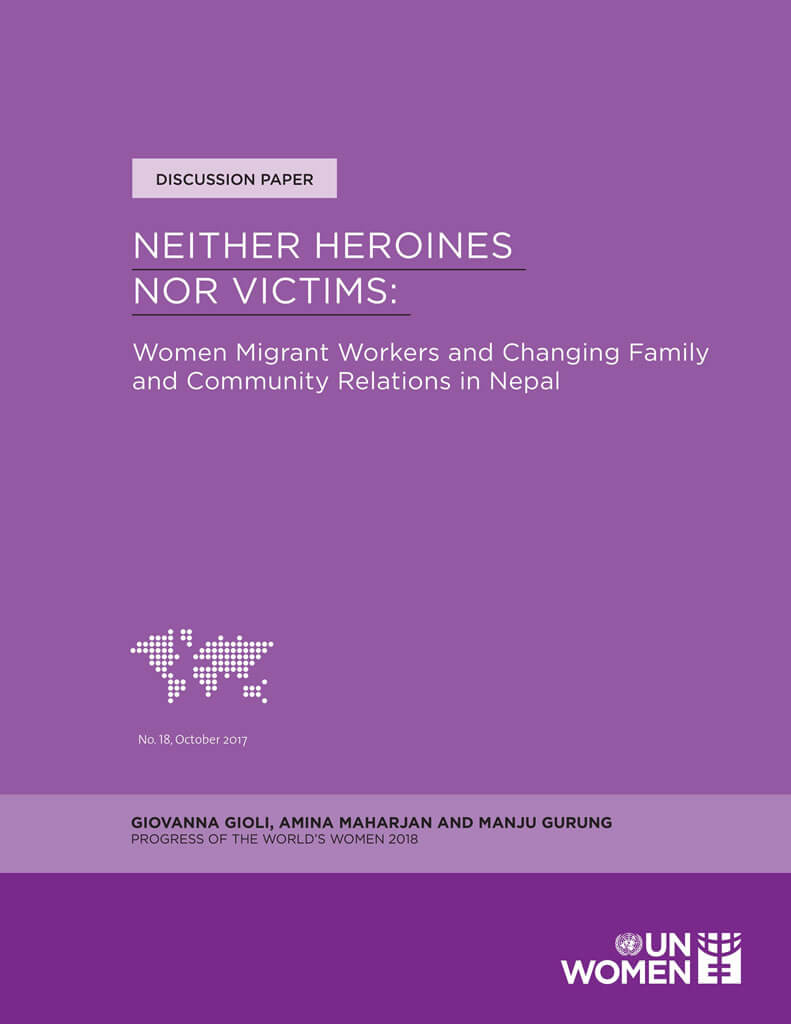
Neither heroines nor victims: Women migrant workers and changing family and community relations in Nepal

Neither heroines nor victims: Women migrant workers and changing family and community relations in Nepal

Publication year 2017
  • Share to Facebook
  • Share to Twitter
  • Share to LinkedIn
  • Share to E-mail
Author(s)/editor(s) Giovanna Gioli, Amina Maharjan, Manju Gurung

Circular labour migration is frequently portrayed as a gender-neutral phenomenon. Despite the growing literature on the feminization of migration, scholarly and policy literature is often gender-blind.

In Nepal, over the last decade, the share of women migrant workers has significantly increased. The National Population Census 2011 shows that about 13 per cent of the absentee population is composed of women. Due to prevailing patriarchal norms and values and skewed policy, female labour migration is traditionally stigmatized and associated with sex work or equated to trafficking. However, with rising demands for cheap labour (particularly domestic work) in destination countries (for example, the Persian Gulf), continued inadequacy of rural employment opportunities and changing aspirations, women are increasingly migrating independently.

Pourakhi, an organization established by women returnees in 2003, has collected more than 1,700 case studies on returnee women migrant workers in Nepal. This paper delves into 307 of these, as well as a consultation with 14 returnee migrant women from 14 districts, to better understand the reintegration process. Rather than focusing on a (necessary) critique of labour markets and on the high human, social and financial costs of migration, this study aims at giving voice to the subjectivities of migrant women in Nepal, as less attention has been paid to this aspect. It unpacks their reasons for undertaking international migration and their struggle for capability to secure a livelihood in the context of globalization.

This paper was produced for UN Women’s flagship report Progress of the World’s Women 2018 to be released as part of the UN Women dicussion paper series.
View online/download

  • PDF version

Bibliographic information

Number of pages
ii + 19
Resource type(s)
Case studies Discussion papers
ISBN
978-1-63214-099-9
Publishing entities
United Nations Entity for Gender Equality and the Empowerment of Women (UN Women)
UN Women office publishing
UN Women Headquarters Office

Tags

Asia and the Pacific Economic empowerment Employment Migrant workers Migration Nepal

Related publications

Migrant women and remittances: Exploring the data from selected countries

Migrant women and remittances: Exploring the data from selected countries

12 June 2020
Migrant women and remittances: Exploring the data from selected countries
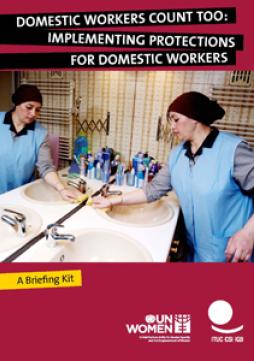
Domestic Workers Count Too: Implementing Protections for Domestic Workers

Domestic Workers Count Too: Implementing Protections for Domestic Workers

1 March 2013
Domestic Workers Count Too: Implementing Protections for Domestic Workers
Mis/representations of women migrant workers in the media: A critical analysis

Mis/representations of women migrant workers in the media: A critical analysis

31 July 2017
Mis/representations of women migrant workers in the media: A critical analysis

Footer menu-HQ

  • News and stories
  • Resources
  • What we do
  • How we work
  • Where we are
  • Partnerships
  • Employment
  • Procurement
  • Contact us
  • Executive Board
  • Commission on the Status of Women

Donate button menu [Footer tablet]

  • Donate

Donate button menu [Footer]

  • Donate

Social media menu

  • Facebook
  • Twitter
  • LinkedIn
  • Flickr
  • YouTube
  • Instagram
UN Women - For all women and girls

Footer bottom [Menu]

  • Copyright
  • Information security
  • Privacy notice
  • Report wrongdoing
  • Terms of use
Share this page
  • Share to Facebook
  • Share to Twitter
  • Share to LinkedIn
  • Share to E-mail

Or copy link