

Universal menu

  • Global
  • Regions
    • Africa
    • Americas and the Caribbean
    • Arab States
    • Asia and the Pacific
    • Europe and Central Asia
  • Knowledge
  • Data
  • Training
  • Transparency
UN Women - For all women and girls

Main Navigation-HQ

  • Who we are
    • About us
      • About UN Women
      • Business model
      • Guiding documents
      • Worldwide presence
    • Leadership
      • Governance structure
      • Executive leadership
      • Executive Board
      • Accountability
    • Work with us
      • Employment
      • Procurement
      • Calls for proposals
      • Contact us
      • UN Women Strategic Plan 2026–2029
      • UN Women Strategic Plan 2026–2029 - social media image
        UN Women Strategic Plan 2026–2029
  • What we do
    • Focus areas
      • Ending violence against women
      • Peace and security
      • Humanitarian action
      • Leadership and governance
      • Economic empowerment
      • Innovation and technology
      • Women with disabilities
      • Youth
      • HIV and AIDS
    • How we work
      • 2030 Agenda for Sustainable Development
      • Commission on the Status of Women
      • Gender parity in the UN system
      • Intergovernmental support
      • Partnerships
      • Research and data
      • Training Centre
      • Trust funds
      • UN system coordination
      • Gender Equality Accelerators
      • Gender Equality Accelerators artwork
        Gender Equality Accelerators
  • News and stories
    • Latest
      • News
      • Articles and explainers
      • In focus
    • Media center
      • Press materials
      • Media contacts
      • Explainer: Why are women so exhausted? Care work and the mental load
      • Two adults stand at a table changing diapers on baby dolls, with laundry hanging on a clothesline behind them in a home setting.
        Explainer: Why are women so exhausted? Care work and the mental load
      • Press release: Aid cuts dismantle women’s organizations working in humanitarian crises
      • A young Ugandan woman sits with another local woman to talk
        Press release: Aid cuts dismantle women’s organizations working in humanitarian crises
  • Digital library
    • Resources
      • Publications
      • Annual reports
      • Progress of the world’s women
      • World survey on the role of women in development
      • The gender snapshot
    • GenderTerm
      • GenderTerm
      • Reprint permissions
      • UN Women Highlights 2025–2026
      • A smiling woman.
        UN Women Highlights 2025–2026
      • The gender snapshot 2025
      • gender snapshot thumbnail transparent
        The gender snapshot 2025
  • Get involved
    • How to get involved
      • For ALL Women and Girls
      • International Women's Day
      • 16 Days of Activism to End Violence against Women and Girls
      • UNiTE! Campaign to End Violence against Women
      • Generation Equality
      • He for She
Ask AI
https://84e5cfacd5c7e99f9825edf344450c.1b.environment.api.powerplatform.com/powervirtualagents/botsbyschema/crad4_websiteQA/directline/token?api-version=2022-03-01-preview
1
-
Ask your question here
AI website assistant

Hello, how can I assist you?

AI chatbot responses may be incorrect. Always verify important information.

Donate button menu

Donate

Breadcrumb

  1. Home
  2. Publications

Website survey

We want to know how we can improve your experience on this website. Completing this survey takes less than 5 minutes.

TAKE THE SURVEY
Image
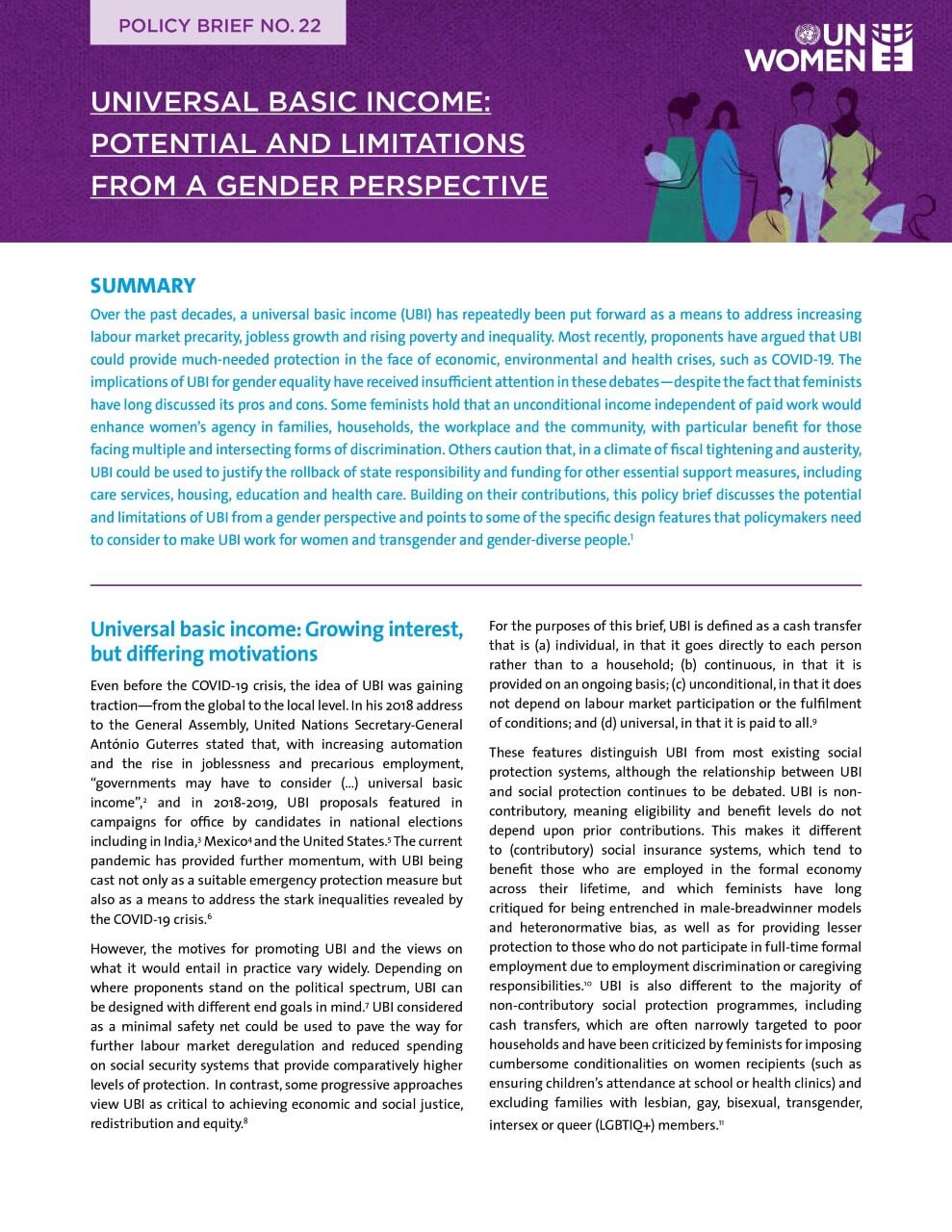
Universal basic income: Potential and limitations from a gender perspective

Universal basic income: Potential and limitations from a gender perspective

Publication year 2021
  • Share to Facebook
  • Share to Twitter
  • Share to LinkedIn
  • Share to E-mail
Author(s)/editor(s) Loui Williams

Over the past decades, universal basic income (UBI) has repeatedly been put forward as a means to address increasing labour market precarity, jobless growth, and rising poverty and inequality. Most recently, proponents have argued that UBI could provide much-needed protection in the face of economic, environmental, and health crises, such as COVID-19.

The implications of UBI for gender equality have received insufficient attention in these debates, despite the fact that feminists have long discussed its pros and cons. Some feminists hold that an unconditional income independent of paid work would enhance women’s agency in families, households, the workplace, and the community, with particular benefit for those facing multiple and intersecting forms of discrimination. Others caution that, in a climate of fiscal tightening and austerity, UBI could be used to justify the rollback of state responsibility and funding for other essential support measures, including care services, housing, education, and health care.

Building on their contributions, this policy brief discusses the potential and limitations of UBI from a gender perspective and points to some of the specific design features that policymakers need to consider to make UBI work for women and transgender and gender-diverse people.
See other UN Women policy briefs.

View online/download

  • Publication (PDF, 229KB)

Bibliographic information

Number of pages
7
Resource type(s)
Briefs
Publishing entities
United Nations Entity for Gender Equality and the Empowerment of Women (UN Women)
UN Women office publishing
UN Women Headquarters Office

Tags

Economic empowerment Financing for gender equality Gender equality and inequality Gender equality and women’s empowerment Governance and national planning Productive resources Social protection

Related publications

Centring women’s economic empowerment in the Fourth International Conference on Financing for Development

Centring women’s economic empowerment in the Fourth International Conference on Financing for Development

23 December 2024
Centring women’s economic empowerment in the Fourth International Conference on Financing for Development
Leveraging digital finance for gender equality and women’s empowerment

Leveraging digital finance for gender equality and women’s empowerment

24 September 2019
Leveraging digital finance for gender equality and women’s empowerment
Image new

The impact of foreign assistance cuts on women’s rights and women-led organizations in Ukraine

20 February 2026
The impact of foreign assistance cuts on women’s rights and women-led organizations in Ukraine

Footer menu-HQ

  • News and stories
  • Resources
  • What we do
  • How we work
  • Where we are
  • Partnerships
  • Employment
  • Procurement
  • Contact us
  • Executive Board
  • Commission on the Status of Women

Donate button menu [Footer tablet]

  • Donate

Donate button menu [Footer]

  • Donate

Social media menu

  • Facebook
  • Twitter
  • LinkedIn
  • Flickr
  • YouTube
  • Instagram
UN Women - For all women and girls

Footer bottom [Menu]

  • Copyright
  • Information security
  • Privacy notice
  • Report wrongdoing
  • Terms of use
Share this page
  • Share to Facebook
  • Share to Twitter
  • Share to LinkedIn
  • Share to E-mail

Or copy link