

Three challenges for rural women amid a cost-of-living crisis
71 million people in the developing world have fallen into poverty in just three months as a direct consequence of global food and energy price surges. The impact on poverty rates is drastically faster than the shock of the COVID-19 pandemic. The current cost-of-living crisis is expected to hit women the hardest, with persistent pay inequality and undervalued work being the main reasons behind the increased financial load they have to shoulder. Women are also usually the primary caretakers for children and the elderly, and in times of crisis, they are disproportionately pushed out of employment and forced to stay at home. Without sufficient government support, they are often left to struggle alone in increasingly dire conditions.
These difficulties are particularly challenging for rural women, who face additional hurdles on their way to financial independence and stability. When crisis hits, rural women are hit the hardest, usually due to poor access to resources, services and information, the heavy burden of unpaid care and domestic work, and discriminatory traditional social norms.
To support rural women in securing their livelihoods and building resilience in the face of crisis, the Joint Programme ‘Accelerating Progress Towards Rural Women’s Economic Empowerment’ (JP RWEE)—a unique partnership between the Food and Agriculture Organization of the United Nations (FAO), the International Fund for Agricultural Development (IFAD), the United Nations entity for Gender Equality and the Empowerment of Women (UN Women) and the World Food Programme (WFP)—tackles barriers facing rural women through a holistic approach that encompasses social, economic and political domains of empowerment. The JP RWEE is currently being implemented in Nepal, Niger, Tanzania, Tunisia, Rwanda and the Pacific Islands (Fiji, Kiribati, Solomon Islands, Tonga).
Increasingly fragile agricultural systems
In many regions around the world, farming is the main source of livelihood and an important income source for the rural population. Such is the case in Tanzania, where approximately 80 percent of women rely on subsistence farming to feed themselves and their families; and in Tunisia, where 70 percent of the country’s agricultural workforce are women.
Rural women, who often struggle to secure their own land to farm in the first place, are facing heightened difficulties in the wake of global crises such as conflict and climate change. In 2022, a significant decrease in the global fertilizer supply—which mainly comes from Ukraine and Russia—has made it more challenging to produce enough food. This shortage is compounding more long-standing threats, such as disruptions to harvests caused by increasingly extreme and unpredictable weather conditions.
“As 95 percent of agricultural activity in Tanzania depends on rainfall, the impact of changes in precipitation on agriculture would be far reaching. The over-reliance on rain-fed agriculture for livelihoods restricts the adaptive capacity of rural communities […]”
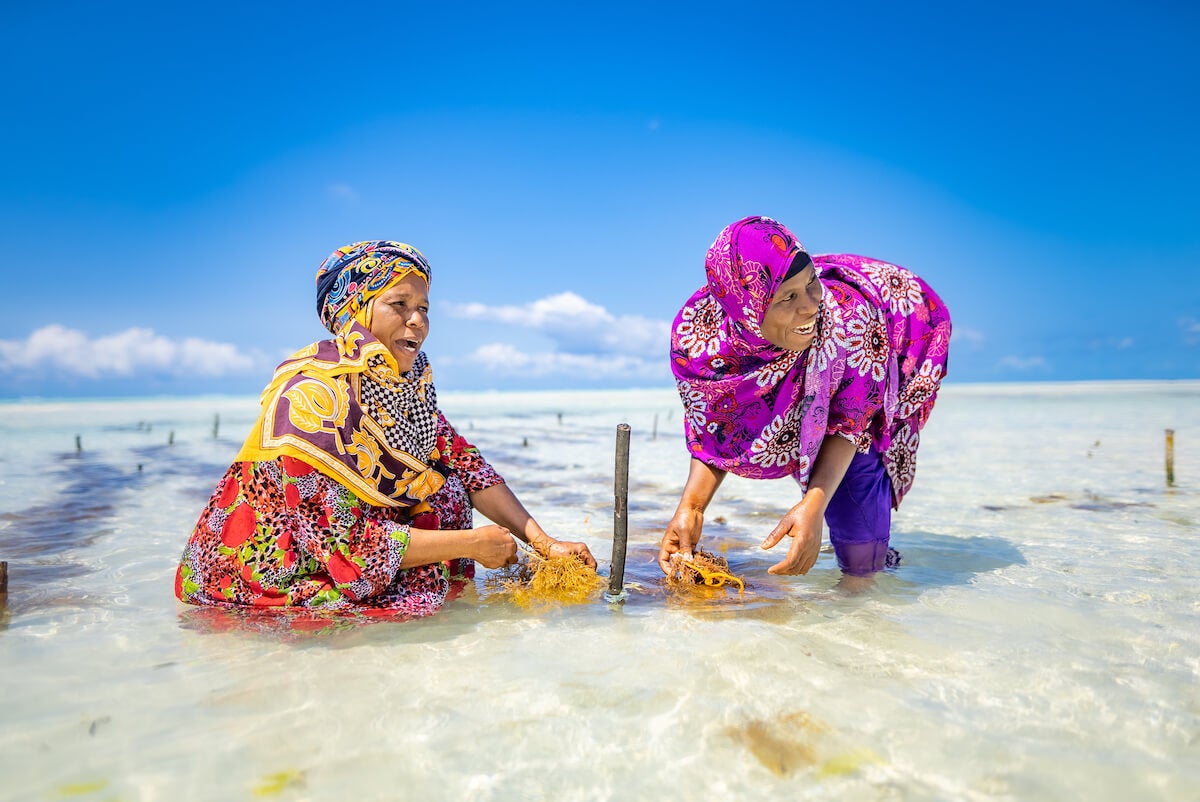
The changing climate conditions are affecting not only land-based resources, but marine ones as well. As rising temperatures increase the risk of irreversible loss of marine and coastal ecosystems, communities that rely on the ocean for their livelihoods need support. In Zanzibar, Tanzania, where aquaculture revolves largely around seaweed farming, sea water and sea temperature rises are greatly affecting production. The Pacific Islands also face increasingly serious impacts of climate change, such as growing water scarcity, rising sea levels, coastal erosion, and increasing water and soil salinity.
The JP RWEE will support rural women in improving production of seaweed, sardines and other products using climate-smart agriculture, which helps to transform agri-food systems via green and climate resilient practices. Through the introduction of climate-smart agriculture, the Programme will help create a local agricultural system centred around biodiversity, resilience and the nutritional needs of rural women and their households.
Restrictive socio-cultural norms
In many countries, rural women and girls spend most of their time on unpaid care and domestic work. Traditional gender norms retain a stronge hold on people’s daily lives in many rural communities, and women are expected to shoulder the majority of household chores and childcare. In Tanzania, women spend 3.7 times more of their time on unpaid care and domestic work than men—and thus have less time at their disposal to engage in paid work or entrepreneurship. Women in Tunisia, who face restricted mobility after certain hours of the day and limited interaction with people outside their families, are widely categorized as “helpers” to male workers rather than as workers in their own right. These long-existing traditions and beliefs discourage them from taking on leadership roles and speaking up, with many remaining unaware of their rights.
To help with the equal distribution of unpaid work and domestic responsibilities, the JP RWEE engages with men as religious and traditional leaders, local authorities and citizens to ensure political and social recognition of the role of women. In many participating countries, the Programme supports participants in developing more equitable household relationships, helping them to identify and address gender inequalities within the home.
“Recognising, reducing, and redistributing the responsibilities of unpaid care work has been highlighted as a priority need for women’s economic empowerment in the Pacific”.
Limited access to services
Lack of access to financial, government and other services is a common obstacle for rural women around the world. Gender inequalities, rooted in discriminatory patriarchal systems and social norms, mean that women are less likely to access agricultural extension services, markets, land and formal financial services despite their high participation in the agriculture sector. In Tanzania, only 12.2 per cent of women use bank services, compared to 21.4 per cent of men. Women are less likely to have access to financial credit, loans, insurance on crops, livestock, and other productive resources, making it difficult for them to engage in economic opportunities such as entrepreneurship. These limitations are often compounded by a lack of finance management knowledge and business literacy.
Across participating countries, the JP RWEE will provide rural women with business and financial management training. In Tunisia, it will support women’s cooperatives to commercialize their products through digital solutions like user-friendly e-market platforms. In Tanzania, the Programme will establish and strengthen existing community-managed savings and loan groups to provide rural women and their households with a mechanism for accumulating savings and building financial security.
“National and local professional organizations play an important role in rural development, but on their own they have only made limited progress in addressing the challenges facing rural women. With the support of the JP RWEE, we will reinforce capacities of rural women to increase their income and access to inputs, knowledge, market and decent work, and strengthen national institutional capacity to implement laws to facilitate access to financial services and advance women’s land rights.”
Related content

Interview: Gender equality is key to a just renewable energy future
For ALL Women and Girls: Robie Halip on Indigenous leadership in renewable energy transition
