
Universal menu

  • Global
  • Regions
    • Africa
    • Americas and the Caribbean
    • Arab States
    • Asia and the Pacific
    • Europe and Central Asia
  • Knowledge
  • Data
  • Training
  • Transparency
UN Women - For all women and girls

Main Navigation-HQ

  • Who we are
    • About us
      • About UN Women
      • Business model
      • Guiding documents
      • Worldwide presence
    • Leadership
      • Governance structure
      • Executive leadership
      • Executive Board
      • Accountability
    • Work with us
      • Employment
      • Procurement
      • Calls for proposals
      • Contact us
      • UN Women Strategic Plan 2026–2029
      • UN Women Strategic Plan 2026–2029 - social media image
        UN Women Strategic Plan 2026–2029
  • What we do
    • Focus areas
      • Ending violence against women
      • Peace and security
      • Humanitarian action
      • Leadership and governance
      • Economic empowerment
      • Innovation and technology
      • Women with disabilities
      • Youth
      • HIV and AIDS
    • How we work
      • 2030 Agenda for Sustainable Development
      • Commission on the Status of Women
      • Gender parity in the UN system
      • Intergovernmental support
      • Partnerships
      • Research and data
      • Training Centre
      • Trust funds
      • UN system coordination
      • Gender Equality Accelerators
      • Gender Equality Accelerators artwork
        Gender Equality Accelerators
  • News and stories
    • Latest
      • News
      • Articles and explainers
      • In focus
    • Media center
      • Press materials
      • Media contacts
      • Explainer: Why are women so exhausted? Care work and the mental load
      • Two adults stand at a table changing diapers on baby dolls, with laundry hanging on a clothesline behind them in a home setting.
        Explainer: Why are women so exhausted? Care work and the mental load
      • Press release: Aid cuts dismantle women’s organizations working in humanitarian crises
      • A young Ugandan woman sits with another local woman to talk
        Press release: Aid cuts dismantle women’s organizations working in humanitarian crises
  • Digital library
    • Resources
      • Publications
      • Annual reports
      • Progress of the world’s women
      • World survey on the role of women in development
      • The gender snapshot
    • GenderTerm
      • GenderTerm
      • Reprint permissions
      • UN Women Highlights 2025–2026
      • A smiling woman.
        UN Women Highlights 2025–2026
      • The gender snapshot 2025
      • gender snapshot thumbnail transparent
        The gender snapshot 2025
  • Get involved
    • How to get involved
      • For ALL Women and Girls
      • International Women's Day
      • 16 Days of Activism to End Violence against Women and Girls
      • UNiTE! Campaign to End Violence against Women
      • Generation Equality
      • He for She
Ask AI
https://84e5cfacd5c7e99f9825edf344450c.1b.environment.api.powerplatform.com/powervirtualagents/botsbyschema/crad4_websiteQA/directline/token?api-version=2022-03-01-preview
1
-
Ask your question here
AI website assistant

Hello, how can I assist you?

AI chatbot responses may be incorrect. Always verify important information.

Donate button menu

Donate

Breadcrumb

  1. Home
  2. Explore Our Latest News
  3. Explore Our Latest News

Website survey

We want to know how we can improve your experience on this website. Completing this survey takes less than 5 minutes.

TAKE THE SURVEY
Impact story

Changing social norms to end violence against women and girls in Kyrgyzstan

18 November 2022
  • Share to Facebook
  • Share to Twitter
  • Share to LinkedIn
  • Share to E-mail

“This is our new family business. Each loaf of bread is made with lots of love because each of us contributes to making it delicious,” enthuses 38-year-old Gulnaz Almambet kyzy, a new business owner who received Spotlight Initiative-supported gender equality training implemented by UN Women in Kyrgyzstan.
Image
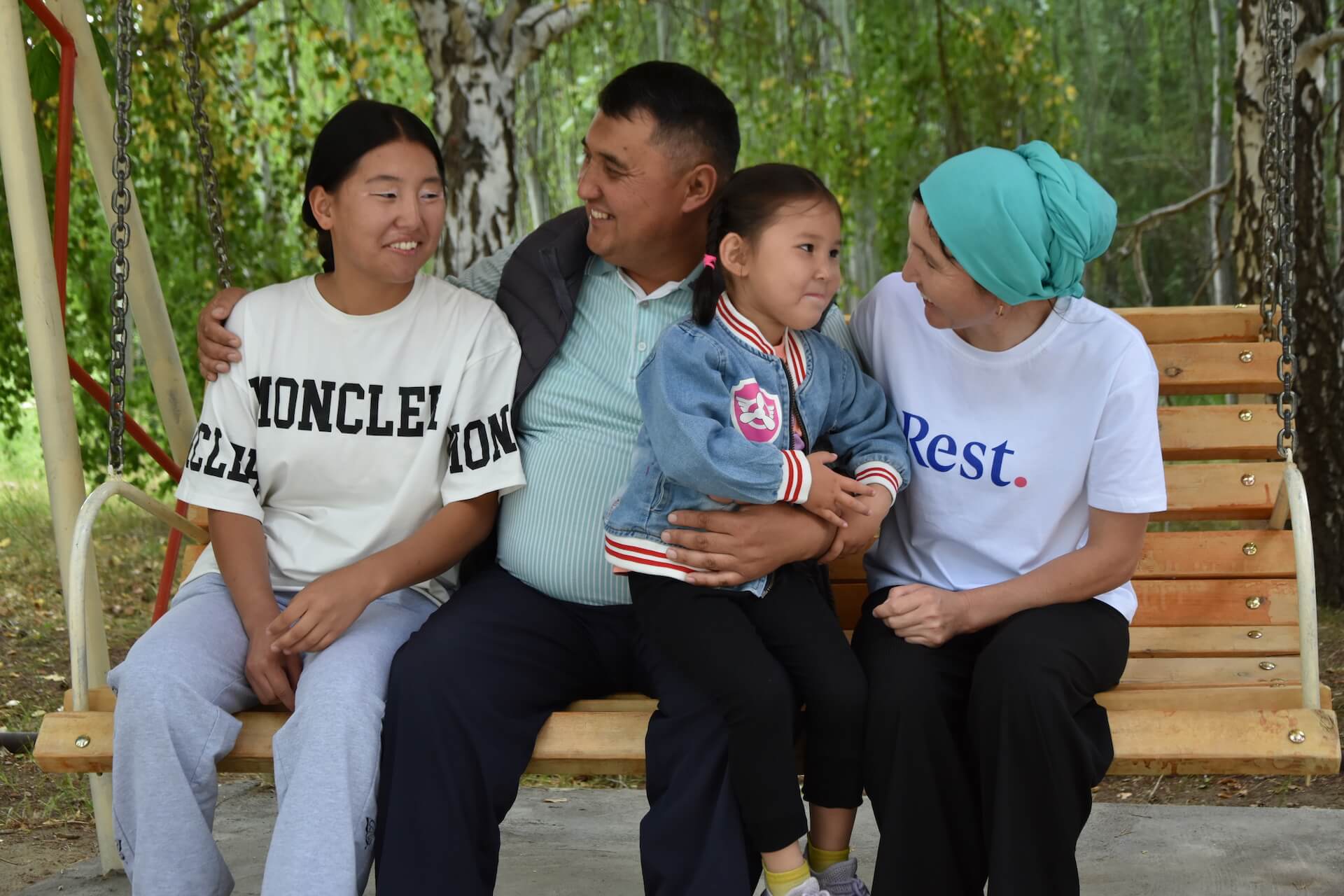
After the GALS training, Gulnaz Almambet kyzy and Rakhat Asankul uulu are modelling equal gender roles for their two daughters. Photo: Education Community Development

Based on the Gender Action Learning System (GALS), the training aims to reduce violence by talking with communities about the power dynamics in their homes.

According to a 2012 country survey, 50 per cent of men and 34 per cent of women believe that a husband is justified in hitting his wife in certain situations. Further, 27 per cent of women and girls aged 15-49 years old who are married or have ever been married reported experiencing physical or sexual violence by a spouse or partner. 

When unpaid work such as childcare and housework is placed predominantly on women, it contributes to unequal power dynamics and can result in an increased likelihood of violence. In 2015, women spent twice as much time as men taking care of children and nearly triple the time on household chores, according to the National Statistical Committee of the Kyrgyz Republic. This burden limits women’s opportunities in formal paid work, resulting in stress and burnout, lower productivity at work and low wages.

Transforming one home at a time

Ms. Almambet kyzy and her husband of 17 years were among more than 2,500 women and 1,600 men who attended community-level GALS training in the provinces of Chui and Naryn in 2021. Working with families, the training provides opportunities for women and men to discuss their relationships and reflect on the social norms that impact their roles in the family. 

“Using the GALS methodology, my husband Rakhat and I saw visually how the tree of our family looked and it was not very beautiful in terms of distribution of household labour, family budget and decision-making,” shares Ms. Almambet kyzy. “We both work 40 hours a week, but he used to come home from work and lie on the couch watching TV, while I was responsible for doing all the housework in the evenings. Unfortunately, it is acceptable behaviour in our country.”

“It is considered shameful in our community when a husband does chores like washing dishes and preparing meals as these are considered purely women’s responsibilities. Since early childhood, we grew up with these social norms and beliefs,” she says. 

After the GALS training, the couple reassessed their roles in caring for the household and their four children. Now, both Ms. Almambet Kyzy and her husband equally split household chores such as preparing meals and cleaning, as well as outdoor activities like building a new toilet or looking after their cattle. 

“The atmosphere in our family has improved a lot with better communication and a more equal distribution of family chores,” says Ms. Almambet Kyzy. “It gave me some time to make my dream come true and open my own business, which has increased our family income by 50 per cent.” 
Image
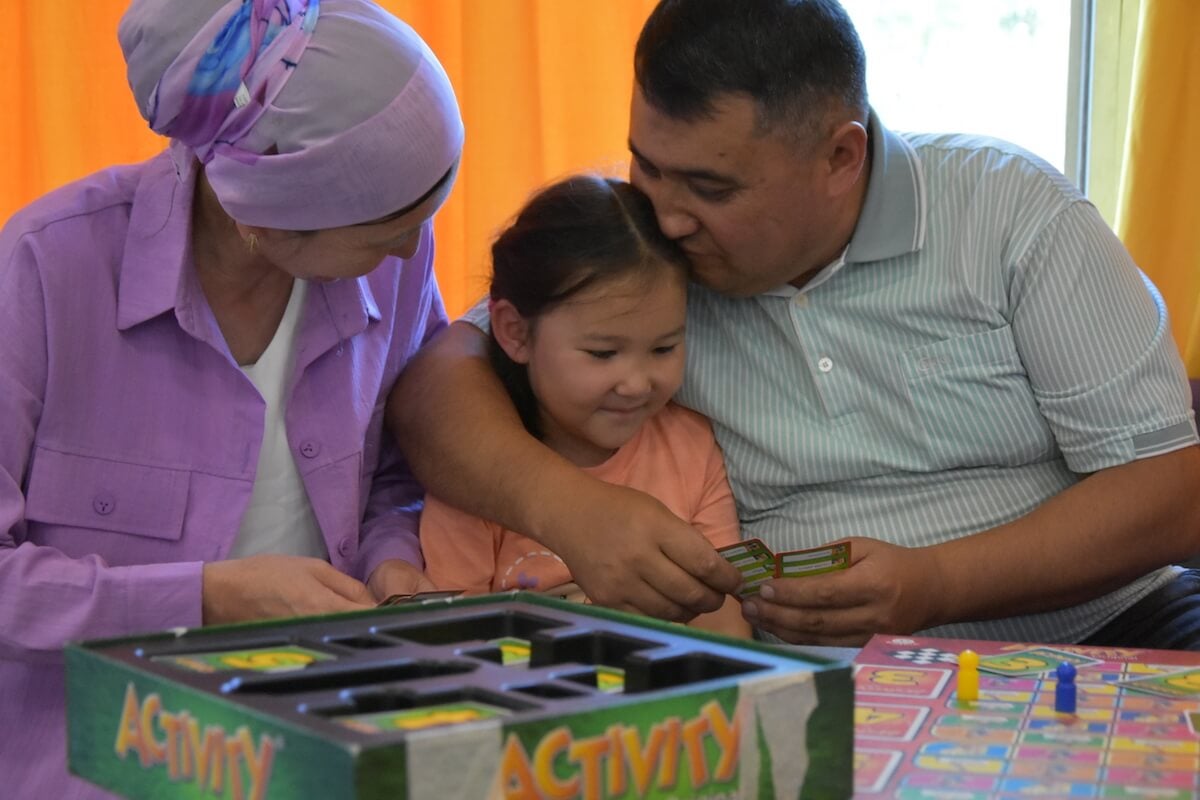
With a more equal distribution of household chores, the family now has more time for leisure. Photo: Education Community Development

A new narrative

In addition to community-level GALS training, UN Women is also working to change social norms in Kyrgyzstan by working in partnership with the media. Under the Spotlight Initiative, journalists from 17 national media organizations took part in a five month-long assessment on gender sensitivity. 

“When a journalist writes an article or prepares material, they must understand that they have a huge responsibility and the news must move people in the right direction,” says Ms. Rakhat Batyrbekova, Editor of the Chui Oblast TV and Radio Company STV, who participated in the training. “The media plays one of the most important roles in promoting gender equality and so a journalist must be gender sensitive. Unfortunately, in our country, such people could previously be counted on one hand.”

After the journalists had completed the course, the 17 participating media organizations and the Ministry of Culture, Information, Sports and Youth Policy co-developed and adopted a Gender Code. The code requires that all signatories apply gender-sensitive approaches in their work and media reporting as well as in their workplaces. 

“Gender stereotypes and social norms are major drivers of violence against women and girls, but gender equality is largely viewed as a foreign or ‘western’ concept that undermines the traditional roles of women and men in Kyrgyz society,” notes Ms. Anara Aitkurmanova, UN Women Programme Coordinator. 

“Our prevention work under the Spotlight Initiative targets all levels of society, and each project helps to reinforce the changes needed to transform harmful social norms, behaviours and practices. Prevention work can sometimes feel hopeless, but it is about changing one family or one media story at a time. And we are seeing positive results,” she concludes. 

Despite its pervasiveness, violence against women is preventable. This 16 Days, we’re highlighting the programmes and initiatives making a difference in the lives of women and girls worldwide. Through education, advocacy, service provision and more, UN Women and partners are working to support survivors, bring perpetrators to justice and end gender-based violence once and for all. These impact stories prove that a better future is not only possible—it’s already being built. 

The Spotlight Initiative is a global initiative of the United Nations funded by the European Union. Its aim is to eliminate all forms of violence against women and girls. Under the Spotlight Initiative, UN Women is working to create positive social norms inside the home and out.

Originally published on the Spotlight Initiative website

Topics

  • Gender stereotypes
  • Unpaid work
  • Ending violence against women and girls
  • Europe and Central Asia
  • Kyrgyzstan

Related content

Image
UNWomen_Placeholder
Statement

A year since Afghan women staff barred from entering United Nations premises across the country

7 September 2026
A year since Afghan women staff barred from entering United Nations premises across the country
Image
Sidi Haidara speaks into a microphone
Feature

One man’s quest to end female genital mutilation (FGM) in Mali

27 August 2026
One man’s quest to end female genital mutilation (FGM) in Mali
Image
A young woman poses for a portrait while wearing a UN Women vest
Feature

Serving through crisis: UN Women’s humanitarian workers on what keeps them going

17 August 2026
Serving through crisis: UN Women’s humanitarian workers on what keeps them going

Footer menu-HQ

  • News and stories
  • Resources
  • What we do
  • How we work
  • Where we are
  • Partnerships
  • Employment
  • Procurement
  • Contact us
  • Executive Board
  • Commission on the Status of Women

Donate button menu [Footer tablet]

  • Donate

Donate button menu [Footer]

  • Donate

Social media menu

  • Facebook
  • Twitter
  • LinkedIn
  • Flickr
  • YouTube
  • Instagram
UN Women - For all women and girls

Footer bottom [Menu]

  • Copyright
  • Information security
  • Privacy notice
  • Report wrongdoing
  • Terms of use
Share this page
  • Share to Facebook
  • Share to Twitter
  • Share to LinkedIn
  • Share to E-mail

Or copy link