
Universal menu

  • Global
  • Regions
    • Africa
    • Americas and the Caribbean
    • Arab States
    • Asia and the Pacific
    • Europe and Central Asia
  • Knowledge
  • Data
  • Training
  • Transparency
UN Women - For all women and girls

Main Navigation-HQ

  • Who we are
    • About us
      • About UN Women
      • Business model
      • Guiding documents
      • Worldwide presence
    • Leadership
      • Governance structure
      • Executive leadership
      • Executive Board
      • Accountability
    • Work with us
      • Employment
      • Procurement
      • Calls for proposals
      • Contact us
      • UN Women Strategic Plan 2026–2029
      • UN Women Strategic Plan 2026–2029 - social media image
        UN Women Strategic Plan 2026–2029
  • What we do
    • Focus areas
      • Ending violence against women
      • Peace and security
      • Humanitarian action
      • Leadership and governance
      • Economic empowerment
      • Innovation and technology
      • Women with disabilities
      • Youth
      • HIV and AIDS
    • How we work
      • 2030 Agenda for Sustainable Development
      • Commission on the Status of Women
      • Gender parity in the UN system
      • Intergovernmental support
      • Partnerships
      • Research and data
      • Training Centre
      • Trust funds
      • UN system coordination
      • Gender Equality Accelerators
      • Gender Equality Accelerators artwork
        Gender Equality Accelerators
  • News and stories
    • Latest
      • News
      • Articles and explainers
      • In focus
    • Media center
      • Press materials
      • Media contacts
      • Explainer: Why are women so exhausted? Care work and the mental load
      • Two adults stand at a table changing diapers on baby dolls, with laundry hanging on a clothesline behind them in a home setting.
        Explainer: Why are women so exhausted? Care work and the mental load
      • Press release: Aid cuts dismantle women’s organizations working in humanitarian crises
      • A young Ugandan woman sits with another local woman to talk
        Press release: Aid cuts dismantle women’s organizations working in humanitarian crises
  • Digital library
    • Resources
      • Publications
      • Annual reports
      • Progress of the world’s women
      • World survey on the role of women in development
      • The gender snapshot
    • GenderTerm
      • GenderTerm
      • Reprint permissions
      • UN Women Highlights 2025–2026
      • A smiling woman.
        UN Women Highlights 2025–2026
      • The gender snapshot 2025
      • gender snapshot thumbnail transparent
        The gender snapshot 2025
  • Get involved
    • How to get involved
      • For ALL Women and Girls
      • International Women's Day
      • 16 Days of Activism to End Violence against Women and Girls
      • UNiTE! Campaign to End Violence against Women
      • Generation Equality
      • He for She
Ask AI
https://84e5cfacd5c7e99f9825edf344450c.1b.environment.api.powerplatform.com/powervirtualagents/botsbyschema/crad4_websiteQA/directline/token?api-version=2022-03-01-preview
1
-
Ask your question here
AI website assistant

Hello, how can I assist you?

AI chatbot responses may be incorrect. Always verify important information.

Donate button menu

Donate

Breadcrumb

  1. Home
  2. Explore Our Latest News
  3. Explore Our Latest News

Website survey

We want to know how we can improve your experience on this website. Completing this survey takes less than 5 minutes.

TAKE THE SURVEY
Feature

Pushing forward: Resisting systemic violence in Afghanistan

18 November 2022
  • Share to Facebook
  • Share to Twitter
  • Share to LinkedIn
  • Share to E-mail

Malalay* is an Afghan activist working to support and restore the rights of women and girls affected by family and social violence in Afghanistan. Since the Taliban’s takeover last August, her work has gotten significantly more difficult—and more dangerous.
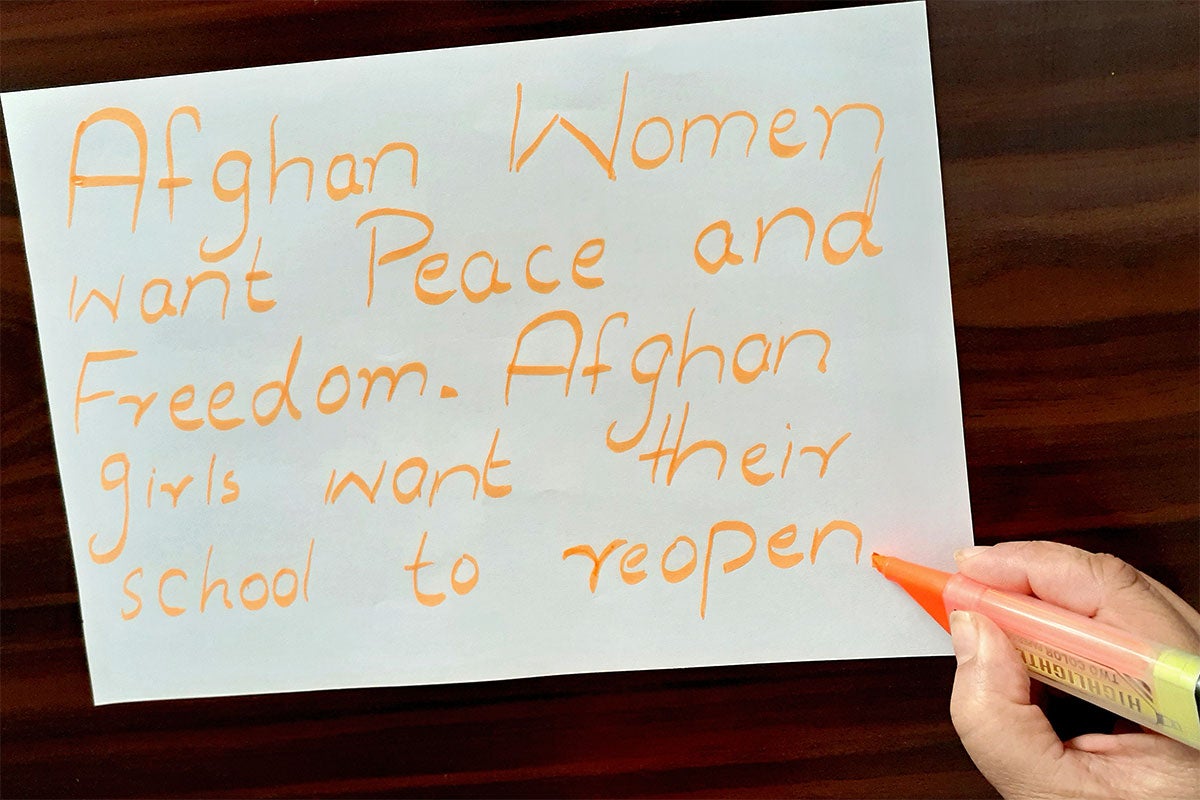
Image
The hand and message of activist Malalay*.
Malalay* is an Afghan lawyer and activist working to support and restore the rights of women and girls affected by family and social violence in Afghanistan. Photo courtesy of Malalay*

Nowhere to turn

It’s been over a year since the Taliban seized control of Afghanistan, reestablishing the regressive regime that had collapsed nearly two decades earlier. Though the group originally promised protections for women’s rights within Sharia law—including the right to work and to study—violations have steadily mounted.

“Women and girls are deprived of their basic rights,” says Malalay. “The right to work, the right to education, and other women’s rights such as freedom and self-sufficiency have been taken away.”

Deprived of political power and barred from most jobs, women are required to cover their faces in public and have been instructed to remain in their homes except in cases of necessity. Girls have been banned from attending school past the sixth grade.

The systematic exclusion of women and girls from public life is itself violence, Malalay stresses. It also leaves them highly susceptible to further abuse in both public and private, without the legal or economic means to seek justice or protection.

“[Women] have always been subjected to violence,” Malalay notes—but now, under the Taliban, they have nowhere to turn: “All the institutions that work and operate to protect women's rights have stopped activities and closed.”

“[This] is a concern for the whole world,” Malalay emphasizes.

Strive and fight

Malalay has been fighting for gender equality in Afghanistan since long before last August. “[Afghan] women and girls [have] always [been] deprived of their constitutional and religious rights,” she says.

Ending violence against Afghan women, Malalay emphasizes, will require women’s economic empowerment and access to law and justice, along with litigation at the national and international level to protect women’s rights.  

Malalay calls on the international community to provide “constant and stable support” for the women and girls of Afghanistan. Keep pushing, she says, until “justice is done, social security is provided and our society reaches prosperity and sustainable peace”.  

She urges women’s rights activists not to give up: “Always and in any situation, strive and fight for equal rights and gender equality.”

Realising the Dream

Ending gender-based violence, Malalay emphasizes, would make the world a better place for everyone. “A world free of violence will be a healthy, successful and stable society,” she says, where men and women have equal rights, equal access to justice and “an equal role in decisions at the family and community level”.

“This,” Malalay says, “[would] be the dream of every woman in the whole world.”  

* Name has been changed to protect the identity of the individual

Topics

  • Ending violence against women and girls
  • Domestic violence/interpersonal violence
  • Political violence
  • Women’s rights
  • Asia and the Pacific
  • Afghanistan

Related content

Image
A young woman poses for a portrait while wearing a UN Women vest
Feature

Serving through crisis: UN Women’s humanitarian workers on what keeps them going

17 August 2026
Serving through crisis: UN Women’s humanitarian workers on what keeps them going
Image
Image placeholder with UN Women logo (English) - 3:2 aspect ratio
Press briefing

Press briefing at the United Nations by UN Women Special Representative in Afghanistan, Susan Ferguson

14 August 2026
Press briefing at the United Nations by UN Women Special Representative in Afghanistan, Susan Ferguson
Image
A portrait of an Afghan woman in silhouette
Press release

Five years after the Taliban takeover: the normalization of the exclusion of women and girls in Afghanistan

12 August 2026
Five years after the Taliban takeover: the normalization of the exclusion of women and girls in Afghanistan

Footer menu-HQ

  • News and stories
  • Resources
  • What we do
  • How we work
  • Where we are
  • Partnerships
  • Employment
  • Procurement
  • Contact us
  • Executive Board
  • Commission on the Status of Women

Donate button menu [Footer tablet]

  • Donate

Donate button menu [Footer]

  • Donate

Social media menu

  • Facebook
  • Twitter
  • LinkedIn
  • Flickr
  • YouTube
  • Instagram
UN Women - For all women and girls

Footer bottom [Menu]

  • Copyright
  • Information security
  • Privacy notice
  • Report wrongdoing
  • Terms of use
Share this page
  • Share to Facebook
  • Share to Twitter
  • Share to LinkedIn
  • Share to E-mail

Or copy link