Universal menu

  • Global
  • Regions
    • Africa
    • Americas and the Caribbean
    • Arab States
    • Asia and the Pacific
    • Europe and Central Asia
  • Knowledge
  • Data
  • Training
  • Transparency
UN Women - For all women and girls

Main Navigation-HQ

  • Who we are
    • About us
      • About UN Women
      • Business model
      • Guiding documents
      • Worldwide presence
    • Leadership
      • Governance structure
      • Executive leadership
      • Executive Board
      • Accountability
    • Work with us
      • Employment
      • Procurement
      • Calls for proposals
      • Contact us
      • UN Women Strategic Plan 2026–2029
      • UN Women Strategic Plan 2026–2029 - social media image
        UN Women Strategic Plan 2026–2029
  • What we do
    • Focus areas
      • Ending violence against women
      • Peace and security
      • Humanitarian action
      • Leadership and governance
      • Economic empowerment
      • Innovation and technology
      • Women with disabilities
      • Youth
      • HIV and AIDS
    • How we work
      • 2030 Agenda for Sustainable Development
      • Commission on the Status of Women
      • Gender parity in the UN system
      • Intergovernmental support
      • Partnerships
      • Research and data
      • Training Centre
      • Trust funds
      • UN system coordination
      • Gender Equality Accelerators
      • Gender Equality Accelerators artwork
        Gender Equality Accelerators
  • News and stories
    • Latest
      • News
      • Articles and explainers
      • In focus
    • Media center
      • Press materials
      • Media contacts
      • Explainer: Why are women so exhausted? Care work and the mental load
      • Two adults stand at a table changing diapers on baby dolls, with laundry hanging on a clothesline behind them in a home setting.
        Explainer: Why are women so exhausted? Care work and the mental load
      • Press release: Aid cuts dismantle women’s organizations working in humanitarian crises
      • A young Ugandan woman sits with another local woman to talk
        Press release: Aid cuts dismantle women’s organizations working in humanitarian crises
  • Digital library
    • Resources
      • Publications
      • Annual reports
      • Progress of the world’s women
      • World survey on the role of women in development
      • The gender snapshot
    • GenderTerm
      • GenderTerm
      • Reprint permissions
      • UN Women Highlights 2025–2026
      • A smiling woman.
        UN Women Highlights 2025–2026
      • The gender snapshot 2025
      • gender snapshot thumbnail transparent
        The gender snapshot 2025
  • Get involved
    • How to get involved
      • For ALL Women and Girls
      • International Women's Day
      • 16 Days of Activism to End Violence against Women and Girls
      • UNiTE! Campaign to End Violence against Women
      • Generation Equality
      • He for She
Ask AI
https://84e5cfacd5c7e99f9825edf344450c.1b.environment.api.powerplatform.com/powervirtualagents/botsbyschema/crad4_websiteQA/directline/token?api-version=2022-03-01-preview
1
-
Ask your question here
AI website assistant

Hello, how can I assist you?

AI chatbot responses may be incorrect. Always verify important information.

Donate button menu

Donate

Breadcrumb

  1. Home
  2. Explore Our Latest News
  3. Explore Our Latest News

Website survey

We want to know how we can improve your experience on this website. Completing this survey takes less than 5 minutes.

TAKE THE SURVEY
Feature

Women in Afghanistan: From almost everywhere to almost nowhere

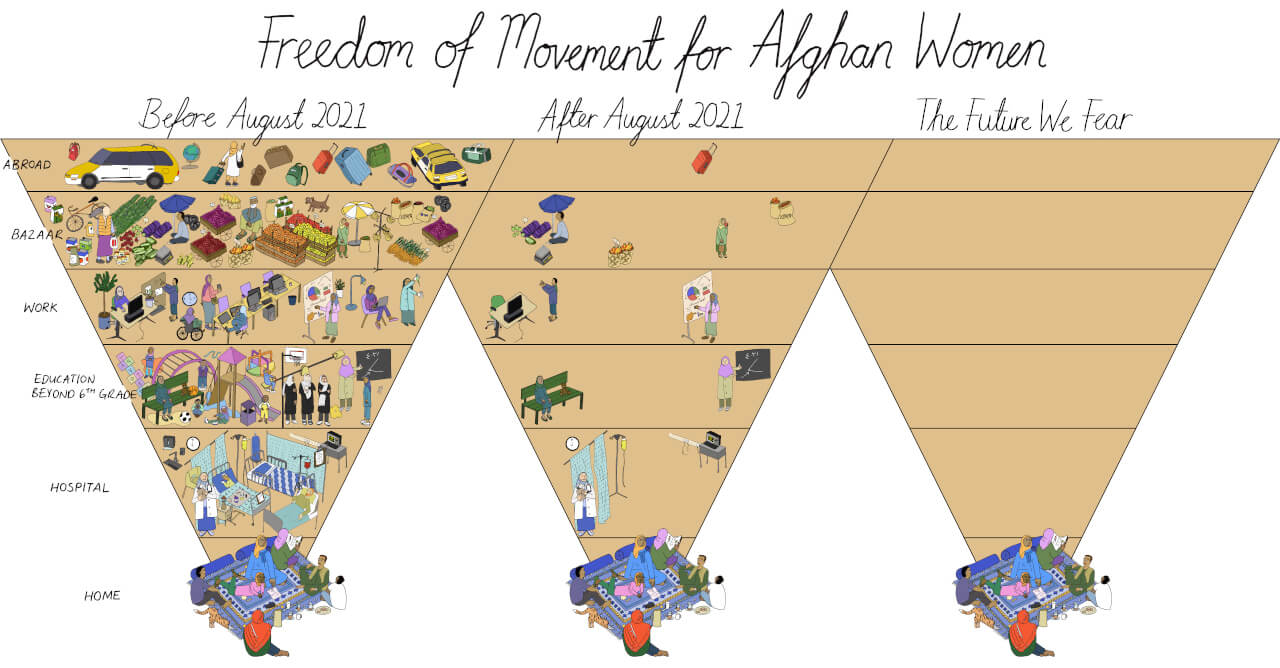
Mona Chalabi illustrates the freedom of movement for Afghan women before and after the Taliban takeover of August 2021.

15 August 2023
  • Share to Facebook
  • Share to Twitter
  • Share to LinkedIn
  • Share to E-mail

UN Women partnered with Mona Chalabi to illustrate the scope and the severity of the restrictions on women and girls’ access to public space and public life in Afghanistan. In international treaties this is referred to as “freedom of movement”. Together, these illustrations show the sheer speed at which progress on gender equality can vanish, and then reverse in a matter of months, while the world watches.
Image
Mona Chalabi illustrates the freedom of movement for Afghan women before and after the Taliban takeover of August 2021.

[ See a larger version of the image (757KB). ]

There are social movements that shake the world. The Afghan women’s rights movement is one of them. Afghan women’s fight for freedom and equality spans generations. Their most fierce battle has been for visibility and presence in public life—for their names to be known, their voices to be heard, and their presence to be acknowledged and valued.

A few statistics [1]:

In 1920, the first school for girls opened in Afghanistan [2]. In 1991, 7,000 women enrolled in higher education, 230,000 girls were in schools, 190 women were professors, and 22,000 women taught in schools across the country [3].

By the end of the Taliban’s first rule in 2001, less than one million Afghan children were in school, and none of them were girls [4].

In 2004, a new constitution enshrined gender equality and reserved 27 per cent of seats in parliament for women. By 2021, Afghan women had secured 69 out of 249 seats in parliament, women were negotiating peace across the country, and laws were in place allowing women to include their names on their children’s birth certificates and identification cards. There was a Ministry of Women’s Affairs, an independent human rights commission, and a law-making violence against women a crime. But more than this, women were visible—from law, politics, and journalism, to sidewalks, parks, and schools.

Over the last two years, the Taliban have issued 80 edicts, 54 of these directly target women and girls [5]. The roll backs started as soon as they took power in August 2021, when they ordered women to stay at home because their foot soldiers were “not familiar with seeing women outside the house and were not trained to respect women” [6]. One year into their rule, and it was clear gender segregation and restricting women’s movement remained the cornerstone of their vision for society. The so-called “Taliban 2.0” never eventuated. On women’s rights, Afghanistan went back to the future.

We are now two years into their rule. Women have been banned from going to parks, gyms, and public bathing houses. They have been stopped from pursuing education beyond the sixth grade. Their ability to work outside of health and education is all but prohibited. The cumulative effect of the Taliban’s edicts and behaviours has largely resulted in the imprisonment of women within the walls of their homes.

The question is, what more can be taken away? On 15 August 2024, on 15 August 2050, what spaces will be left for Afghan women to access? What will this visual look like?

For many women across the world, walking out your front door is an ordinary part of life. For many Afghan women, it is extraordinary. It is an act of defiance. Despite all these challenges, women have found ways to carve out pockets of hope. Afghan women are still forming new civil society groups to address community needs, running businesses, and providing health, education, and protection services. Afghan women will not give up their right to live full lives, equal in dignity. They will not accept living in a world where they are not worthy of living the same life as a man.

And neither should we.

Afghanistan is not the only country in the world where women’s rights are being rolled back. But what is happening in Afghanistan is an alarm bell for all of us because it shows how decades of progress on gender equality and women’s rights can be wiped out in months. It is a clarion call to everyone that the fight for women’s rights in Afghanistan is a global fight, and a battle for women’s rights everywhere.

What we all do—or fail to do—for women and girls in Afghanistan is the ultimate test of who we are as a global community, and what we stand for.


Notes

[1] The Afghan women’s rights movement is not bound to a timeline but spams over generations since the beginning of what we know today as Afghanistan. The following years are just some selected milestones in the history of the country.

[2] Afghanistan Quarterly Journal, 2018.

[3] Kaplan, 1992.

[4] https://wiisglobal.org/afghan-womens-education-under-the-taliban-2/#_ednref2

[5] Source: https://feminist.org/our-work/afghan-women-and-girls/taliban-edicts/

[6] Source: https://www.bbc.com/news/world-asia-58315413

About Mona Chalabi
Mona Chalabi is an award-winning writer and illustrator. Using words, colour, and sound, Mona rehumanizes data to help us understand our world and the way we live in it. Her work has earned her a Pulitzer Prize. Her writing and illustrations have been featured in The New York Times, The New Yorker, and The Guardian, where she is currently the data editor. Her video, audio, and production work has been featured on Netflix, NPR, the BBC, and National Geographic. https://monachalabi.com/

UN Women is on the ground in Afghanistan, supporting Afghan women and girls every day. Our in-country strategy centres on investing in women—from scaling up support to women’s organizations and women humanitarian workers delivering life-saving services, to investing in women-led businesses. This work could not have been possible without the instrumental support of our Afghan women staff.

Topics

  • Gender equality and women’s empowerment
  • Gender discrimination
  • Human rights
  • Fundamental freedoms
  • Women’s rights
  • Asia and the Pacific
  • Afghanistan

Related content

Image
A young woman poses for a portrait while wearing a UN Women vest
Feature

Serving through crisis: UN Women’s humanitarian workers on what keeps them going

17 August 2026
Serving through crisis: UN Women’s humanitarian workers on what keeps them going
Image
Image placeholder with UN Women logo (English) - 3:2 aspect ratio
Press briefing

Press briefing at the United Nations by UN Women Special Representative in Afghanistan, Susan Ferguson

14 August 2026
Press briefing at the United Nations by UN Women Special Representative in Afghanistan, Susan Ferguson
Image
A portrait of an Afghan woman in silhouette
Press release

Five years after the Taliban takeover: the normalization of the exclusion of women and girls in Afghanistan

12 August 2026
Five years after the Taliban takeover: the normalization of the exclusion of women and girls in Afghanistan

Footer menu-HQ

  • News and stories
  • Resources
  • What we do
  • How we work
  • Where we are
  • Partnerships
  • Employment
  • Procurement
  • Contact us
  • Executive Board
  • Commission on the Status of Women

Donate button menu [Footer tablet]

  • Donate

Donate button menu [Footer]

  • Donate

Social media menu

  • Facebook
  • Twitter
  • LinkedIn
  • Flickr
  • YouTube
  • Instagram
UN Women - For all women and girls

Footer bottom [Menu]

  • Copyright
  • Information security
  • Privacy notice
  • Report wrongdoing
  • Terms of use
Share this page
  • Share to Facebook
  • Share to Twitter
  • Share to LinkedIn
  • Share to E-mail

Or copy link