
Universal menu

  • Global
  • Regions
    • Africa
    • Americas and the Caribbean
    • Arab States
    • Asia and the Pacific
    • Europe and Central Asia
  • Knowledge
  • Data
  • Training
  • Transparency
UN Women - For all women and girls

Main Navigation-HQ

  • Who we are
    • About us
      • About UN Women
      • Business model
      • Guiding documents
      • Worldwide presence
    • Leadership
      • Governance structure
      • Executive leadership
      • Executive Board
      • Accountability
    • Work with us
      • Employment
      • Procurement
      • Calls for proposals
      • Contact us
      • UN Women Strategic Plan 2026–2029
      • UN Women Strategic Plan 2026–2029 - social media image
        UN Women Strategic Plan 2026–2029
  • What we do
    • Focus areas
      • Ending violence against women
      • Peace and security
      • Humanitarian action
      • Leadership and governance
      • Economic empowerment
      • Innovation and technology
      • Women with disabilities
      • Youth
      • HIV and AIDS
    • How we work
      • 2030 Agenda for Sustainable Development
      • Commission on the Status of Women
      • Gender parity in the UN system
      • Intergovernmental support
      • Partnerships
      • Research and data
      • Training Centre
      • Trust funds
      • UN system coordination
      • Gender Equality Accelerators
      • Gender Equality Accelerators artwork
        Gender Equality Accelerators
  • News and stories
    • Latest
      • News
      • Articles and explainers
      • In focus
    • Media center
      • Press materials
      • Media contacts
      • Explainer: Why are women so exhausted? Care work and the mental load
      • Two adults stand at a table changing diapers on baby dolls, with laundry hanging on a clothesline behind them in a home setting.
        Explainer: Why are women so exhausted? Care work and the mental load
      • Press release: Aid cuts dismantle women’s organizations working in humanitarian crises
      • A young Ugandan woman sits with another local woman to talk
        Press release: Aid cuts dismantle women’s organizations working in humanitarian crises
  • Digital library
    • Resources
      • Publications
      • Annual reports
      • Progress of the world’s women
      • World survey on the role of women in development
      • The gender snapshot
    • GenderTerm
      • GenderTerm
      • Reprint permissions
      • UN Women Highlights 2025–2026
      • A smiling woman.
        UN Women Highlights 2025–2026
      • The gender snapshot 2025
      • gender snapshot thumbnail transparent
        The gender snapshot 2025
  • Get involved
    • How to get involved
      • For ALL Women and Girls
      • International Women's Day
      • 16 Days of Activism to End Violence against Women and Girls
      • UNiTE! Campaign to End Violence against Women
      • Generation Equality
      • He for She
Ask AI
https://84e5cfacd5c7e99f9825edf344450c.1b.environment.api.powerplatform.com/powervirtualagents/botsbyschema/crad4_websiteQA/directline/token?api-version=2022-03-01-preview
1
-
Ask your question here
AI website assistant

Hello, how can I assist you?

AI chatbot responses may be incorrect. Always verify important information.

Donate button menu

Donate

Breadcrumb

  1. Home
  2. Explore Our Latest News
  3. Explore Our Latest News

Website survey

We want to know how we can improve your experience on this website. Completing this survey takes less than 5 minutes.

TAKE THE SURVEY
Interview

For All Women and Girls: Pendo Vestine on closing the gender gap for girls in tech

From overcoming gender bias to launching a tech initiative, Pendo Vestine proves that young women can lead in STEM and shape the future of innovation. 

22 April 2025
  • Share to Facebook
  • Share to Twitter
  • Share to LinkedIn
  • Share to E-mail

#ForAllWomenAndGirls is a rallying call for action on the 30th anniversary of the Beijing Declaration and Platform for Action. Pendo Vestine from Rwanda is an alumni from the UN Women’s regional programme, African Girls Can Code Initiative. Spearheaded by UN Women, the International Telecommunication Union, and the African Union, the programme has taught coding and other skills to more than 1,600 girls and young women in 11 countries across the region.

In this interview, Vestine talks about the importance of creating opportunities for girls and young women to access and lead in science and technology.
Image
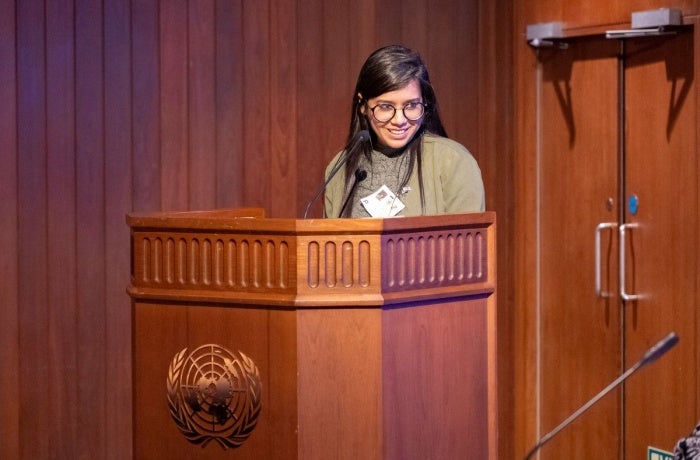
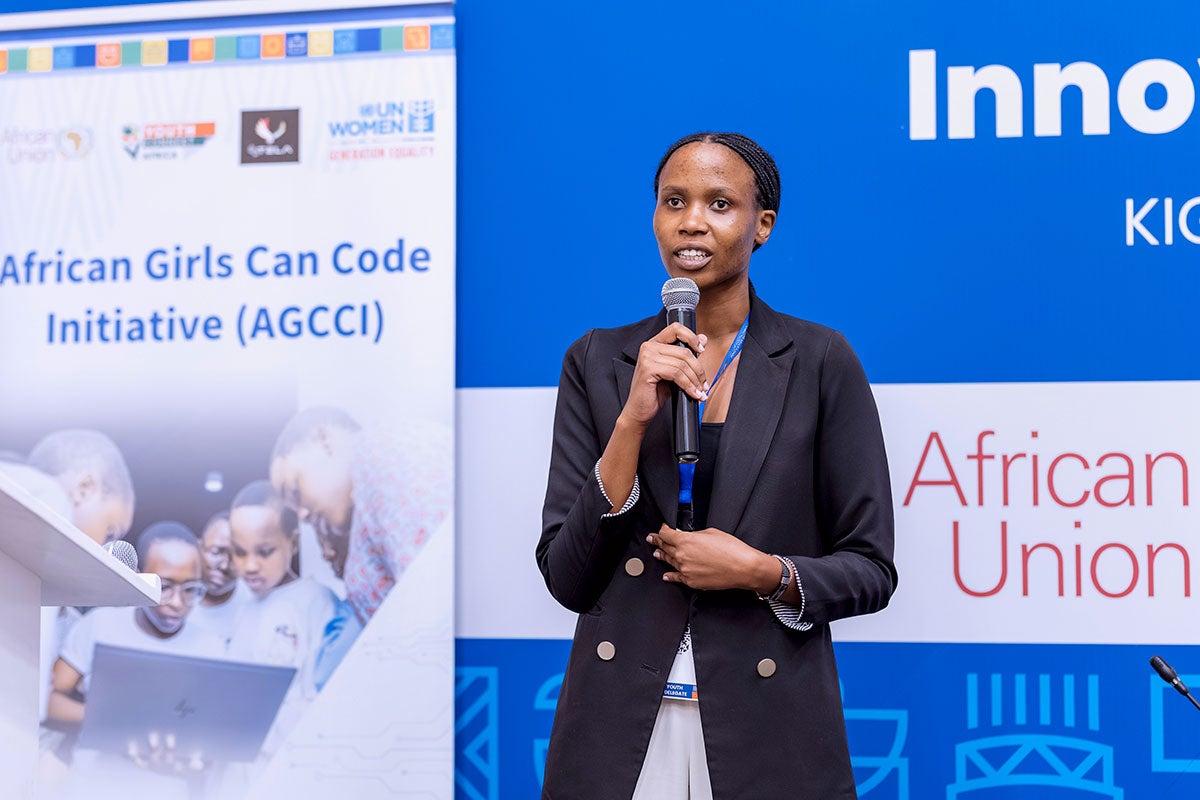
Pendo Vestine speaks at a forum in Kigali about her coding work and experience in the African Girls Can Code Initiative (AGCCI). Photo: UN Women
Pendo Vestine speaks at a forum in Kigali, Rwanda, about her coding work and experience in the African Girls Can Code Initiative. Photo: UN Women

From learner to leader: Pendo Vestine’s mission to empower girls in tech

Pendo Vestine, a software engineering student at the African Leadership University (ALU) is deeply passionate about closing the gender gap in the tech industry and believes that the best way to do it is by creating opportunities for young girls and women to access education, mentorship, and leadership roles in Science, Technology Engineering and Mathematics (STEM). 

Vestine grew up in a community in Gatsibo district, eastern part of Rwanda, where girls' education was not a priority. “I saw many talented girls being denied opportunities simply because they were girls,” she shared. The unfairness inspired her to challenge the gender stereotypes and norms that hold women and girls back from accessing and leading in technology. 

“My journey took a meaningful turn when I joined the African Leadership University (ALU). I was immersed in a culture of leadership, innovation, and problem-solving,” said Vestine. “Meeting like-minded individuals who shared my passion inspired me to think bigger and take action to promote gender equality in tech and education. This is what drives me every day to create opportunities for those who are often overlooked.”

Vestine has created an application called HerTek, which offers online tech courses and mentorship for girls and young women, and partners with schools and universities to connect them with opportunities in the tech industry.

“Through this platform, I’ve been able to break down barriers, provide access to quality education, and inspire young girls to pursue careers in STEM. Seeing girls gain confidence, skills, and opportunities through HerTek has been my greatest achievement,” Vestine claimed. 
Image
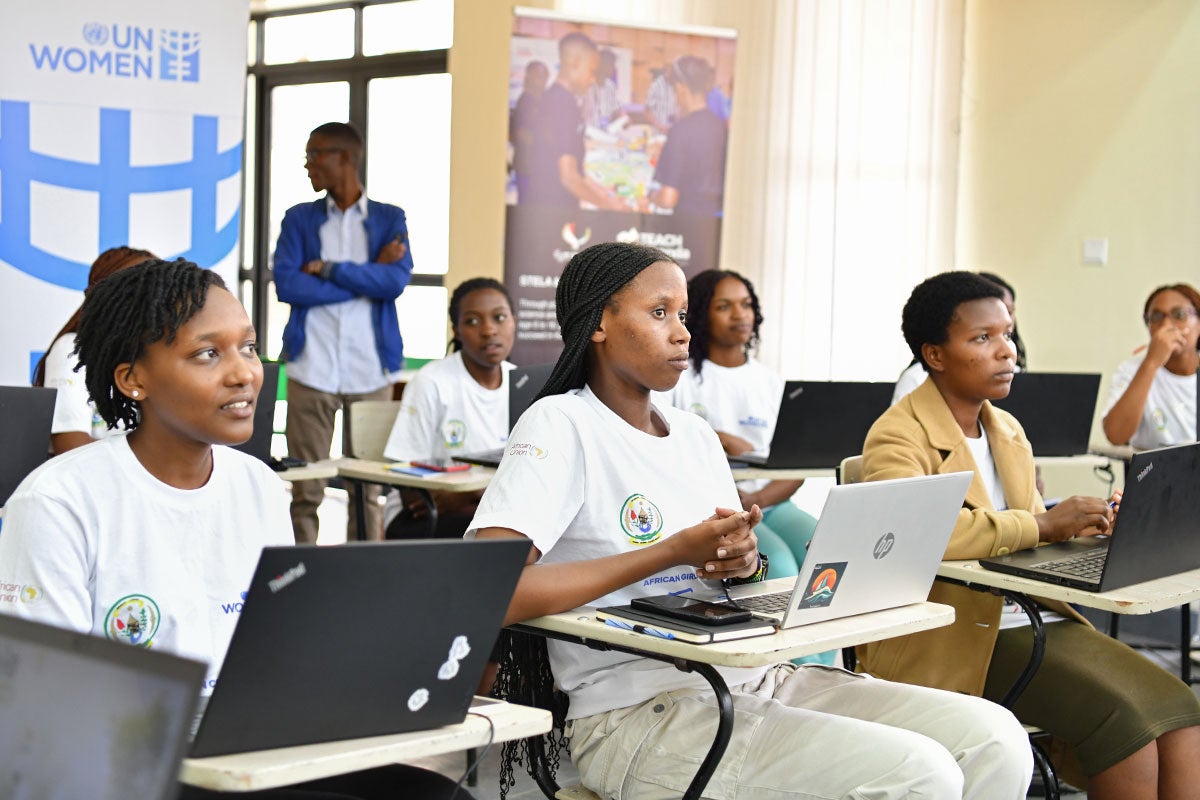
Pendo Vestine (center) participates in a session of the African Girls Can Code bootcamp. Photo: UN Women
Pendo Vestine (centre) participates in a session of the African Girls Can Code bootcamp. Photo: UN Women

The future of STEM is female, but we must break the gender barriers

Vestine says that some of the biggest challenges that hinder girls from pursuing STEM careers include gender bias, lack of female role models in tech, and financial constraints that girls face in accessing tech education and skills. 

“Families often prioritize boys' education, leaving girls with fewer chances to pursue their dreams,” she explained. 

“But I didn’t let these obstacles stop me,” she said. “I found incredible support through mentorship programmes, coding bootcamps, and organizations dedicated to empowering women in tech. Initiatives like the African Girls Can Code Initiative and SieMentEmpowHer were game-changers for me, as they helped me build my skills, gain confidence, and helped me believe in my own potential.”

“This journey taught me the power of community and the importance of creating opportunities for others facing similar challenges,” she added. 

The Beijing Declaration and Platform for Action and the unfinished business of gender equality in STEM

Vestine first learned about the Beijing Platform for Action when she got involved with women’s empowerment programmes. “The Beijing Declaration remains relevant, because gender inequality still exists in many sectors, especially in STEM, where women and girls still face discrimination, lack of access to education, and barriers to leadership,” she said.

“It serves as a reminder and call to action for governments, organizations, and individuals to continue working towards gender equality.” 

There has been a lot of progress in girls and women’s access to STEM since the adoption of the Beijing Platform for Action in 1995. However, in rural areas, limited resources and persistent gender biases have made progress too slow. “To move forward, we must focus on these overlooked communities, break down stereotypes, and ensure equal access for all,” urged Vestine. 

For all women and girls… equal opportunities and freedom to pursue their dreams 

Despite the barriers, Pendo Vestine feels hopeful when she sees more young girls accessing and leading technology.  “When a girl is given the right opportunities, she can transform her future and uplift her community,” she said.

“My dream is for a world where every girl has access to quality education, equal opportunities, and the freedom to pursue her dreams without limitations. A future where women lead in technology, innovation, and decision-making.”

Topics

  • Gender equality and women’s empowerment
  • Innovation and technology
  • Information and communications technology (ICT)
  • Youth
  • Girls
  • Africa
  • Rwanda

Related content

Image
A portrait of an Afghan woman in silhouette
Press release

Five years after the Taliban takeover: the normalization of the exclusion of women and girls in Afghanistan

12 August 2026
Five years after the Taliban takeover: the normalization of the exclusion of women and girls in Afghanistan
Image
UNWomen_Placeholder
Statement

UN Women statement for International Youth Day

11 August 2026
UN Women statement for International Youth Day
Image
Women pose in front of a bus with the Born Perfect campaign banner
Feature

Inside Liberia’s campaign to end female genital mutilation (FGM)

10 August 2026
Inside Liberia’s campaign to end female genital mutilation (FGM)

Footer menu-HQ

  • News and stories
  • Resources
  • What we do
  • How we work
  • Where we are
  • Partnerships
  • Employment
  • Procurement
  • Contact us
  • Executive Board
  • Commission on the Status of Women

Donate button menu [Footer tablet]

  • Donate

Donate button menu [Footer]

  • Donate

Social media menu

  • Facebook
  • Twitter
  • LinkedIn
  • Flickr
  • YouTube
  • Instagram
UN Women - For all women and girls

Footer bottom [Menu]

  • Copyright
  • Information security
  • Privacy notice
  • Report wrongdoing
  • Terms of use
Share this page
  • Share to Facebook
  • Share to Twitter
  • Share to LinkedIn
  • Share to E-mail

Or copy link