
Universal menu

  • Global
  • Regions
    • Africa
    • Americas and the Caribbean
    • Arab States
    • Asia and the Pacific
    • Europe and Central Asia
  • Knowledge
  • Data
  • Training
  • Transparency
UN Women - For all women and girls

Main Navigation-HQ

  • Who we are
    • About us
      • About UN Women
      • Business model
      • Guiding documents
      • Worldwide presence
    • Leadership
      • Governance structure
      • Executive leadership
      • Executive Board
      • Accountability
    • Work with us
      • Employment
      • Procurement
      • Calls for proposals
      • Contact us
      • UN Women Strategic Plan 2026–2029
      • UN Women Strategic Plan 2026–2029 - social media image
        UN Women Strategic Plan 2026–2029
  • What we do
    • Focus areas
      • Ending violence against women
      • Peace and security
      • Humanitarian action
      • Leadership and governance
      • Economic empowerment
      • Innovation and technology
      • Women with disabilities
      • Youth
      • HIV and AIDS
    • How we work
      • 2030 Agenda for Sustainable Development
      • Commission on the Status of Women
      • Gender parity in the UN system
      • Intergovernmental support
      • Partnerships
      • Research and data
      • Training Centre
      • Trust funds
      • UN system coordination
      • Gender Equality Accelerators
      • Gender Equality Accelerators artwork
        Gender Equality Accelerators
  • News and stories
    • Latest
      • News
      • Articles and explainers
      • In focus
    • Media center
      • Press materials
      • Media contacts
      • Explainer: Why are women so exhausted? Care work and the mental load
      • Two adults stand at a table changing diapers on baby dolls, with laundry hanging on a clothesline behind them in a home setting.
        Explainer: Why are women so exhausted? Care work and the mental load
      • Press release: Aid cuts dismantle women’s organizations working in humanitarian crises
      • A young Ugandan woman sits with another local woman to talk
        Press release: Aid cuts dismantle women’s organizations working in humanitarian crises
  • Digital library
    • Resources
      • Publications
      • Annual reports
      • Progress of the world’s women
      • World survey on the role of women in development
      • The gender snapshot
    • GenderTerm
      • GenderTerm
      • Reprint permissions
      • UN Women Highlights 2025–2026
      • A smiling woman.
        UN Women Highlights 2025–2026
      • The gender snapshot 2025
      • gender snapshot thumbnail transparent
        The gender snapshot 2025
  • Get involved
    • How to get involved
      • For ALL Women and Girls
      • International Women's Day
      • 16 Days of Activism to End Violence against Women and Girls
      • UNiTE! Campaign to End Violence against Women
      • Generation Equality
      • He for She
Ask AI
https://84e5cfacd5c7e99f9825edf344450c.1b.environment.api.powerplatform.com/powervirtualagents/botsbyschema/crad4_websiteQA/directline/token?api-version=2022-03-01-preview
1
-
Ask your question here
AI website assistant

Hello, how can I assist you?

AI chatbot responses may be incorrect. Always verify important information.

Donate button menu

Donate

Breadcrumb

  1. Home
  2. Explore Our Latest News
  3. Explore Our Latest News

Website survey

We want to know how we can improve your experience on this website. Completing this survey takes less than 5 minutes.

TAKE THE SURVEY
News

Women need to be leaders in addressing climate change challenges, say leaders in Asia and the Pacific

18 March 2022
  • Share to Facebook
  • Share to Twitter
  • Share to LinkedIn
  • Share to E-mail

Originally published on UN Women's regional website for Asia and the Pacific

Women and girls need to be better represented in all aspects of climate change, environmental and disaster risk reduction (DRR) policy and programme processes, from the leadership and decision-making spaces, data collection and analysis, to policy formulation, programme design, and all the way through to implementation on the ground, as well as the monitoring and evaluating of these efforts.

This was the clear message from the officials, civil society representatives and other practitioners gathered for the Asia-Pacific regional consultation ahead of the 66th session of the Commission on the Status of Women (CSW66), which took place virtually on 9-10 February 2022. The consultations focused on the CSW 66 Priority Theme: “Achieving gender equality and the empowerment of all women and girls in the context of climate change, environmental and disaster risk reduction policies and programmes.”

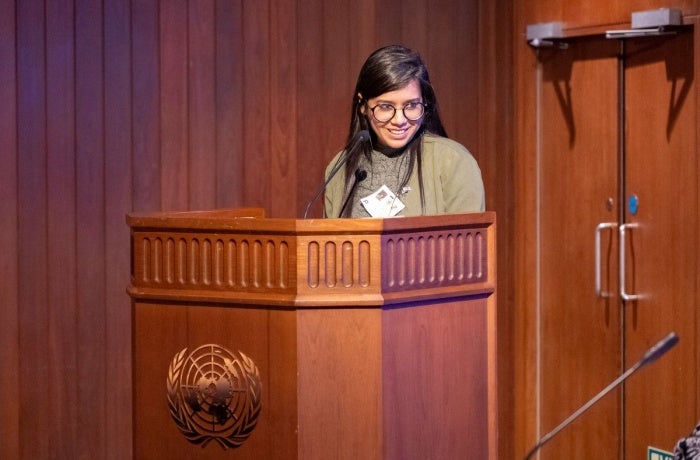
The Asia-Pacific region is particularly prone to disasters which “have compounded the impacts of the ongoing COVID-19 pandemic, further increasing poverty, magnifying inequalities, and worsening the vulnerability of women and girls, and other vulnerable and marginalized groups,” said Sarah Knibbs, Officer-in-Charge, UN Women Asia and the Pacific, in her opening remarks.

Women bear a disproportionate share of the impacts of disasters, including increased violence and greater household care responsibilities, Knibbs stated. At the same time, they have less access to resources that might improve their resilience, such as control over land and other productive assets, or to health services and social protection.

And despite women’s leading role in managing natural resources, “women’s situational knowledge continues to be underutilized in environmental policies and disaster risk reduction efforts and strategies,” she said. “Further, women continue to be underrepresented in decision-making about the environment.”

Another challenge was the lack of data on the connections between gender equality and climate change, Knibbs said. As such, key concerns regarding this nexus “continue to be overlooked by policy makers and other stakeholders.”

The issue of data was brought up by speakers at these consultations. “Ultimately, if there is no data and evidence, the problem doesn't exist,” said Subhalakshmi Nandi, Senior Programme Officer, Gender Equality with the Bill and Melinda Gates Foundation, pointing to the importance of data in gaining political traction, and to enable quantitative planning and resource allocation.

But if comprehensive gender-specific data are lacking, there is enough information to be certain that women and girls bear the brunt of the impact from climate change, environmental degradation, and related disasters. 

“We know that 95 per cent of deaths in the Solomon Islands 2014 floods were women, and 55 per cent of deaths in the 2015 earthquake in Nepal were women,” said Hope Peisley, Assistant-Secretary with the Women's Safety and International Engagement Branch, Office for Women, Department of the Australian Prime Minister and Cabinet.

But the same pandemic could provide an opportunity. “The pandemic has reminded us how fragile and vulnerable we are as a planet,” said Nandi. “We have the opportunity to kind of press the reset button.”

The consultations yielded a number of key recommendations, which as a whole emphasized women’s voice and agency in the design of any policies and actions around climate change, the environment and DRR. Women in all their diversity have a key role to play in the design and implementation of any such programmes. For more on these recommendations, please access the full report here.

Topics

  • Climate change
  • Disaster risk reduction
  • Commission on the Status of Women
  • Asia and the Pacific

Related content

Image
UNWomen_Placeholder
Statement

A year since Afghan women staff barred from entering United Nations premises across the country

7 September 2026
A year since Afghan women staff barred from entering United Nations premises across the country
Image
UNWomen_Placeholder
Press briefing

Nepal floods: 43,000 women and girls need immediate humanitarian assistance

1 September 2026
Nepal floods: 43,000 women and girls need immediate humanitarian assistance
Image
A village is devastated by floods, thick with mud and debris
Press release

Nearly 160,000 women and girls impacted by Nepal flash floods

28 August 2026
Nearly 160,000 women and girls impacted by Nepal flash floods

Footer menu-HQ

  • News and stories
  • Resources
  • What we do
  • How we work
  • Where we are
  • Partnerships
  • Employment
  • Procurement
  • Contact us
  • Executive Board
  • Commission on the Status of Women

Donate button menu [Footer tablet]

  • Donate

Donate button menu [Footer]

  • Donate

Social media menu

  • Facebook
  • Twitter
  • LinkedIn
  • Flickr
  • YouTube
  • Instagram
UN Women - For all women and girls

Footer bottom [Menu]

  • Copyright
  • Information security
  • Privacy notice
  • Report wrongdoing
  • Terms of use
Share this page
  • Share to Facebook
  • Share to Twitter
  • Share to LinkedIn
  • Share to E-mail

Or copy link