
Universal menu

  • Global
  • Regions
    • Africa
    • Americas and the Caribbean
    • Arab States
    • Asia and the Pacific
    • Europe and Central Asia
  • Knowledge
  • Data
  • Training
  • Transparency
UN Women - For all women and girls

Main Navigation-HQ

  • Who we are
    • About us
      • About UN Women
      • Business model
      • Guiding documents
      • Worldwide presence
    • Leadership
      • Governance structure
      • Executive leadership
      • Executive Board
      • Accountability
    • Work with us
      • Employment
      • Procurement
      • Calls for proposals
      • Contact us
      • UN Women Strategic Plan 2026–2029
      • UN Women Strategic Plan 2026–2029 - social media image
        UN Women Strategic Plan 2026–2029
  • What we do
    • Focus areas
      • Ending violence against women
      • Peace and security
      • Humanitarian action
      • Leadership and governance
      • Economic empowerment
      • Innovation and technology
      • Women with disabilities
      • Youth
      • HIV and AIDS
    • How we work
      • 2030 Agenda for Sustainable Development
      • Commission on the Status of Women
      • Gender parity in the UN system
      • Intergovernmental support
      • Partnerships
      • Research and data
      • Training Centre
      • Trust funds
      • UN system coordination
      • Gender Equality Accelerators
      • Gender Equality Accelerators artwork
        Gender Equality Accelerators
  • News and stories
    • Latest
      • News
      • Articles and explainers
      • In focus
    • Media center
      • Press materials
      • Media contacts
      • Explainer: Why are women so exhausted? Care work and the mental load
      • Two adults stand at a table changing diapers on baby dolls, with laundry hanging on a clothesline behind them in a home setting.
        Explainer: Why are women so exhausted? Care work and the mental load
      • Press release: Aid cuts dismantle women’s organizations working in humanitarian crises
      • A young Ugandan woman sits with another local woman to talk
        Press release: Aid cuts dismantle women’s organizations working in humanitarian crises
  • Digital library
    • Resources
      • Publications
      • Annual reports
      • Progress of the world’s women
      • World survey on the role of women in development
      • The gender snapshot
    • GenderTerm
      • GenderTerm
      • Reprint permissions
      • UN Women Highlights 2025–2026
      • A smiling woman.
        UN Women Highlights 2025–2026
      • The gender snapshot 2025
      • gender snapshot thumbnail transparent
        The gender snapshot 2025
  • Get involved
    • How to get involved
      • For ALL Women and Girls
      • International Women's Day
      • 16 Days of Activism to End Violence against Women and Girls
      • UNiTE! Campaign to End Violence against Women
      • Generation Equality
      • He for She
Ask AI
https://84e5cfacd5c7e99f9825edf344450c.1b.environment.api.powerplatform.com/powervirtualagents/botsbyschema/crad4_websiteQA/directline/token?api-version=2022-03-01-preview
1
-
Ask your question here
AI website assistant

Hello, how can I assist you?

AI chatbot responses may be incorrect. Always verify important information.

Donate button menu

Donate

Breadcrumb

  1. Home
  2. Explore Our Latest News
  3. Explore Our Latest News

Website survey

We want to know how we can improve your experience on this website. Completing this survey takes less than 5 minutes.

TAKE THE SURVEY
Press release

Press release: New UN policy paper shows the devastating impacts of the Ukraine war on women and girls

The war has widened gender gaps in food insecurity, malnutrition, energy poverty, and increased gender-based violence inside Ukraine and around the world.

22 September 2022
  • Share to Facebook
  • Share to Twitter
  • Share to LinkedIn
  • Share to E-mail

A new UN policy paper, published as the UN Security Council meets on Ukraine, reveals how the war and its global impacts on food, energy, and finance are affecting women and girls disproportionately, both inside Ukraine and globally. From the school-aged girls who are at risk of being obliged to drop out to get married for dowry or bride-price income for desperate families, to the physical and health challenges of the 265,000 Ukrainian women who were pregnant when the war broke out, the “Global gendered impacts of the Ukraine crisis on energy access and food security and nutrition” policy paper lays out how the crisis is aggravating already existing inequalities around the world.
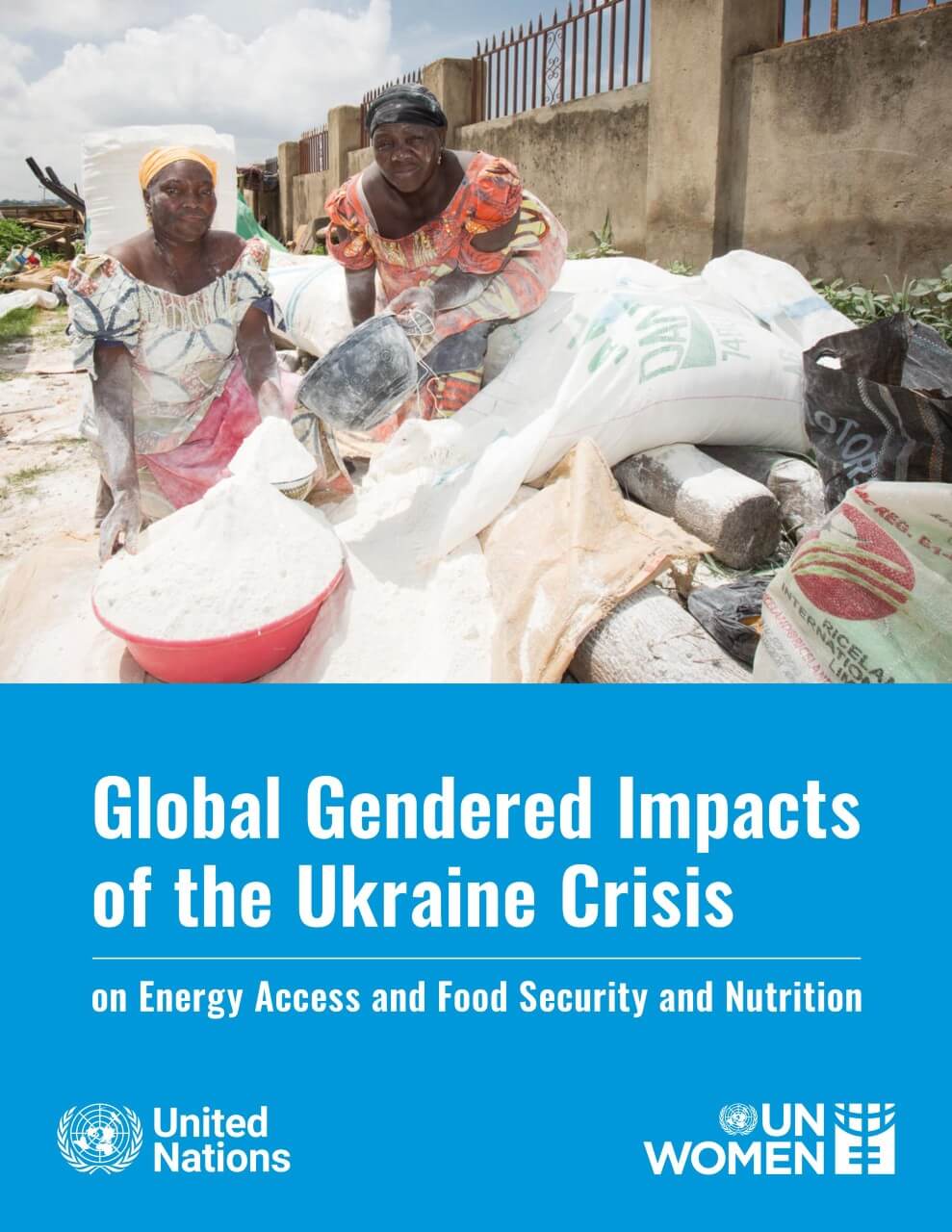
Global gendered impacts of the Ukraine crisis on energy access and food, security, and nutrition

Developed by UN Women and the UN Global Crisis Response Group on the War in Ukraine (GCRG), the report shows that war-induced food price hikes and shortages have widened the global gender gap in food insecurity, as women have even reduced their own food intake to give it to other household members. Spiralling energy prices have also caused families to return to using less-clean fuels and technologies, exposing women and girls to household air pollution, which already kills 3.2 million people, mostly women and children, per year.

Women-headed households in Ukraine were already more food-insecure prior to the war, with 37.5 per cent of them experiencing moderate or severe levels of food insecurity compared to 20.5 per cent of male-headed households. Now, rural women in the territories occupied by the Russian military are increasingly unable to perform agricultural work due to high insecurity and lack of resources, yet they are rising to the challenge to accommodate and feed internally displaced people, multiplying their unpaid care and domestic work responsibilities.

Additionally, the report shows that there are alarming increases in gender-based violence; transactional sex for food and survival; sexual exploitation and trafficking; and early, child, and forced marriage as a result of these worsened living conditions in conflict, crisis, and humanitarian contexts worldwide.

Sima Bahous, UN Women Executive Director, said: “Systemic, gendered crises require systemic, gendered solutions. That means ensuring that women and girls, including from marginalized groups, are part of all the decision-making processes. That is simply the only way to be certain that their rights and needs are fully taken into account as we respond to the clear facts before us.”

Among other recommendations, the policy paper calls on the international community to:

  • Prioritize women’s and girls’ voice, agency, participation and leadership in conflict response, recovery, and peacebuilding;
  • Enhance gender statistics and sex-disaggregated data to build the evidence base for gender-responsive policy, planning, and reconstruction measures, and to track and monitor gender-related impacts of food insecurity and energy poverty on women and girls;
  • Promote and protect the right to food by targeting the specific nutrition needs of women and girls, and accelerate the transformation towards more equitable, gender-responsive, and sustainable food systems, and equitable access to inputs, technologies, and markets by women; and
  • Ensure equal access to affordable and sustainable energy by creating fiscal space to achieve energy access and renewable energy solutions for all women and girls and their communities, through windfall taxes on the largest oil and gas companies and protecting women and girls and their communities from bearing the brunt of escalating fuel and energy prices.

The policy paper was presented at the high-level roundtable, “How do we best respond to the disproportionate impacts of rising food insecurity on women and girls?”, on the sidelines of the UN General Assembly, hosted by the Government of Denmark and the Government of Nigeria in partnership with OCHA, UNHCR, UNFPA, UNICEF, UN Women, WFP, and Save the Children, together with representatives from women-led organizations.

Read the full policy paper and find out more about UN Women’s work in Ukraine.

Media contact

  • María Sánchez, [ Click to reveal ]

Topics

  • 2030 Agenda for Sustainable Development
  • Sustainable Development Goals (SDGs)
  • Climate change
  • Energy
  • Economic empowerment
  • Macroeconomic policies
  • Financial and economic crisis
  • Food security
  • Ending violence against women and girls
  • Peace and security
  • Conflict, war
  • Sexual violence in conflict
  • Europe and Central Asia
  • Ukraine

Related content

Image
A young woman poses for a portrait while wearing a UN Women vest
Feature

Serving through crisis: UN Women’s humanitarian workers on what keeps them going

17 August 2026
Serving through crisis: UN Women’s humanitarian workers on what keeps them going
Image
Image placeholder with UN Women logo (English) - 3:2 aspect ratio
Press briefing

Press briefing at the United Nations by UN Women Special Representative in Afghanistan, Susan Ferguson

14 August 2026
Press briefing at the United Nations by UN Women Special Representative in Afghanistan, Susan Ferguson
Image
A portrait of an Afghan woman in silhouette
Press release

Five years after the Taliban takeover: the normalization of the exclusion of women and girls in Afghanistan

12 August 2026
Five years after the Taliban takeover: the normalization of the exclusion of women and girls in Afghanistan

Footer menu-HQ

  • News and stories
  • Resources
  • What we do
  • How we work
  • Where we are
  • Partnerships
  • Employment
  • Procurement
  • Contact us
  • Executive Board
  • Commission on the Status of Women

Donate button menu [Footer tablet]

  • Donate

Donate button menu [Footer]

  • Donate

Social media menu

  • Facebook
  • Twitter
  • LinkedIn
  • Flickr
  • YouTube
  • Instagram
UN Women - For all women and girls

Footer bottom [Menu]

  • Copyright
  • Information security
  • Privacy notice
  • Report wrongdoing
  • Terms of use
Share this page
  • Share to Facebook
  • Share to Twitter
  • Share to LinkedIn
  • Share to E-mail

Or copy link