
Universal menu

  • Global
  • Regions
    • Africa
    • Americas and the Caribbean
    • Arab States
    • Asia and the Pacific
    • Europe and Central Asia
  • Knowledge
  • Data
  • Training
  • Transparency
UN Women - For all women and girls

Main Navigation-HQ

  • Who we are
    • About us
      • About UN Women
      • Business model
      • Guiding documents
      • Worldwide presence
    • Leadership
      • Governance structure
      • Executive leadership
      • Executive Board
      • Accountability
    • Work with us
      • Employment
      • Procurement
      • Calls for proposals
      • Contact us
      • UN Women Strategic Plan 2026–2029
      • UN Women Strategic Plan 2026–2029 - social media image
        UN Women Strategic Plan 2026–2029
  • What we do
    • Focus areas
      • Ending violence against women
      • Peace and security
      • Humanitarian action
      • Leadership and governance
      • Economic empowerment
      • Innovation and technology
      • Women with disabilities
      • Youth
      • HIV and AIDS
    • How we work
      • 2030 Agenda for Sustainable Development
      • Commission on the Status of Women
      • Gender parity in the UN system
      • Intergovernmental support
      • Partnerships
      • Research and data
      • Training Centre
      • Trust funds
      • UN system coordination
      • Gender Equality Accelerators
      • Gender Equality Accelerators artwork
        Gender Equality Accelerators
  • News and stories
    • Latest
      • News
      • Articles and explainers
      • In focus
    • Media center
      • Press materials
      • Media contacts
      • Explainer: Why are women so exhausted? Care work and the mental load
      • Two adults stand at a table changing diapers on baby dolls, with laundry hanging on a clothesline behind them in a home setting.
        Explainer: Why are women so exhausted? Care work and the mental load
      • Press release: Aid cuts dismantle women’s organizations working in humanitarian crises
      • A young Ugandan woman sits with another local woman to talk
        Press release: Aid cuts dismantle women’s organizations working in humanitarian crises
  • Digital library
    • Resources
      • Publications
      • Annual reports
      • Progress of the world’s women
      • World survey on the role of women in development
      • The gender snapshot
    • GenderTerm
      • GenderTerm
      • Reprint permissions
      • UN Women Highlights 2025–2026
      • A smiling woman.
        UN Women Highlights 2025–2026
      • The gender snapshot 2025
      • gender snapshot thumbnail transparent
        The gender snapshot 2025
  • Get involved
    • How to get involved
      • For ALL Women and Girls
      • International Women's Day
      • 16 Days of Activism to End Violence against Women and Girls
      • UNiTE! Campaign to End Violence against Women
      • Generation Equality
      • He for She
Ask AI
https://84e5cfacd5c7e99f9825edf344450c.1b.environment.api.powerplatform.com/powervirtualagents/botsbyschema/crad4_websiteQA/directline/token?api-version=2022-03-01-preview
1
-
Ask your question here
AI website assistant

Hello, how can I assist you?

AI chatbot responses may be incorrect. Always verify important information.

Donate button menu

Donate

Breadcrumb

  1. Home
  2. Explore Our Latest News
  3. Explore Our Latest News

Website survey

We want to know how we can improve your experience on this website. Completing this survey takes less than 5 minutes.

TAKE THE SURVEY

From victims to leaders: Ending gender-based violence in the Lake Chad Basin

6 December 2021
  • Share to Facebook
  • Share to Twitter
  • Share to LinkedIn
  • Share to E-mail

Aissa Doumara Ngatansou was 15 years old when she was forced into marriage.

Nearly 30 per cent of girls in Ngatansou’s home in North Cameroon are married before the age of 18, facing loss of education, high rates of maternal mortality, and increased risk of gender-based violence. Many others suffer sexual violence at the hands of Boko Haram militants, who have terrorized the region for over a decade.

Today, at 49, Ngatansou is working to change the narrative for women and girls in the Lake Chad Basin – an area encompassing Cameroon, Chad, Niger and Nigeria.
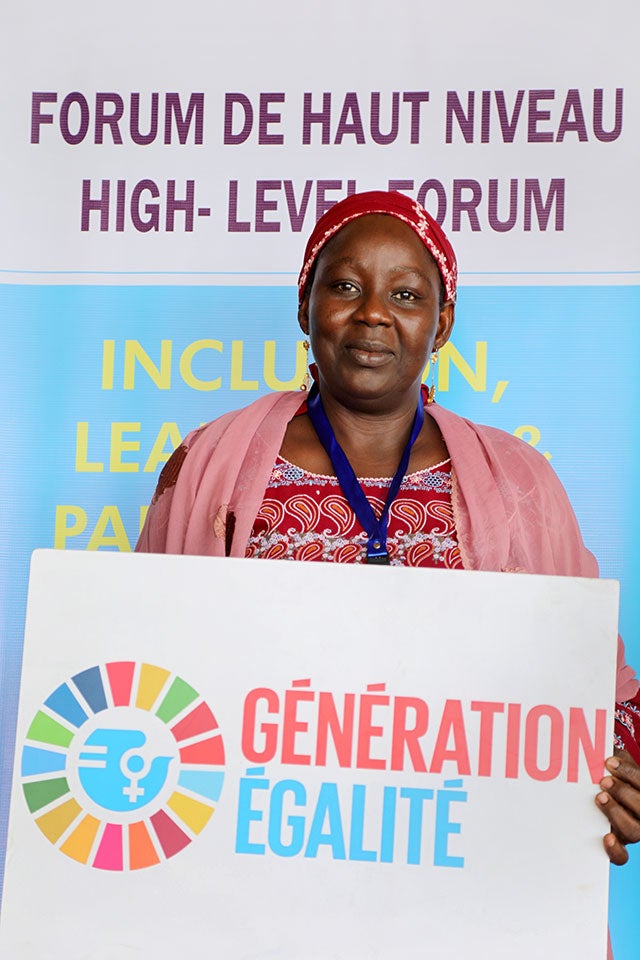
Aissa Doumara Ngatansou holds a Generation Egalite sign.
Aissa Doumara Ngatansou, co-founder of the Association for the Fight against Violence against Women, during the High-Level Forum on “Inclusion, leadership, and participation of women and girls in humanitarian action and risk-informed recovery and resilience” in September 2021. Photo: UN Women
Aissa Doumara Ngatansou, co-founder of the Association for the Fight against Violence against Women,  during the High-Level Forum on “Inclusion, leadership, and participation of women and girls in humanitarian action and risk-informed recovery and resilience” in September 2021. Photo: UN Women

Her organization, the Association for the Elimination of Violence Against Women, gives women decision-making power over their daily lives and offers a way out of crisis and disaster. Her latest project is sponsored by UN Women, with the support of Japan and Spain, which are signatories of the Compact on Women, Peace and Security and Humantarian Action (WPS-HA).

At a time when many local women’s organizations are scaling down disaster resilience initiatives or closing their doors due to lack of funding, Ngatansou’s project has had remarkable reach and success.

In the first half of 2020, her organization provided psychological support to over 420 women and 290 girls affected by conflict, crisis and disaster, as well as gender-based violence. In addition, over 500 girls received support to stay in school, giving them an alternative to child marriage.

Ngantansou also engaged 200 community leaders, including survivors of sexual violence, teaching them to address trauma and mediate conflict.

“When they first come to us we enroll them in programmes to strengthen their skills and self esteem,” Ngantansou said. “By the end of this process they become leaders of their own associations and are trained to solve community conflicts.”

Women giving hope to women

Ngantansou struggles to hold back tears as she speaks about the progress made in the fight for gender equality in Cameroon – an effort which garnered her the first Simone Veil Prize for courage in advancing women’s rights, awarded by the French Government in 2019.

“The example set by the women we support gives hope to others and shows us how violence against women and girls affects all of society,” she said. “It doesn’t only target the victim, but also her family and children, her community and the whole country. Fighting against it is the key to enhancing human rights and promoting development.”

Ngantansou is proud to have helped remove the taboo from discussions about gender-based violence, giving survivors the courage to seek trauma counseling and demand change in the halls of government. “Now I even hear female politicians publicly reveal that they too were victims of violence. I am glad I could live to witness this change, and to know I have contributed to it.”
Image
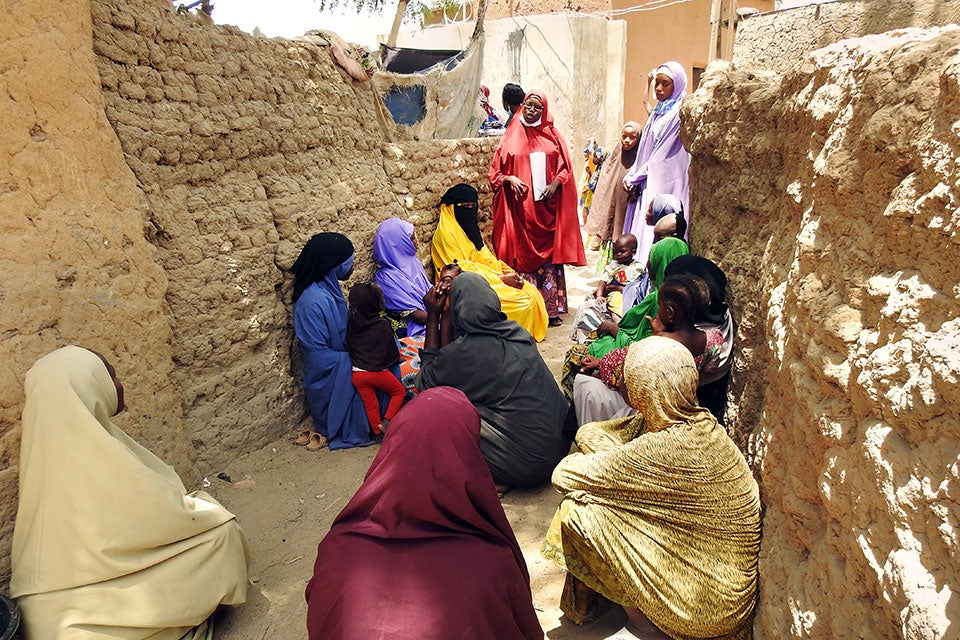
Community members gather to learn.
Community members learned information on gender-based violence prevention and response, gender and masculinity concepts in Damaturu, Yobe State, north-east of Nigeria. Photo: UN Women

Community members learned information on gender-based violence prevention and response, gender and masculinity concepts in Damaturu, Yobe State, north-east of Nigeria. Photo: UN Women

Supporting women at all stages of crisis

For UN Women, the partnership with Ngantansou is part of a two-year project in the Lake Chad Basin, which promotes women’s leadership in disaster risk reduction and humanitarian response, and provides opportunities for their voices to be heard by policymakers.

According to UN Women programme manager Toshihisa Nakamura, these efforts fall under the organization’s broader Women’s Resilience to Disasters programming, which gives women and girls the tools to survive and thrive during all stages of disaster.

Disasters often displace women and girls, making them more vulnerable to exploitation and gender-based violence. They also fuel conflict over natural resources, which trigger refugee crises. Sexual abuse cases in internally displaced person camps often go unreported but are estimated to be in the thousands.

While conflict must be addressed at its source, humanitarian response also needs to provide women and girls with a way out of crisis – from counseling and sexual and reproductive health services, to education and economic empowerment – which is known as a humanitarian-development-peace nexus approach.

Instability, according to Nakamura, also presents operational challenges for crisis response, as disasters destroy infrastructure and generate high security risks for people working or living in the area.

"We need to deliver programmes in a way that really addresses these challenges,” Nakamura said. “We need to work with local partners, including women’s organizations, as well as have a plan B, C and even D, and keep learning every day.”
Image
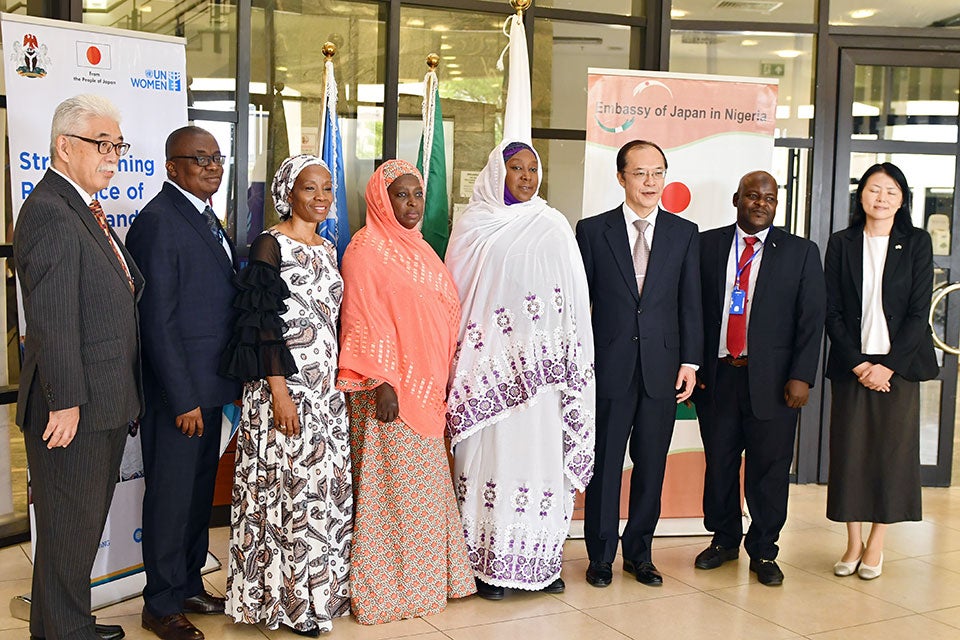
Representatives of  Governments of Japan and Nigeria, as well as UN Women Nigeria Country Office at the launch of the project “Strengthening Resilience of Women and Girls affected by Conflicts, violent extremism and climate change in the Lake Chad Region”. Photo: UN Women
Representatives of Governments of Japan and Nigeria, as well as UN Women Nigeria Country Office at the launch of the project “Strengthening Resilience of Women and Girls affected by Conflicts, Violent Extremism and Climate Change in the Lake Chad Region”. Photo: UN Women.

An inclusive global movement for gender equality

Since the project’s launch in April 2020, UN Women has partnered with over 100 stakeholders and local women’s organizations, connecting them with funding and resources and multiplying their efforts.

“It really takes a lot of partners with different expertise – whether that’s governments who provide funding and political support, organizations like UN Women, which contribute expertise in gender equality and women’s empowerment initiatives, or local women’s organizations who have the trust of their communities and can advise on what’s most needed,” Nakamura said.

“As a signatory of the newly launched WPS-HA Compact, and as part of the Generation Equality Action Coalition on Climate Justice, UN Women believes that we have the chance to scale up these efforts and truly catalyze a global movement for gender equality.”

To learn more about the WPS-HA Compact and the 5-year global movement on gender equality, go to wpshacompact.org

Topics

  • Ending violence against women and girls
  • Humanitarian action
  • Peace and security
  • Africa
  • Cameroon
  • Chad
  • Niger
  • Nigeria
  • Japan
  • Spain

Related content

Image
A young woman poses for a portrait while wearing a UN Women vest
Feature

Serving through crisis: UN Women’s humanitarian workers on what keeps them going

17 August 2026
Serving through crisis: UN Women’s humanitarian workers on what keeps them going
Image
Image placeholder with UN Women logo (English) - 3:2 aspect ratio
Press briefing

Press briefing at the United Nations by UN Women Special Representative in Afghanistan, Susan Ferguson

14 August 2026
Press briefing at the United Nations by UN Women Special Representative in Afghanistan, Susan Ferguson
Image
A portrait of an Afghan woman in silhouette
Press release

Five years after the Taliban takeover: the normalization of the exclusion of women and girls in Afghanistan

12 August 2026
Five years after the Taliban takeover: the normalization of the exclusion of women and girls in Afghanistan

Footer menu-HQ

  • News and stories
  • Resources
  • What we do
  • How we work
  • Where we are
  • Partnerships
  • Employment
  • Procurement
  • Contact us
  • Executive Board
  • Commission on the Status of Women

Donate button menu [Footer tablet]

  • Donate

Donate button menu [Footer]

  • Donate

Social media menu

  • Facebook
  • Twitter
  • LinkedIn
  • Flickr
  • YouTube
  • Instagram
UN Women - For all women and girls

Footer bottom [Menu]

  • Copyright
  • Information security
  • Privacy notice
  • Report wrongdoing
  • Terms of use
Share this page
  • Share to Facebook
  • Share to Twitter
  • Share to LinkedIn
  • Share to E-mail

Or copy link