
Sixteen defining moments for gender equality in 2021
Originally published on un-women.medium.com
As 2021 comes to a close, we’re taking a look back at some of the major moments for gender equality and women’s rights from the past 12 months. From women at the forefront of the ongoing fight against COVID-19, to new laws to support survivors of gender-based violence, from women in the highest political offices to eliminating gender stereotypes in advertising, join us in celebrating some of the small and big strides for gender equality in 2021.
Power and politics
1. Women reach highest levels of decision-making
In 2021, eight countries have elected or sworn in their first woman Head of State or Government, with Barbados, Estonia and Moldova having women as President and Prime Minister for at least part of the year.
The year started off with Kaja Kallas taking office in January as Estonia’s first woman Prime Minister. Samia Suluhu Hassan became Tanzania’s first woman President in March. In May, Fiamē Naomi Mata'afa was elected Prime Minister of Samoa. June saw Robinah Nabbanja nominated to the role of Prime Minister of Uganda.
Najla Bouden Ramadhane was named Tunisia’s Prime Minister in September, making her the first woman to lead a country in the Arab region. After a 2020 decision that Barbados would become a Republic, the first presidential election held in October 2021 saw Sandra Mason become the country’s first-ever female President.
Sweden’s parliament voted in Magdalena Andersson as Prime Minister in November. In December, Xiomara Castro was elected President of Honduras; she will officially take office in 2022.
Overall, 2021 was a good year for women in politics. Albania has a record-setting 70 per cent women cabinet, Germany got its first gender-equal cabinet, and Iraq and Kosovo exceeded their gender quotas for parliament. In January Kamala Harris took office as the first woman Vice President of the United States. Harris is notably also the first Black-American and Asian-American to fill the role.
.@KamalaHarris is the first woman, first Black and first South Asian Vice President of the United States.
— UN Women (@UN_Women) January 20, 2021
Here's to many more moments like this around the world.#GenerationEquality #Inauguration2021 pic.twitter.com/otqPsiQKti
2. Ngozi Okonjo-Iweala becomes the first woman and first African to lead the World Trade Organization
In March, Ngozi Okonjo-Iweala took office as the Director-General of the World Trade Organization, making her both the first woman and the first African to hold this position in the organization’s 26-year history.
Okonjo-Iweala is no stranger to shattering glass ceilings, having been the first woman to become Nigeria’s Finance Minister and Foreign Minister.
On March 1, Dr. Ngozi Okonjo-Iweala of Nigeria will take over as the WTO’s next Director-General. She makes history as the 1st woman and 1st African to head the organization @NOIweala #WTODG
— WTO (@wto) February 20, 2021
Learn more: https://t.co/yfDhNhERs5 pic.twitter.com/nEyRTFxPBO
Laws and policy
3. Spain strengthens rape laws
Spain approved a bill defining all non-consensual sex as rape, in a move meant to centre survivors and toughen penalties for perpetrators.
The new legislation comes in the wake of the 2016 “wolf pack” gang rape case, which sparked national outrage. Based on a “yes means yes” model, it will require explicit consent for sexual acts. Spain joins 11 other European countries who have expanded their legal definition of rape in this way.
The bill also reclassifies street harassment and female genital mutilation as criminal offenses and introduces imprisonment for work-related sexual harassment.
4. Lebanon makes progress towards ending child marriage
The Higher Islamic Council in Lebanon approved a Family Law amendment, including a new chapter on the marriage of minors. The new legislation bans the marriage of children under the age of 15 and stipulates that girls must give their consent to marry, or else the marriage can be annulled.
Before the COVID-19 pandemic, more than 100 million girls were expected to marry before their 18th birthday in the next decade. Now, due to the economic shocks, insecurity and school closures, up to 10 million more girls are at risk of becoming child brides, unless countries around the world take urgent action to drive change.
Ending child marriage – any formal marriage or informal union involving a child under the age of 18 – is part of the UN Sustainable Development Goals.
In 🇱🇧, the Higher Islamic Council has modified its personal status law to ban the marriage of children below the age of 15, with a recommendation to ensure 18 years of age for marriage.
— UN Women Lebanon (@unwomenlebanon) May 4, 2021
This is an important step towards ending #ChildMarriage in the country pic.twitter.com/ka0zCDclUC
5. Marriage equality advances around the world
Switzerland announced that same-sex couples would be able to marry or convert their registered partnerships into marriage in the country, following a popular vote on the subject in September when 64.1 per cent supported same-sex marriage. In December, Chile’s Congress passed a law to legalize same-sex marriage, becoming the 31st country where same-sex marriage is legal.
While there are still 69 countries that have laws criminalizing homosexuality and a long way to go until there is universal recognition that love is love, 2021 saw some promising moves to decriminalize same-sex partnerships. In February, Angola signed into law a revised penal code to allow same-sex relationships and ban discrimination on the basis of sexual orientation. With a landmark decision in March, a Japanese court ruled that the government's ban on gay marriage is unconstitutional, paving the way for marriage equality.
PERIOD. pic.twitter.com/e26Cz8UMzt
— UN Women (@UN_Women) December 22, 2021
6. Chile sets new gender equality standard in constitutional drafting
In May, Chile elected the world’s first gender-equal constitutional assembly, which activists say could help set a new global standard.
Chile’s current constitution, drafted in 1980 during the Pinochet dictatorship, does guarantee non-discrimination based on sex, but does not ensure women’s rights within marriage and restricts their sexual and reproductive rights. It has also been criticized for failing to provide healthcare, education, and other social protections.
Calls for a new constitution were amplified during a popular uprising in October 2019, and an overwhelming 79 per cent of Chileans voted in favor of a constitutional assembly with gender parity.
Science and technology
7. Women continue leading COVID-19 research and response
Nearly two years since COVID-19 was declared to be a pandemic, every corner of the world has felt the devastating impacts of the virus. As health and care workers, women and girls have been on the front lines of response, but they have also been leaders in research and innovation. Throughout 2021, vaccine rollouts increased around the world, thanks to many women scientists and experts.
From teenager Amika Chebrolu’s research on the lead molecule to selectively bind to the spike protein of SARS-CoV-2 and inhibit the virus, to the critical research pioneered by women researchers like Kizzmekia Corbett, Katalin Karikó, Özlem Türeci and others, the distribution of vaccines around the world has been a critical tool in combatting the COVID-19 pandemic.
These five women are leading the fight against the pandemic.
— World Economic Forum (@wef) March 16, 2021
📕 Read more: https://t.co/RwogjUQ88D pic.twitter.com/sVLZrH7hXg
8. New Nasdaq policy requires diversity on company boards
A new policy requires that the roughly 3.000 companies publicly traded through Nasdaq, the US-owned electronic stock exchange, have at least one woman on their board of directors. A recent review found that about 75 per cent of the Nasdaq listed companies, primarily tech-related and growth companies, did not meet the threshold.
The new policy, a major step in assuring women’s leadership in private-sector leadership, also requires racial diversity, and the inclusion of at least one board member who self-identifies as LGBTIQ+.
9. Recognizing the contributions of Henrietta Lacks
In October, the World Health Organization honoured the legacy of Henrietta Lacks, a Black American woman and mother. Lacks died of cervical cancer in 1951, but cells taken from her, without her knowledge or consent, were commercialized and distributed around the world.
The HeLa cells have contributed to nearly 75,000 studies, paving the way in advancements across medicine including polio vaccines, HIV/AIDS medications and breakthroughs in in-vitro fertilization and vital COVID-18 research.
By recognizing Henrietta Lacks’ life and legacy, WHO is calling for collective action to rectify and eliminate inequality and unjust disparities in global health.
Thank you, Henrietta Lacks!
— World Health Organization (WHO) (@WHO) October 13, 2021
Today @DrTedros honoured Henrietta Lacks posthumously with a WHO Director-General’s award, acknowledging her story - one of inequity - and recognizing her world-changing legacy to science and health https://t.co/vVx1Hn52lO pic.twitter.com/rshT1shwfn
Sport
10. The most gender-equal Olympics
With a year of delay because of the COVID-19 pandemic, the Tokyo 2020 Olympics kicked off on 23 July 2021 with almost 49 per cent of participating athletes being women, making it the most gender-balanced Games in history.
For the first time, there was at least one female and one male athlete in each of the teams participating in the Games, and a sporting schedule that gave equal visibility for men and women’s events during primetime hours. The first modern Olympic Games held in 1896 in Athens did not feature a single female competitor.
Did you know?
— UN Women (@UN_Women) August 18, 2021
This year's @Olympics was the most gender-balanced games in history and a landmark for gender balance in sport!#Tokyo2020 👏👏👏 pic.twitter.com/6N09OhhzlO
Arts and entertainment
11. Women directors finally get more recognition
Chloé Zhao made history this year at the Oscars, when she became the first woman of colour and the first woman of Asian descent to earn best director at the Academy Awards. The "Nomadland" director was only the second woman to win the award, following the footsteps of Kathryn Bigelow, who won for directing "Hurt Locker" in 2010. This was also the first year ever that two women were nominated for best director. In fact, during the 93-year history of the Oscars, only seven women have been nominated in the director category, including 2021 nominees, Zhao and Fennell.
The Golden Globe awards also recognized women directors’ achievements with three women who have been nominated in the best director category. This was the first time more than one woman has been shortlisted in a single year. Previously, only five women were ever nominated in the 77-year awards history.
Join us in celebrating Chloé Zhao who became the first woman of color, and second woman ever to win the #Oscar for directing!
— UN Women (@UN_Women) April 26, 2021
Only 7 women have been recognized in the #Oscars director category. #HERstory pic.twitter.com/w17kb8mNZR
12. A Dutch museum permanently features women artists
For the first time in its 200-year history, the Rijksmusem in Amsterdam announced that three 17th century paintings by women artists will be placed on permanent display.
The three works, The Serenade by Judith Leyster, the Memorial Portrait of Moses ter Borch by Gesina ter Borch and Still Life with Flowers in a Glass Vase by Rachel Ruysch, are now on display in the Gallery of Honour, alongside
13. Lego announces the end of gender bias in their toys
Following a global survey commissioned by Lego and conducted by the Geena Davis Institute on Gender in Media, the Danish company announced they’ll take steps towards removing gender-bias in their toys and marketing, including stopping the use of labelling toys ‘for girls’ or ‘for boys’.
Lego will also work to expand the diversity of characters and roles represented in their products, in the hopes of every child being able to identify with the toys.
Women leading action
14. Generation Equality Forum sets course to accelerate action
Kicking off in March in Mexico, and concluding in Paris in July, the Generation Equality Forum brought together governments, civil society, philanthropy, private sector and youth activists and launched a five-year action journey to drive progress towards gender equality. With nearly USD 40 billion in investments, as well as ambitious policy and programme commitments, the Forum convened by UN Women and co-hosted by the governments of France and Mexico, marks a critical moment in women’s rights and equality movements, especially as the world assesses the impact of COVID-19.
🎬That’s a wrap! 🎬
— UN Women (@UN_Women) July 2, 2021
The #GenerationEquality Forum Paris concluded today with nearly $40 billion of investments for gender equality.
Thank you to all those who joined us. #ActForEqual pic.twitter.com/helEepS6u7
15. Maria Ressa wins Nobel Peace Prize
Maria Ressa, alongside Dmitry Muratov, was awarded the 2021 Nobel Peace Prize for her work in safeguarding freedom of expression. Ressa, the co-founder of the digital media company dedicated to investigative journalism, has long used her work as a journalist and author to expose abuses of power in the Philippines.
Ressa is the 18th woman to win the Nobel Peace Prize since its inception in 1901, and the first person from the Philippines.
There was only one more woman who won the #NobelPrize this year.
— UN Women (@UN_Women) October 9, 2021
The underrepresentation of women needs to change.
Who is a woman that you would like to see win the @NobelPrize? pic.twitter.com/4eyUeWPWDO
16. Afghan women speak truth to power
On 15 August 2021, Kabul fell to the Taliban, drastically impacting the lives of all Afghans, especially Afghan women and girls. Girls are banned from attending secondary school, women are unable to continue work, and violence against women is on the rise.
Against all odds, many Afghan women took to the streets in protest. Others persisted to speak out in different ways, to safeguard their human rights. One delegation travelled to New York to participate in a series of high-level meetings at the United Nations Headquarters on the sidelines of the UN Security Council Open Debate on Women, Peace and Security. The group, including parliamentarians, women’s rights advocates, journalists, civil society leaders and researchers, called for women’s full and equal participation in humanitarian assistance, peace efforts, and governance.
"Afghan women will never give up on their rights...
— UN Women (@UN_Women) October 18, 2021
And UN Women will never stop walking along side them."@unwomenafghan Deputy Representative, @DavidianAli on our commitment to #StayAndDeliver support to women and girls in #Afghanistan. pic.twitter.com/grrO0qN4mI
Related content
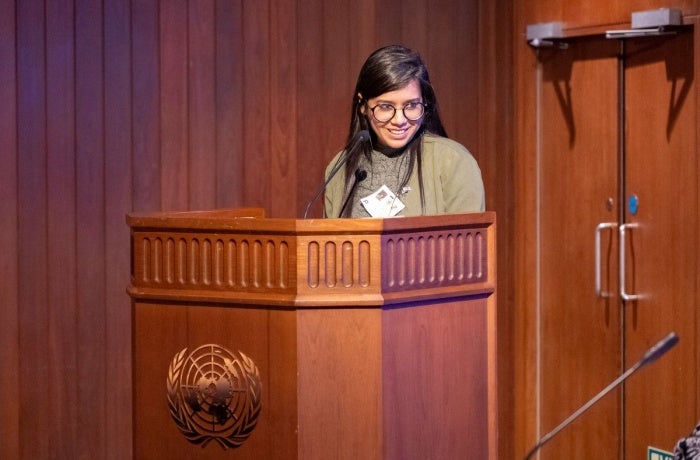
For ALL Women and Girls: Sushmita S. Preetha on elevating and protecting women journalists
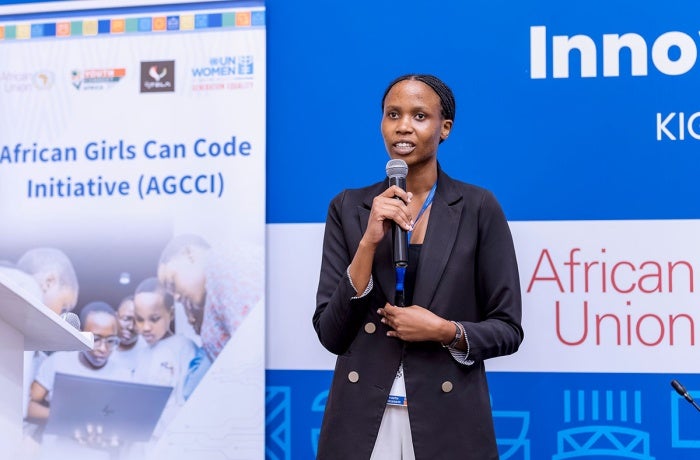
For All Women and Girls: Pendo Vestine on closing the gender gap for girls in tech
