
Universal menu

  • Global
  • Regions
    • Africa
    • Americas and the Caribbean
    • Arab States
    • Asia and the Pacific
    • Europe and Central Asia
  • Knowledge
  • Data
  • Training
  • Transparency
UN Women - For all women and girls

Main Navigation-HQ

  • Who we are
    • About us
      • About UN Women
      • Business model
      • Guiding documents
      • Worldwide presence
    • Leadership
      • Governance structure
      • Executive leadership
      • Executive Board
      • Accountability
    • Work with us
      • Employment
      • Procurement
      • Calls for proposals
      • Contact us
      • UN Women Strategic Plan 2026–2029
      • UN Women Strategic Plan 2026–2029 - social media image
        UN Women Strategic Plan 2026–2029
  • What we do
    • Focus areas
      • Ending violence against women
      • Peace and security
      • Humanitarian action
      • Leadership and governance
      • Economic empowerment
      • Innovation and technology
      • Women with disabilities
      • Youth
      • HIV and AIDS
    • How we work
      • 2030 Agenda for Sustainable Development
      • Commission on the Status of Women
      • Gender parity in the UN system
      • Intergovernmental support
      • Partnerships
      • Research and data
      • Training Centre
      • Trust funds
      • UN system coordination
      • Gender Equality Accelerators
      • Gender Equality Accelerators artwork
        Gender Equality Accelerators
  • News and stories
    • Latest
      • News
      • Articles and explainers
      • In focus
    • Media center
      • Press materials
      • Media contacts
      • Explainer: Why are women so exhausted? Care work and the mental load
      • Two adults stand at a table changing diapers on baby dolls, with laundry hanging on a clothesline behind them in a home setting.
        Explainer: Why are women so exhausted? Care work and the mental load
      • Press release: Aid cuts dismantle women’s organizations working in humanitarian crises
      • A young Ugandan woman sits with another local woman to talk
        Press release: Aid cuts dismantle women’s organizations working in humanitarian crises
  • Digital library
    • Resources
      • Publications
      • Annual reports
      • Progress of the world’s women
      • World survey on the role of women in development
      • The gender snapshot
    • GenderTerm
      • GenderTerm
      • Reprint permissions
      • UN Women Highlights 2025–2026
      • A smiling woman.
        UN Women Highlights 2025–2026
      • The gender snapshot 2025
      • gender snapshot thumbnail transparent
        The gender snapshot 2025
  • Get involved
    • How to get involved
      • For ALL Women and Girls
      • International Women's Day
      • 16 Days of Activism to End Violence against Women and Girls
      • UNiTE! Campaign to End Violence against Women
      • Generation Equality
      • He for She
Ask AI
https://84e5cfacd5c7e99f9825edf344450c.1b.environment.api.powerplatform.com/powervirtualagents/botsbyschema/crad4_websiteQA/directline/token?api-version=2022-03-01-preview
1
-
Ask your question here
AI website assistant

Hello, how can I assist you?

AI chatbot responses may be incorrect. Always verify important information.

Donate button menu

Donate

Breadcrumb

  1. Home
  2. Explore Our Latest News
  3. Explore Our Latest News

Website survey

We want to know how we can improve your experience on this website. Completing this survey takes less than 5 minutes.

TAKE THE SURVEY
Feature

In South Africa, girls join forces to overcome adversity and drive change

11 October 2022
  • Share to Facebook
  • Share to Twitter
  • Share to LinkedIn
  • Share to E-mail

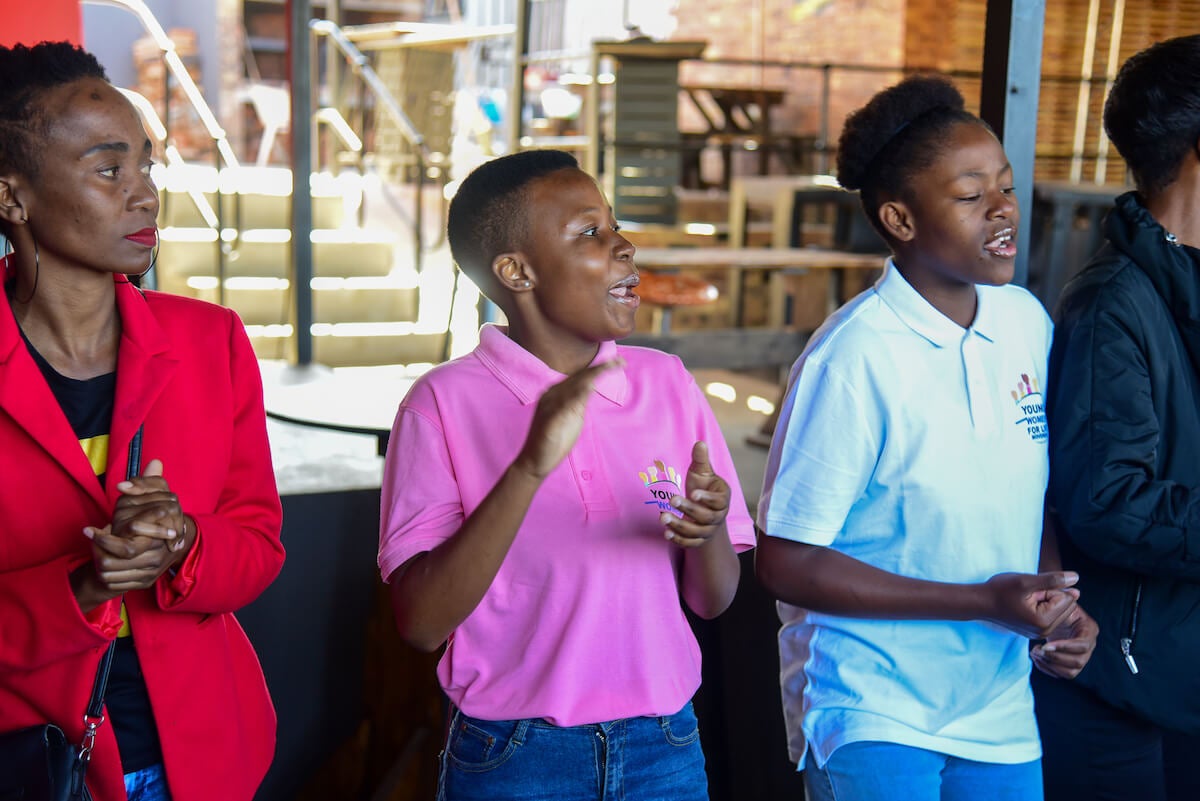
The sounds of laughter, singing and clapping emanate from a small event space deep in Mamelodi township on the outskirts of Pretoria, South Africa. Inside, a group of girls are excitedly preparing to begin a group dialogue session. The participants, whose ages range from 15 to 25, have been brought together by their desire for change—and their belief that they can drive it themselves by speaking directly to powerful groups and decision-makers. This is the Young Women for Life (YWfL) movement.
Image
Young women for life movement members in Mamelodi township sing at the beginning of their group dialogue. Photo: UN Women/James Ochweri

The movement, convened by the Southern African Catholic Bishops Conference (SACBC) Justice and Peace Commission and supported by UN Women South Africa Multi-Country office, was founded in 2019 to help empower South African women and girls in the face of discrimination and hardship. Together, members confront the challenges and threats they encounter in their day-to-day lives—including unemployment, HIV infection and gender-based violence.

Youth in South Africa continue to be disadvantaged in the labour market, with an unemployment rate higher than the national average. In the first quarter of 2022, Statistics South Africa reported respective unemployment rates of 63.9 percent and 42.1 per cent for those aged 15-24 and 25-34 years, while the current official national rate stands at 34.5 percent. A World Bank report showed that job losses in COVID-19 times are disproportionally concentrated among low-income earners, worsening already severe inequalities.

Girls and young women are particularly vulnerable to socio-economic challenges in South Africa’s patriarchal society, and they often find themselves compromising their sexual and reproductive health to survive from day to day. All the sites where the YWfL movement is present are high-burden areas for HIV prevalence and treatment defaulting, where girls and young women face similar socio-economic vulnerabilities to HIV. Across South Africa, adolescent girls and young women account for 35 percent of all new HIV infections. Gender-based violence, too, remains a pervasive issue: In 2021, Statistics South Africa released a report indicating that one in five women (21 percent) had experienced physical violence by a partner.

Enter the Young Women for Life movement. Structured through local “ward cell” groups that meet, share and strategize, the movement uses group dialogues to raise awareness around HIV and to discuss issues relating to gender dynamics and the pressures that lead to transactional sexual relationships. These dialogues have formed the foundation from which young women across South Africa have been able to support and encourage each other over the past two years, as well as to strategise about social change, advocacy and financial improvement initiatives.
Image
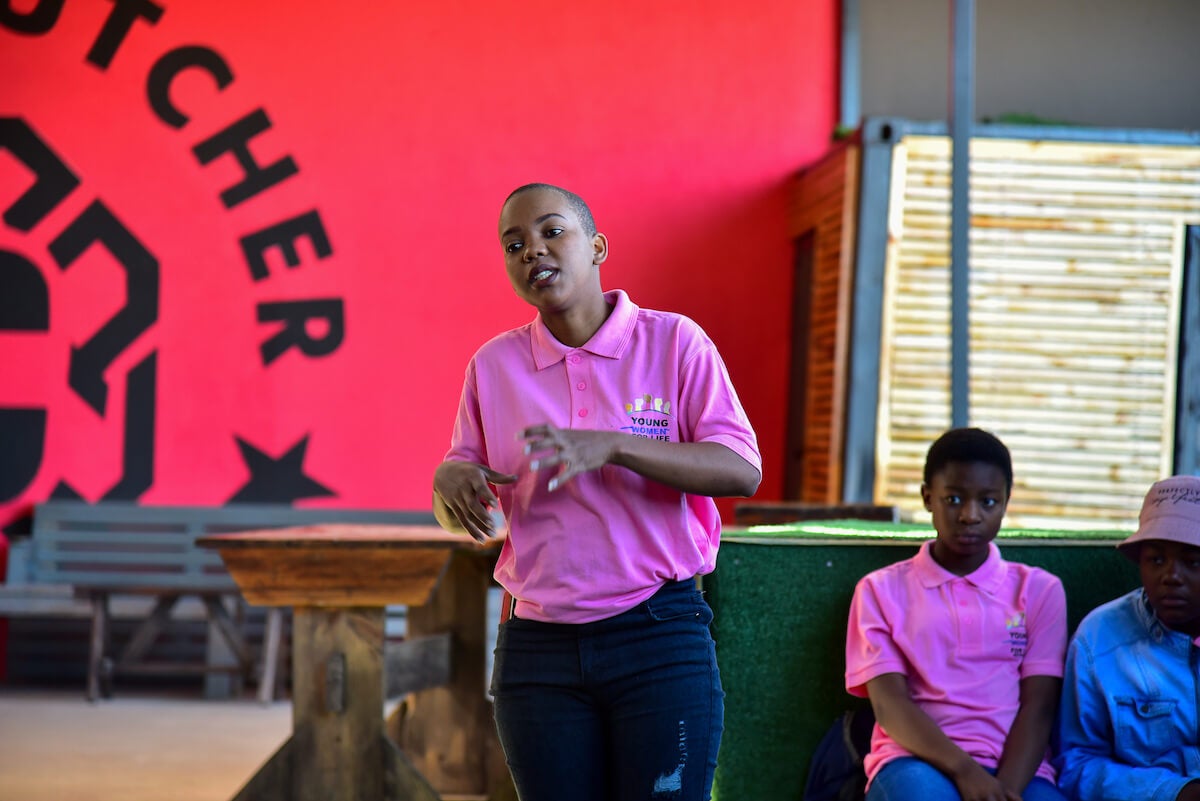
A Young Women for Life member speaking at the group dialogue session. Photo: UN Women/James Ochweri

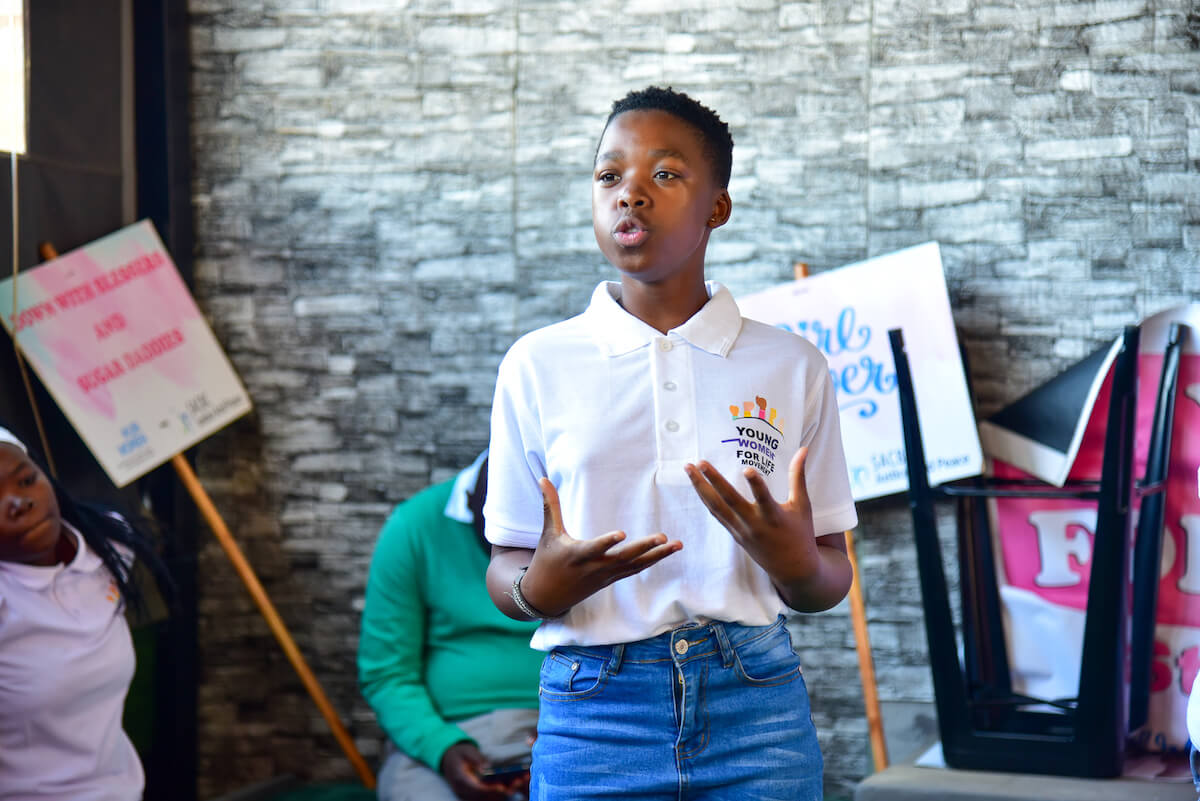
During the group dialogue sessions, the girls are led by trainers, Volunteers from the community who work with SACBC in driving activities on the ground.. The girls break into smaller groups to debate questions posed by the trainers around key issues like HIV prevalence, gender-based violence and transactional sexual relationships. “The dialogues are informed by the context and what the young women are living on a day-to-day basis”, explains Jacqueline Nzisabira, the UN Women Regional HIV/AIDS Policy Specialist. Afterwards, the smaller groups reconvene and report back on their discussions. Often touching on members’ personal experiences, these reporting sessions become a moment of shared catharsis.
Image
A Young Women for Life member reporting on what her group discussed. Photo: UN Women/James Ochweri

Beyond offering emotional support, the Young Women for Life movement is fighting to improve women and girls’ access to justice. This includes monitoring court cases surrounding gender-based violence and advocating for improved services for the survivors involved in these cases.  In 2021, members were involved in the resolution of 135 cases of rape and femicide—from the time they were reported to the police through to their conclusion in court. The movement supported young women and their families in navigating the criminal justice system and accessing counselling and pyscho-social support services. 

Members also picket outside courts as a way of making their presence known to the magistrates and of drawing public attention to cases of rape and other forms of gender-based violence. During sentencing, they make legal submissions to magistrates to ensure no leniency is given in rape and femicide cases. In the past, members have reported magistrates to the South African Department of Justice when they have given lenient sentences that do not comply with sentencing guidelines.

The YWfL movement also works to build the resourcefulness and resilience of girls and young women in the face of financial strain and limited economic opportunities, particularly during the COVID-19 pandemic. UN Women and SACBC recently conducted economic empowerment and life skills trainings with 600 young women from across South Africa in partnership with Nokia’s incubation programme, which offers training opportunities that can lead to employment and further skills development.

On the benefits she has seen as the programme implementation continues, Jacqueline says, “This programme has shown results beyond what we expected. It is exposing the issues that are driving prevalence of HIV and Gender-based violence. It’s helping us and the Government to address the right issues. The young women have become more resilient and they’re taking their destinies into their own hands through reinforcing their voice and their agency”. Father Stan Muyebe, director of the Southern African Catholic Bishops Conference, adds: “Our vision for the movement in the next few years is for the girls to own the whole process by themselves, with our support. We want them to have the ownership, direction, and vision on the empowerment that they want”.


Topics

  • Economic empowerment
  • Ending violence against women and girls
  • Access to justice and legal protection
  • Gender equality and women’s empowerment
  • HIV and AIDS
  • Girls
  • Africa
  • South Africa

Related content

Image
A young woman poses for a portrait while wearing a UN Women vest
Feature

Serving through crisis: UN Women’s humanitarian workers on what keeps them going

17 August 2026
Serving through crisis: UN Women’s humanitarian workers on what keeps them going
Image
Image placeholder with UN Women logo (English) - 3:2 aspect ratio
Press briefing

Press briefing at the United Nations by UN Women Special Representative in Afghanistan, Susan Ferguson

14 August 2026
Press briefing at the United Nations by UN Women Special Representative in Afghanistan, Susan Ferguson
Image
A portrait of an Afghan woman in silhouette
Press release

Five years after the Taliban takeover: the normalization of the exclusion of women and girls in Afghanistan

12 August 2026
Five years after the Taliban takeover: the normalization of the exclusion of women and girls in Afghanistan

Footer menu-HQ

  • News and stories
  • Resources
  • What we do
  • How we work
  • Where we are
  • Partnerships
  • Employment
  • Procurement
  • Contact us
  • Executive Board
  • Commission on the Status of Women

Donate button menu [Footer tablet]

  • Donate

Donate button menu [Footer]

  • Donate

Social media menu

  • Facebook
  • Twitter
  • LinkedIn
  • Flickr
  • YouTube
  • Instagram
UN Women - For all women and girls

Footer bottom [Menu]

  • Copyright
  • Information security
  • Privacy notice
  • Report wrongdoing
  • Terms of use
Share this page
  • Share to Facebook
  • Share to Twitter
  • Share to LinkedIn
  • Share to E-mail

Or copy link