
Universal menu

  • Global
  • Regions
    • Africa
    • Americas and the Caribbean
    • Arab States
    • Asia and the Pacific
    • Europe and Central Asia
  • Knowledge
  • Data
  • Training
  • Transparency
UN Women - For all women and girls

Main Navigation-HQ

  • Who we are
    • About us
      • About UN Women
      • Business model
      • Guiding documents
      • Worldwide presence
    • Leadership
      • Governance structure
      • Executive leadership
      • Executive Board
      • Accountability
    • Work with us
      • Employment
      • Procurement
      • Calls for proposals
      • Contact us
      • UN Women Strategic Plan 2026–2029
      • UN Women Strategic Plan 2026–2029 - social media image
        UN Women Strategic Plan 2026–2029
  • What we do
    • Focus areas
      • Ending violence against women
      • Peace and security
      • Humanitarian action
      • Leadership and governance
      • Economic empowerment
      • Innovation and technology
      • Women with disabilities
      • Youth
      • HIV and AIDS
    • How we work
      • 2030 Agenda for Sustainable Development
      • Commission on the Status of Women
      • Gender parity in the UN system
      • Intergovernmental support
      • Partnerships
      • Research and data
      • Training Centre
      • Trust funds
      • UN system coordination
      • Gender Equality Accelerators
      • Gender Equality Accelerators artwork
        Gender Equality Accelerators
  • News and stories
    • Latest
      • News
      • Articles and explainers
      • In focus
    • Media center
      • Press materials
      • Media contacts
      • Explainer: Why are women so exhausted? Care work and the mental load
      • Two adults stand at a table changing diapers on baby dolls, with laundry hanging on a clothesline behind them in a home setting.
        Explainer: Why are women so exhausted? Care work and the mental load
      • Press release: Aid cuts dismantle women’s organizations working in humanitarian crises
      • A young Ugandan woman sits with another local woman to talk
        Press release: Aid cuts dismantle women’s organizations working in humanitarian crises
  • Digital library
    • Resources
      • Publications
      • Annual reports
      • Progress of the world’s women
      • World survey on the role of women in development
      • The gender snapshot
    • GenderTerm
      • GenderTerm
      • Reprint permissions
      • UN Women Highlights 2025–2026
      • A smiling woman.
        UN Women Highlights 2025–2026
      • The gender snapshot 2025
      • gender snapshot thumbnail transparent
        The gender snapshot 2025
  • Get involved
    • How to get involved
      • For ALL Women and Girls
      • International Women's Day
      • 16 Days of Activism to End Violence against Women and Girls
      • UNiTE! Campaign to End Violence against Women
      • Generation Equality
      • He for She
Ask AI
https://84e5cfacd5c7e99f9825edf344450c.1b.environment.api.powerplatform.com/powervirtualagents/botsbyschema/crad4_websiteQA/directline/token?api-version=2022-03-01-preview
1
-
Ask your question here
AI website assistant

Hello, how can I assist you?

AI chatbot responses may be incorrect. Always verify important information.

Donate button menu

Donate

Breadcrumb

  1. Home
  2. Explore Our Latest News
  3. Explore Our Latest News

Website survey

We want to know how we can improve your experience on this website. Completing this survey takes less than 5 minutes.

TAKE THE SURVEY
Feature

Women grapple with unplanned pregnancies after sexual violence in Sudan war

10 April 2024
  • Share to Facebook
  • Share to Twitter
  • Share to LinkedIn
  • Share to E-mail

After war broke out in Sudan in mid-April 2023 between the Sudanese Armed Forces (SAF) and the Rapid Support Forces (RSF), 18-year-old Amna Salih* sheltered in her home to avoid the dangers of the conflict. 

One day, there was a knock at the door.

“I panicked but shakingly opened the door and there were some soldiers. They came inside and on realizing that I was alone, they started to rape me, one after another with a gun pointed at me”, she said through tears. "They stayed in my house for four days and did it every day.”

When the soldiers left at last, with the help of a neighbour, Salih was able to escape to a friend’s house in a safer part of the city. 

“I was only able to explain what happened to another friend who lived outside Sudan. She sent me some money and advised me to quickly leave the city”, she said. Salih fled the city and travelled throughout Sudan until she arrived at an internally displaced persons’ (IDP) shelter.

The UN High Commissioner for Human Rights has reported that at least 118 people had been subjected to sexual violence, including rape, gang rape, and attempted rape in Sudan as of mid-December 2023, including 19 children.
Image
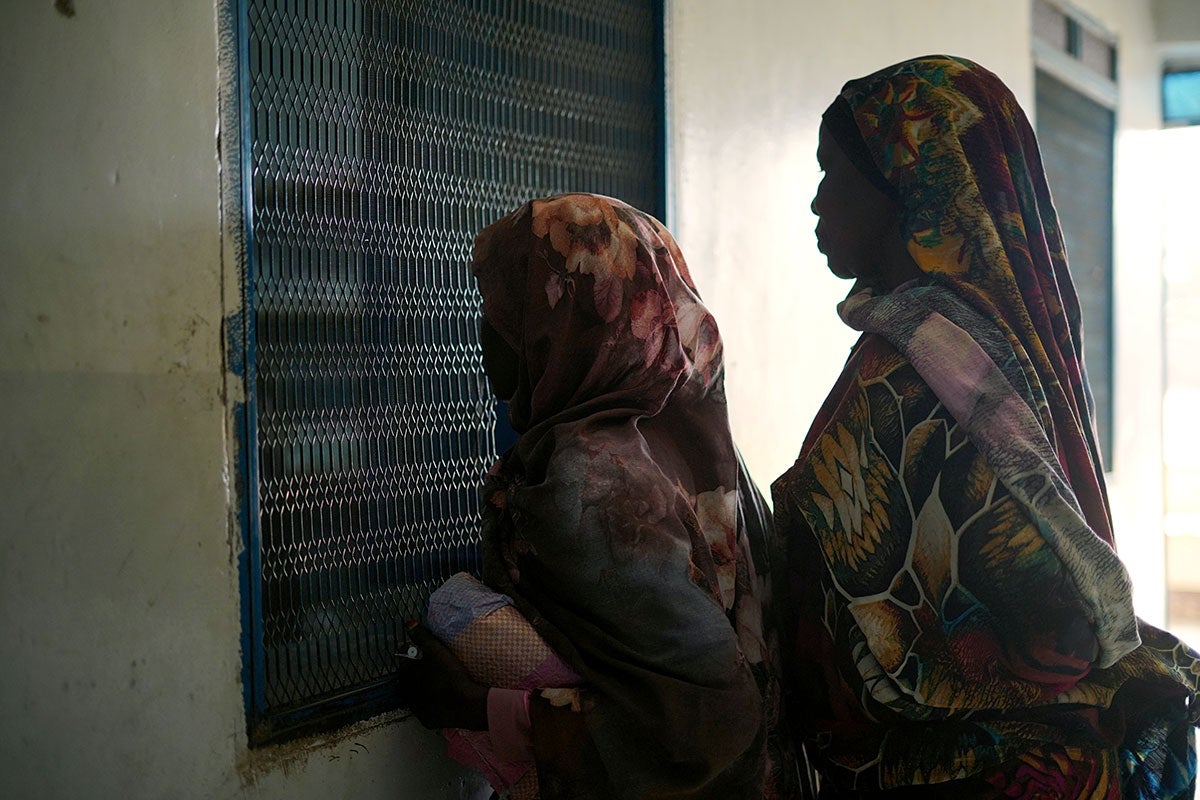
On 2 May 2023 people wait for treatment at Fashir Reproductive health centre. The centre received WASH and health supplies from UNICEF.
On 2 May 2023 people wait for treatment at Fashir Reproductive health
centre. The centre received WASH and health supplies from UNICEF.
Photo: UNICEF/Mohamed Zakaria
On 2 May 2023 people wait for treatment at Fashir Reproductive health centre. The centre received WASH and health supplies from UNICEF. Photo: UNICEF/Mohamed Zakaria

Many of those attacks were committed in homes and on the streets, that report said, adding that only four victims of sexual violence were willing and able to report to the authorities, owing to stigma, distrust of the justice system, the collapse of the institutions of justice, and fear of reprisals. 

A few months after arriving in the IDP shelter, Salih was shocked to find out that she was pregnant. 

“It has really been a struggle”, she said. “Being pregnant in an IDP shelter with no proper medical care or proper nutrition.”

The Sudanese Organization for Research and Development (SORD) in Kassala State and the Women Awareness Organization (AWOON) in Port Sudan have partnered with UN Women to care for internally displaced persons in Sudan, especially vulnerable women affected by sexual and gender-based violence. 

A year into the war, one of SORD’s critical tasks has been caring for pregnant women and girls, many of whom were impregnated due to sexual abuse. 

Nahid Ahmed, a specialist in psychotherapy at AWOON, said that the organization has worked with women survivors of gender-based violence and sexual assault.

“We have cases of sexual violence, which we follow closely, though many women don’t want to talk about their experiences”, Ahmed said.“They need intensive psychological support which we offer, and medication where needed.”

The Red Sea Emergency Room and AWOON, in collaboration with UN Women, have established six Women Situation Rooms (WSRs) to help women access an array of humanitarian services, including helping pregnant women access traditional obstetric care in the absence of health professionals, and providing shelter, food, and water to displaced people. 

“We have referred them to the obstetrics and gynaecology departments, and we follow them up closely”, Ahmed said, adding that AWOON worked to support the mental health of pregnant women who survived sexual assaults.

WSRs also provide organizations the opportunity to network, access and share information, and serve as distribution points for goods and services collected through community efforts. Committees at the WSRs coordinate the evacuation of civilians from frontline areas, repair electrical systems to restore power to medical centres, and search for missing persons and reunite them with their families.

The situation room framework can provide women and frontline responders with aid, but “a lot of support is needed in terms of technical and financial assistance for greater effectiveness”, said one UN Women humanitarian worker in Sudan.

According to OCHA, the number of people in need of gender-based violence services in Sudan has increased by more than 1 million, reaching 4.2 million people since the start of the war, and that number is expected to reach 6.9 million during 2024.

The SORD Organization runs one WSR in Kassala where, among other tasks, they document conflict-related sexual and gender-based violence. Through coordinated efforts with women-led organizations, they ensure affected women access necessary services. It’s here where Salih and over 60 other survivors of gender-based violence attend therapy sessions with counselors for psychological support. 

During the last months of her pregnancy, Salih was taken in by a family in the host community who cared for her before the baby was born.

When she delivered her baby, Salih declined to put the child into foster care, citing her own difficult childhood as an adoptee and survivor of childhood sexual assault.  

“I don’t want my child to go through the same”, she said, adding that she wanted to see her baby every day.  

*Salih's name has been changed to protect her safety.

Topics

  • Peace and security
  • Conflict, war
  • Sexual violence in conflict
  • Africa
  • Sudan

Related content

Image
A young woman poses for a portrait while wearing a UN Women vest
Feature

Serving through crisis: UN Women’s humanitarian workers on what keeps them going

17 August 2026
Serving through crisis: UN Women’s humanitarian workers on what keeps them going
Image
A portrait of an Afghan woman in silhouette
Press release

Five years after the Taliban takeover: the normalization of the exclusion of women and girls in Afghanistan

12 August 2026
Five years after the Taliban takeover: the normalization of the exclusion of women and girls in Afghanistan
Image
Women pose in front of a bus with the Born Perfect campaign banner
Feature

Inside Liberia’s campaign to end female genital mutilation (FGM)

10 August 2026
Inside Liberia’s campaign to end female genital mutilation (FGM)

Footer menu-HQ

  • News and stories
  • Resources
  • What we do
  • How we work
  • Where we are
  • Partnerships
  • Employment
  • Procurement
  • Contact us
  • Executive Board
  • Commission on the Status of Women

Donate button menu [Footer tablet]

  • Donate

Donate button menu [Footer]

  • Donate

Social media menu

  • Facebook
  • Twitter
  • LinkedIn
  • Flickr
  • YouTube
  • Instagram
UN Women - For all women and girls

Footer bottom [Menu]

  • Copyright
  • Information security
  • Privacy notice
  • Report wrongdoing
  • Terms of use
Share this page
  • Share to Facebook
  • Share to Twitter
  • Share to LinkedIn
  • Share to E-mail

Or copy link