
Universal menu

  • Global
  • Regions
    • Africa
    • Americas and the Caribbean
    • Arab States
    • Asia and the Pacific
    • Europe and Central Asia
  • Knowledge
  • Data
  • Training
  • Transparency
UN Women - For all women and girls

Main Navigation-HQ

  • Who we are
    • About us
      • About UN Women
      • Business model
      • Guiding documents
      • Worldwide presence
    • Leadership
      • Governance structure
      • Executive leadership
      • Executive Board
      • Accountability
    • Work with us
      • Employment
      • Procurement
      • Calls for proposals
      • Contact us
      • UN Women Strategic Plan 2026–2029
      • UN Women Strategic Plan 2026–2029 - social media image
        UN Women Strategic Plan 2026–2029
  • What we do
    • Focus areas
      • Ending violence against women
      • Peace and security
      • Humanitarian action
      • Leadership and governance
      • Economic empowerment
      • Innovation and technology
      • Women with disabilities
      • Youth
      • HIV and AIDS
    • How we work
      • 2030 Agenda for Sustainable Development
      • Commission on the Status of Women
      • Gender parity in the UN system
      • Intergovernmental support
      • Partnerships
      • Research and data
      • Training Centre
      • Trust funds
      • UN system coordination
      • Gender Equality Accelerators
      • Gender Equality Accelerators artwork
        Gender Equality Accelerators
  • News and stories
    • Latest
      • News
      • Articles and explainers
      • In focus
    • Media center
      • Press materials
      • Media contacts
      • Explainer: Why are women so exhausted? Care work and the mental load
      • Two adults stand at a table changing diapers on baby dolls, with laundry hanging on a clothesline behind them in a home setting.
        Explainer: Why are women so exhausted? Care work and the mental load
      • Press release: Aid cuts dismantle women’s organizations working in humanitarian crises
      • A young Ugandan woman sits with another local woman to talk
        Press release: Aid cuts dismantle women’s organizations working in humanitarian crises
  • Digital library
    • Resources
      • Publications
      • Annual reports
      • Progress of the world’s women
      • World survey on the role of women in development
      • The gender snapshot
    • GenderTerm
      • GenderTerm
      • Reprint permissions
      • UN Women Highlights 2025–2026
      • A smiling woman.
        UN Women Highlights 2025–2026
      • The gender snapshot 2025
      • gender snapshot thumbnail transparent
        The gender snapshot 2025
  • Get involved
    • How to get involved
      • For ALL Women and Girls
      • International Women's Day
      • 16 Days of Activism to End Violence against Women and Girls
      • UNiTE! Campaign to End Violence against Women
      • Generation Equality
      • He for She
Ask AI
https://84e5cfacd5c7e99f9825edf344450c.1b.environment.api.powerplatform.com/powervirtualagents/botsbyschema/crad4_websiteQA/directline/token?api-version=2022-03-01-preview
1
-
Ask your question here
AI website assistant

Hello, how can I assist you?

AI chatbot responses may be incorrect. Always verify important information.

Donate button menu

Donate

Breadcrumb

  1. Home
  2. Explore Our Latest News
  3. Explore Our Latest News

Website survey

We want to know how we can improve your experience on this website. Completing this survey takes less than 5 minutes.

TAKE THE SURVEY
News

Recognize care as a human right, urge leaders of the Global Alliance for Care

14 December 2021
  • Share to Facebook
  • Share to Twitter
  • Share to LinkedIn
  • Share to E-mail

At a high-level event on International Human Rights Day, 10 December, the Global Alliance for Care called for a human rights perspective to be incorporated across all efforts to transform the global care agenda.

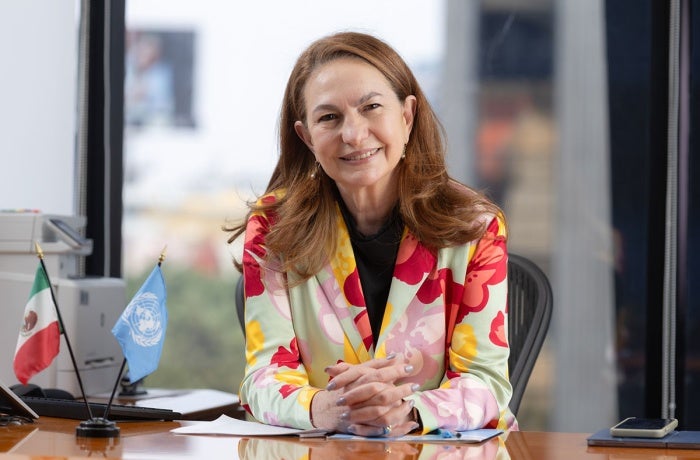
“The right to care is a human right… A comprehensive care system is a human right. We need to highlight this, we need it to become visible,” said UN Women Regional Director for Latin America and the Caribbean, María Noel Vaeza.

The Government of Mexico through its National Institute of Women (INMUJERES) and UN Women co-convene the Alliance.

“Today, on International Human Rights Day, it is necessary to make visible the double dimension of the concept of care: care is at the same time a right that people should have access to, but also the act of caring is a key function for the reproduction of society,” said President of INMUJERES, Nadine Gasman, welcoming attendees gathered both virtually and in-person in Mexico City for the event on “The Right to Care”. 

“The Global Alliance for Care is conceived as a space where it is recognized that it is possible to work, co-create and advance collectively to put the implementation of the global feminist care agenda at the centre, where the contributions of its 52 members are equally valuable”.

The Alliance was launched at the Generation Equality Forum as a collective commitment of the Action Coalition on Economic Justice and Rights.

Together, its 52 members from diverse sectors are working across key focus areas, including advocacy, multilateralism and international cooperation; knowledge promotion and data generation; and communication, to transform the care economy for the economic empowerment of women and girls.

COVID-19 and the care crisis

The COVID-19 pandemic pushed the already fragile global care economy into crisis mode.

Before the pandemic, women spent approximately three times more time than men on unpaid care and domestic work, globally. UN Women research shows this time burden increased during the pandemic. On average, women now spend nearly as much time doing unpaid care work as a full-time paid job.

The overburdening of women and girls impedes their human rights. For example, “when a teenager or a girl becomes a care provider, this is an obstacle to her access to education,” explained Youth Activist, Elvira Pablo. “Care work is a key right because it opens the door to the fulfilment of other rights.”

Window of opportunity for the care economy

But the crisis also offers an opportunity to strengthen care policies and systems, say leaders of the Alliance. Increasing and implementing commitments to transform the care economy will accelerate an equitable economic recovery.

Six core commitments define the Alliances’ strategy to reshape the care agenda. These include promoting the generation of data and evidence on care; investing in social and physical care infrastructure; and fostering positive social norms through awareness campaigns.

By encouraging commitment and action in these areas, members of the Alliance aim to promote cultural transformation and guarantee the recognition, reduction and redistribution of care and domestic work, and remuneration and representation of care workers.

Scaling solutions

Speakers shared examples of innovative practices that protect the human rights of caregivers and recipients. These cases can be scaled up to care system solutions, explained Chairperson of the Huairou Commission, Violet Shivutse.

“For us as caregivers, scaling is how we are able to formalize the role of caregivers in decision making, in co-designing. Scaling for us is being aware of how we are going to put resources in the hands of caregivers,” outlined Shivutse.

Leaders urged new actors to join the Alliance and help realize the feminist care agenda by 2026.

More resources

  • Unpaid care work: Your daily load and why it matters
  • COVID-19 and the care economy: Immediate action and structural transformation for a gender-responsive recovery
  • Whose time to care: Unpaid care and domestic work during COVID-19

Topics

  • Economic empowerment
  • Unpaid work
  • COVID-19
  • Human rights
  • Latin America and the Caribbean
  • Mexico

Related content

Image
Image placeholder with UN Women logo (English) - 3:2 aspect ratio
Press briefing

Press briefing at the United Nations by UN Women Special Representative in Afghanistan, Susan Ferguson

14 August 2026
Press briefing at the United Nations by UN Women Special Representative in Afghanistan, Susan Ferguson
Image
A portrait of an Afghan woman in silhouette
Press release

Five years after the Taliban takeover: the normalization of the exclusion of women and girls in Afghanistan

12 August 2026
Five years after the Taliban takeover: the normalization of the exclusion of women and girls in Afghanistan
Image
A woman stands amid a crowd of people and motorcycles on a busy street.
Feature

How aid cuts are threatening women’s organizations responding to Haiti’s gang violence

6 August 2026
How aid cuts are threatening women’s organizations responding to Haiti’s gang violence

Footer menu-HQ

  • News and stories
  • Resources
  • What we do
  • How we work
  • Where we are
  • Partnerships
  • Employment
  • Procurement
  • Contact us
  • Executive Board
  • Commission on the Status of Women

Donate button menu [Footer tablet]

  • Donate

Donate button menu [Footer]

  • Donate

Social media menu

  • Facebook
  • Twitter
  • LinkedIn
  • Flickr
  • YouTube
  • Instagram
UN Women - For all women and girls

Footer bottom [Menu]

  • Copyright
  • Information security
  • Privacy notice
  • Report wrongdoing
  • Terms of use
Share this page
  • Share to Facebook
  • Share to Twitter
  • Share to LinkedIn
  • Share to E-mail

Or copy link