
Universal menu

  • Global
  • Regions
    • Africa
    • Americas and the Caribbean
    • Arab States
    • Asia and the Pacific
    • Europe and Central Asia
  • Knowledge
  • Data
  • Training
  • Transparency
UN Women - For all women and girls

Main Navigation-HQ

  • Who we are
    • About us
      • About UN Women
      • Business model
      • Guiding documents
      • Worldwide presence
    • Leadership
      • Governance structure
      • Executive leadership
      • Executive Board
      • Accountability
    • Work with us
      • Employment
      • Procurement
      • Calls for proposals
      • Contact us
      • UN Women Strategic Plan 2026–2029
      • UN Women Strategic Plan 2026–2029 - social media image
        UN Women Strategic Plan 2026–2029
  • What we do
    • Focus areas
      • Ending violence against women
      • Peace and security
      • Humanitarian action
      • Leadership and governance
      • Economic empowerment
      • Innovation and technology
      • Women with disabilities
      • Youth
      • HIV and AIDS
    • How we work
      • 2030 Agenda for Sustainable Development
      • Commission on the Status of Women
      • Gender parity in the UN system
      • Intergovernmental support
      • Partnerships
      • Research and data
      • Training Centre
      • Trust funds
      • UN system coordination
      • Gender Equality Accelerators
      • Gender Equality Accelerators artwork
        Gender Equality Accelerators
  • News and stories
    • Latest
      • News
      • Articles and explainers
      • In focus
    • Media center
      • Press materials
      • Media contacts
      • Explainer: Why are women so exhausted? Care work and the mental load
      • Two adults stand at a table changing diapers on baby dolls, with laundry hanging on a clothesline behind them in a home setting.
        Explainer: Why are women so exhausted? Care work and the mental load
      • Press release: Aid cuts dismantle women’s organizations working in humanitarian crises
      • A young Ugandan woman sits with another local woman to talk
        Press release: Aid cuts dismantle women’s organizations working in humanitarian crises
  • Digital library
    • Resources
      • Publications
      • Annual reports
      • Progress of the world’s women
      • World survey on the role of women in development
      • The gender snapshot
    • GenderTerm
      • GenderTerm
      • Reprint permissions
      • UN Women Highlights 2025–2026
      • A smiling woman.
        UN Women Highlights 2025–2026
      • The gender snapshot 2025
      • gender snapshot thumbnail transparent
        The gender snapshot 2025
  • Get involved
    • How to get involved
      • For ALL Women and Girls
      • International Women's Day
      • 16 Days of Activism to End Violence against Women and Girls
      • UNiTE! Campaign to End Violence against Women
      • Generation Equality
      • He for She
Ask AI
https://84e5cfacd5c7e99f9825edf344450c.1b.environment.api.powerplatform.com/powervirtualagents/botsbyschema/crad4_websiteQA/directline/token?api-version=2022-03-01-preview
1
-
Ask your question here
AI website assistant

Hello, how can I assist you?

AI chatbot responses may be incorrect. Always verify important information.

Donate button menu

Donate

Breadcrumb

  1. Home
  2. Explore Our Latest News
  3. Explore Our Latest News

Website survey

We want to know how we can improve your experience on this website. Completing this survey takes less than 5 minutes.

TAKE THE SURVEY
Statement

Statement by principals of the Inter-Agency Standing Committee on the Democratic Republic of the Congo – Crushing levels of violence, displacement fuel unprecedented civilian suffering

30 April 2024
Inter-Agency Standing Committee
  • Share to Facebook
  • Share to Twitter
  • Share to LinkedIn
  • Share to E-mail

[PDF version]

New York/Geneva/Rome/Washington — Escalating conflict is driving record levels of gender-based violence, displacement and hunger in the eastern part of the Democratic Republic of the Congo (DRC), threatening to push the country to the brink of catastrophe without urgent international action.

Decades of conflict and the resulting humanitarian emergency have already exhausted and traumatized millions of civilians. In the last few months alone, more than 700,000 people have been forced to flee their homes, bringing the total number of displaced people to an all-time high of 7.2 million.
Image
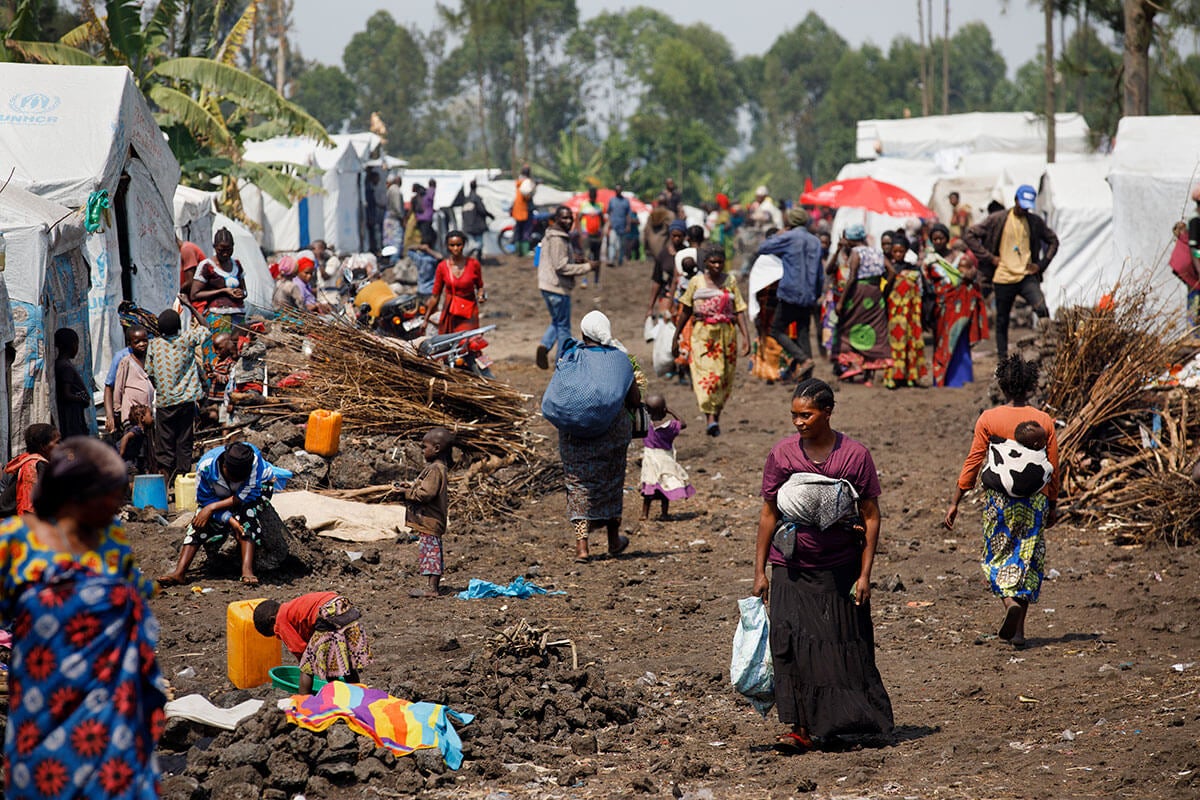
In the Democratic Republic of Congo, a woman walks through Rusayo camp for internally displaced people in August 2023. Located outside of Goma, the camp emerged as a shelter for people taking refuge from violence and, according to the World Food Programme, has grown from housing 45,000 people in January 2023 to 95,000 people by February 2024. Photo: UN Women/Ryan Brown.

Ensuring that sufficient aid reaches civilians in need swiftly and without impediment is critical. But this year’s Humanitarian Response Plan is woefully underfunded, with just 16 per cent of the USD 2.6 billion needed having been received. The gap between rapidly rising needs and sufficient resources means millions of people are left without the lifesaving support they need.

This lack of resources is compounding the crisis by forcing humanitarian organizations to curb their assistance, with women and girls paying a devastatingly high price. Minimal protection and security in crowded displacement camps means many are forced to exchange sex for survival and support for their families. When they venture outside to collect firewood, water or for work, they are also exposed to appalling levels of sexual violence.

Gender-based violence has surged to unprecedented levels, with recorded cases surging between 2022 and 2023. Stigma and the fear of retaliation prevent many survivors from coming forward. In addition to sexual violence, children are also at risk of other threats, including abduction, killing, maiming and recruitment by armed groups.

Perpetrators of human rights violations must be held accountable for their crimes. Under international humanitarian law, civilians must be protected.

More than 25 million people—a quarter of the population—continue to face crisis or emergency levels of food insecurity in the DRC, a country facing one of the world’s largest food crises. Cholera and measles are also spreading rapidly as the health sector continues to deteriorate. Climate extremes worsened by El Niño are yet another threat for already struggling families.

Bringing an end to the escalating humanitarian crisis in the DRC requires addressing its root causes: conflict, the exploitation of natural resources, illicit financial flows, prevailing gender inequality and development deficits.

We must step up our support to the Congolese people, including to women and girls who are bearing the brunt of this conflict, as they work to rebuild their lives and livelihoods and return to their homes. The international community must mobilize additional resources for the humanitarian response and support for civil society organizations—as well as the political will to end the violence once and for all.

Signatories:

  • Martin Griffiths, Emergency Relief Coordinator and Under-Secretary-General for Humanitarian Affairs (OCHA)
  • Sofia Sprechmann Sineiro, Secretary General, CARE International
  • Qu Dongyu, Director-General, Food and Agriculture Organization (FAO)
  • Nimo Hassan, Chair, International Council of Voluntary Agencies (ICVA)
  • Jamie Munn, Executive Director, International Council of Voluntary Agencies (ICVA)
  • Amy E. Pope, Director General, International Organization for Migration (IOM)
  • Tom Hart, President and Chief Executive Officer, InterAction
  • Tjada D'Oyen McKenna, Chief Executive Officer, Mercy Corps
  • Volker Türk, United Nations High Commissioner for Human Rights (OHCHR)
  • Paula Gaviria Betancur, United Nations Special Rapporteur on the Human Rights of Internally Displaced Persons (SR on HR of IDPs)
  • Achim Steiner, Administrator, United Nations Development Programme (UNDP)
  • Janti Soeripto, President and Chief Executive Officer, Save the Children
  • Michal Mlynár, Executive Director a.i., United Nations Human Settlement Programme (UN-Habitat)
  • Filippo Grandi, United Nations High Commissioner for Refugees (UNHCR)
  • Natalia Kanem, Executive Director, United Nations Population Fund (UNFPA)
  • Catherine Russell, Executive Director, UN Children’s Fund (UNICEF)
  • Sima Bahous, Under-Secretary-General and Executive Director, UN Women
  • Cindy McCain, Executive Director, World Food Programme (WFP)
  • Tedros Adhanom Ghebreyesus, Director-General, World Health Organization (WHO)
  • Andrew Morley, President and the Chief Executive Officer, World Vision International

Reprinted from the website of the Inter-Agency Standing Committee (IASC). UN Under-Secretary-General and UN Women Executive Director Sima Bahous is a member of the IASC.

Topics

  • Ending violence against women and girls
  • Rape/sexual assault
  • Human rights
  • Humanitarian action
  • Peace and security
  • Conflict, war
  • Sexual violence in conflict
  • Africa
  • Congo, Democratic Republic of the

Related content

Image
A young woman poses for a portrait while wearing a UN Women vest
Feature

Serving through crisis: UN Women’s humanitarian workers on what keeps them going

17 August 2026
Serving through crisis: UN Women’s humanitarian workers on what keeps them going
Image
Image placeholder with UN Women logo (English) - 3:2 aspect ratio
Press briefing

Press briefing at the United Nations by UN Women Special Representative in Afghanistan, Susan Ferguson

14 August 2026
Press briefing at the United Nations by UN Women Special Representative in Afghanistan, Susan Ferguson
Image
A portrait of an Afghan woman in silhouette
Press release

Five years after the Taliban takeover: the normalization of the exclusion of women and girls in Afghanistan

12 August 2026
Five years after the Taliban takeover: the normalization of the exclusion of women and girls in Afghanistan

Footer menu-HQ

  • News and stories
  • Resources
  • What we do
  • How we work
  • Where we are
  • Partnerships
  • Employment
  • Procurement
  • Contact us
  • Executive Board
  • Commission on the Status of Women

Donate button menu [Footer tablet]

  • Donate

Donate button menu [Footer]

  • Donate

Social media menu

  • Facebook
  • Twitter
  • LinkedIn
  • Flickr
  • YouTube
  • Instagram
UN Women - For all women and girls

Footer bottom [Menu]

  • Copyright
  • Information security
  • Privacy notice
  • Report wrongdoing
  • Terms of use
Share this page
  • Share to Facebook
  • Share to Twitter
  • Share to LinkedIn
  • Share to E-mail

Or copy link