Universal menu

  • Global
  • Regions
    • Africa
    • Americas and the Caribbean
    • Arab States
    • Asia and the Pacific
    • Europe and Central Asia
  • Knowledge
  • Data
  • Training
  • Transparency
UN Women - For all women and girls

Main Navigation-HQ

  • Who we are
    • About us
      • About UN Women
      • Business model
      • Guiding documents
      • Worldwide presence
    • Leadership
      • Governance structure
      • Executive leadership
      • Executive Board
      • Accountability
    • Work with us
      • Employment
      • Procurement
      • Calls for proposals
      • Contact us
      • UN Women Strategic Plan 2026–2029
      • UN Women Strategic Plan 2026–2029 - social media image
        UN Women Strategic Plan 2026–2029
  • What we do
    • Focus areas
      • Ending violence against women
      • Peace and security
      • Humanitarian action
      • Leadership and governance
      • Economic empowerment
      • Innovation and technology
      • Women with disabilities
      • Youth
      • HIV and AIDS
    • How we work
      • 2030 Agenda for Sustainable Development
      • Commission on the Status of Women
      • Gender parity in the UN system
      • Intergovernmental support
      • Partnerships
      • Research and data
      • Training Centre
      • Trust funds
      • UN system coordination
      • Gender Equality Accelerators
      • Gender Equality Accelerators artwork
        Gender Equality Accelerators
  • News and stories
    • Latest
      • News
      • Articles and explainers
      • In focus
    • Media center
      • Press materials
      • Media contacts
      • Explainer: Why are women so exhausted? Care work and the mental load
      • Two adults stand at a table changing diapers on baby dolls, with laundry hanging on a clothesline behind them in a home setting.
        Explainer: Why are women so exhausted? Care work and the mental load
      • Press release: Aid cuts dismantle women’s organizations working in humanitarian crises
      • A young Ugandan woman sits with another local woman to talk
        Press release: Aid cuts dismantle women’s organizations working in humanitarian crises
  • Digital library
    • Resources
      • Publications
      • Annual reports
      • Progress of the world’s women
      • World survey on the role of women in development
      • The gender snapshot
    • GenderTerm
      • GenderTerm
      • Reprint permissions
      • UN Women Highlights 2025–2026
      • A smiling woman.
        UN Women Highlights 2025–2026
      • The gender snapshot 2025
      • gender snapshot thumbnail transparent
        The gender snapshot 2025
  • Get involved
    • How to get involved
      • For ALL Women and Girls
      • International Women's Day
      • 16 Days of Activism to End Violence against Women and Girls
      • UNiTE! Campaign to End Violence against Women
      • Generation Equality
      • He for She
Ask AI
https://84e5cfacd5c7e99f9825edf344450c.1b.environment.api.powerplatform.com/powervirtualagents/botsbyschema/crad4_websiteQA/directline/token?api-version=2022-03-01-preview
1
-
Ask your question here
AI website assistant

Hello, how can I assist you?

AI chatbot responses may be incorrect. Always verify important information.

Donate button menu

Donate

Breadcrumb

  1. Home
  2. Publications

Website survey

We want to know how we can improve your experience on this website. Completing this survey takes less than 5 minutes.

TAKE THE SURVEY
Image
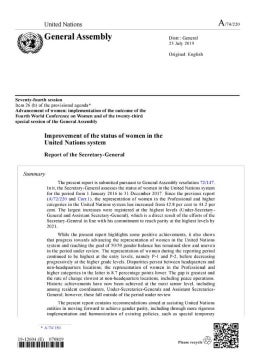
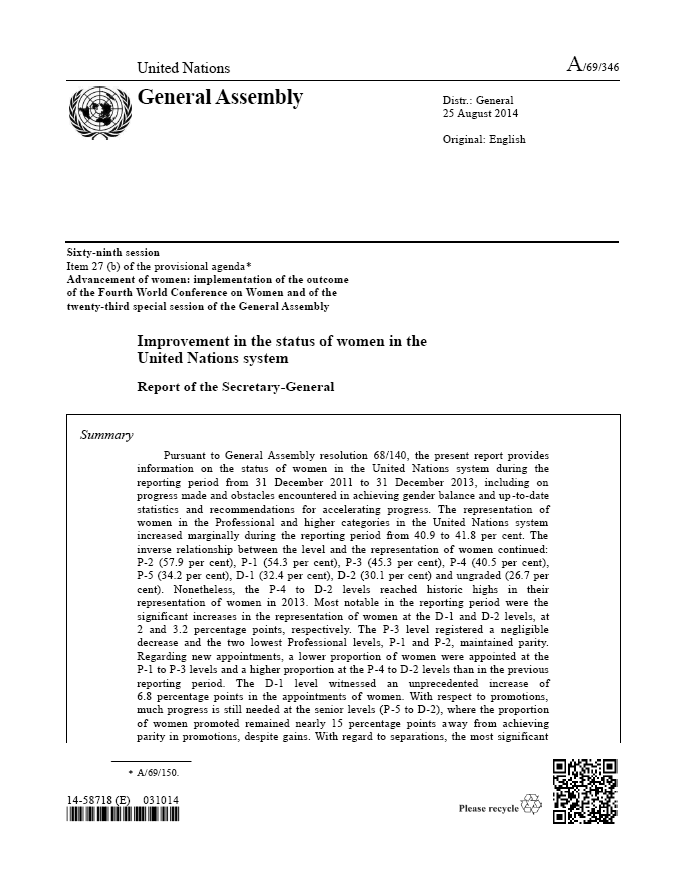
Improvement in the status of women in the United Nations system: Report of the Secretary-General (2014)

Improvement in the status of women in the United Nations system: Report of the Secretary-General (2014)

Publication year 2014
  • Share to Facebook
  • Share to Twitter
  • Share to LinkedIn
  • Share to E-mail

Pursuant to General Assembly resolution 68/140, this report (A/69/346) provides information on the status of women in the United Nations system during the reporting period from 31 December 2011 to 31 December 2013, including on progress made and obstacles encountered in achieving gender balance and up-to-date statistics and recommendations for accelerating progress.

The representation of women in the Professional and higher categories in the United Nations system increased marginally during the reporting period from 40.9 to 41.8 per cent. The inverse relationship between the level and the representation of women continued: P-2 (57.9 per cent), P-1 (54.3 per cent), P-3 (45.3 per cent), P-4 (40.5 per cent),P-5 (34.2 per cent), D-1 (32.4 per cent), D-2 (30.1 per cent) and ungraded (26.7 per cent). Nonetheless, the P-4 to D-2 levels reached historic highs in their representation of women in 2013. Most notable in the reporting period were the significant increases in the representation of women at the D-1 and D-2 levels, at
2 and 3.2 percentage points, respectively. The P-3 level registered a negligible decrease and the two lowest Professional levels, P-1 and P-2, maintained parity.

Regarding new appointments, a lower proportion of women were appointed at the P-1 to P-3 levels and a higher proportion at the P-4 to D-2 levels than in the previous reporting period. The D-1 level witnessed an unprecedented increase of 6.8 percentage points in the appointments of women. With respect to promotions, much progress is still needed at the senior levels (P-5 to D-2), where the proportion of women promoted remained nearly 15 percentage points away from achieving parity in promotions, despite gains. With regard to separations, the most significant gender disparity was in the higher separation of women in non-headquarters locations compared with headquarters.

The Secretariat, the largest entity of the United Nations system, distinguished itself during the current reporting period by attaining its highest representation of women to date at the P-2 to D-1 levels: P-2 (55.8 per cent), P-3 (43.4 per cent), P-4 (39.2 per cent), P-5 (31.7 per cent) and D-1 (30.2 per cent). However, the most senior levels continued to register the lowest representation of women: D-2 (26.9 per cent) and ungraded (24.6 per cent). Notably, the representation of women in 2013 at the D-2 level approximates to that of a decade ago (26.8 per cent).

The continuing challenge for the United Nations system, including the Secretariat, is to reverse the inverse relationship between seniority and the representation of women, which points to the need to target each level. In that respect, 50 per cent of the entities surveyed by the United Nations Entity for Gender Equality and the Empowerment of Women (UN-Women) on impediments to achieving gender balance cited a “lack of special measures for appointments and promotions” among their top three choices.

Recommendations to address those challenges include: the need for more intensive sponsorship by senior leaders; more rigorous promulgation and implementation of existing policies, including special measures for women and flexible working arrangements; enhanced monitoring and accountability; career development for female staff members, accompanied by targeted outreach; and harmonization and unification of gender-related policies, as part of the development and implementation of the United Nations System-wide Action Plan for Gender Equality and the Empowerment of Women, led by UN-Women. Approved by the United Nations Chief Executives Board in 2012, it is the first unified gender accountability framework of the United Nations system and establishes 15 standards, 3 of which pertain to the status of women and their equal representation in the United Nations system, to be achieved by 2017.
View online/download

  • Report [ ar | en | es | fr | ru | zh ]
  • Annexes — download all in a ZIP archive or individually below:
    • Annex I: Gender distribution of staff by nationality at the P-1 to UG levels of the United Nations system, on contracts of one year or more, at all locations, as at 31 December 2013
    • Annex II: Projections on attainment of parity at the P-1 to UG levels of the United Nations system, on contracts of one year or more and at all locations, based on average annual increment between31 December 2003 and 31 December 2013
    • Annex III: Projections on attainment of parity at the P-1 to UG levels of the United Nations Secretariat, on contracts of one year or more and at all locations, based on average annual increment between 31 December 2003 and 31 December 2013
    • Annex IV: Gender distribution of staff at the P-1 to UG levels, on contracts of one year or more, at Headquarters and non-Headquarters locations in the United Nations system, by entity, as of 31December 2013
    • Annex V: Gender distribution of staff at the P-1 to UG levels, on contracts of one year or more, at Headquarters and non-Headquarters locations in the United Nations Secretariat, by department, as of 31 December 2013
    • Annex VI: Representation of women at each stage of the staff selection process in the United Nations system, from 1 January 2012 to 31 December 2013
    • Annex VII: Gender distribution of appointments at the P-1 to UG levels, on contracts of one year or more, at Headquarters and non-Headquarters locations in the United Nations system, by entity, from 1 January 2012 to 31 December 2013
    • Annex VIII: Gender distribution of promotions at the P-1 to D-2 levels, on contracts of one year or more, at Headquarters and non-Headquarters locations in the United Nations system, by entity, from 1 January 2012 to 31 December 2013
    • Annex IX: Gender distribution of separations at the P-1 to UG levels, on contracts of one year or more, at Headquarters and non-Headquarters locations in the United Nations system, by entity, from 1 January 2012 to 31 December 2013
    • Annex X: Gender distribution of separations by reason, at the P-1 to UG levels, for contracts of one year or more, at all locations in the United Nations system, from 1 January 2012 to 31December 2013
    • Annex XI: Status of women in the Department of Peacekeeping Operations and Department of Field Support (DPKO/DFS)
    • Annex XII: Significance of Beijing+20 for the attainment of gender parity

Bibliographic information

Number of pages
63 + annexes
Resource type(s)
Institutional reports
Publishing entities
United Nations Entity for Gender Equality and the Empowerment of Women (UN Women)
UN Women office publishing
UN Women Headquarters Office
Governing body/ies
UN General Assembly (UNGA)

Tags

Accountability in the UN system Gender equality and women’s empowerment Gender mainstreaming Monitoring, evaluation and reporting UN system coordination Women in the UN system

Related publications

Improvement in the status of women in the United Nations system: Report of the Secretary-General (2025)

Improvement in the status of women in the United Nations system: Report of the Secretary-General (2025)

25 July 2025
Improvement in the status of women in the United Nations system: Report of the Secretary-General (2025)
Improvement in the status of women in the United Nations system: Report of the Secretary-General (2023)

Improvement in the status of women in the United Nations system: Report of the Secretary-General (2023)

18 July 2023
Improvement in the status of women in the United Nations system 2023
Improvement in the status of women in the United Nations system: Report of the Secretary-General (2021)

Improvement in the status of women in the United Nations system: Report of the Secretary-General (2021)

1 July 2021
Improvement in the status of women in the United Nations system: Report of the Secretary-General (2021)

Footer menu-HQ

  • News and stories
  • Resources
  • What we do
  • How we work
  • Where we are
  • Partnerships
  • Employment
  • Procurement
  • Contact us
  • Executive Board
  • Commission on the Status of Women

Donate button menu [Footer tablet]

  • Donate

Donate button menu [Footer]

  • Donate

Social media menu

  • Facebook
  • Twitter
  • LinkedIn
  • Flickr
  • YouTube
  • Instagram
UN Women - For all women and girls

Footer bottom [Menu]

  • Copyright
  • Information security
  • Privacy notice
  • Report wrongdoing
  • Terms of use
Share this page
  • Share to Facebook
  • Share to Twitter
  • Share to LinkedIn
  • Share to E-mail

Or copy link