Universal menu

  • Global
  • Regions
    • Africa
    • Americas and the Caribbean
    • Arab States
    • Asia and the Pacific
    • Europe and Central Asia
  • Knowledge
  • Data
  • Training
  • Transparency
UN Women - For all women and girls

Main Navigation-HQ

  • Who we are
    • About us
      • About UN Women
      • Business model
      • Guiding documents
      • Worldwide presence
    • Leadership
      • Governance structure
      • Executive leadership
      • Executive Board
      • Accountability
    • Work with us
      • Employment
      • Procurement
      • Calls for proposals
      • Contact us
      • UN Women Strategic Plan 2026–2029
      • UN Women Strategic Plan 2026–2029 - social media image
        UN Women Strategic Plan 2026–2029
  • What we do
    • Focus areas
      • Ending violence against women
      • Peace and security
      • Humanitarian action
      • Leadership and governance
      • Economic empowerment
      • Innovation and technology
      • Women with disabilities
      • Youth
      • HIV and AIDS
    • How we work
      • 2030 Agenda for Sustainable Development
      • Commission on the Status of Women
      • Gender parity in the UN system
      • Intergovernmental support
      • Partnerships
      • Research and data
      • Training Centre
      • Trust funds
      • UN system coordination
      • Gender Equality Accelerators
      • Gender Equality Accelerators artwork
        Gender Equality Accelerators
  • News and stories
    • Latest
      • News
      • Articles and explainers
      • In focus
    • Media center
      • Press materials
      • Media contacts
      • Explainer: Why are women so exhausted? Care work and the mental load
      • Two adults stand at a table changing diapers on baby dolls, with laundry hanging on a clothesline behind them in a home setting.
        Explainer: Why are women so exhausted? Care work and the mental load
      • Press release: Aid cuts dismantle women’s organizations working in humanitarian crises
      • A young Ugandan woman sits with another local woman to talk
        Press release: Aid cuts dismantle women’s organizations working in humanitarian crises
  • Digital library
    • Resources
      • Publications
      • Annual reports
      • Progress of the world’s women
      • World survey on the role of women in development
      • The gender snapshot
    • GenderTerm
      • GenderTerm
      • Reprint permissions
      • UN Women Highlights 2025–2026
      • A smiling woman.
        UN Women Highlights 2025–2026
      • The gender snapshot 2025
      • gender snapshot thumbnail transparent
        The gender snapshot 2025
  • Get involved
    • How to get involved
      • For ALL Women and Girls
      • International Women's Day
      • 16 Days of Activism to End Violence against Women and Girls
      • UNiTE! Campaign to End Violence against Women
      • Generation Equality
      • He for She
Ask AI
https://84e5cfacd5c7e99f9825edf344450c.1b.environment.api.powerplatform.com/powervirtualagents/botsbyschema/crad4_websiteQA/directline/token?api-version=2022-03-01-preview
1
-
Ask your question here
AI website assistant

Hello, how can I assist you?

AI chatbot responses may be incorrect. Always verify important information.

Donate button menu

Donate

Breadcrumb

  1. Home
  2. Explore Our Latest News
  3. Explore Our Latest News

Website survey

We want to know how we can improve your experience on this website. Completing this survey takes less than 5 minutes.

TAKE THE SURVEY
Feature

Women in Sudan seek relief amid spiraling displacement crisis

8 January 2024
  • Share to Facebook
  • Share to Twitter
  • Share to LinkedIn
  • Share to E-mail

In the village of Jabait, in eastern Sudan, one can see hundreds of women waiting for aid at the office of the Women and Children Development Association.

Some of the women at the WCDA office are locals from Jabait, while others have arrived from throughout the country. Nine months after conflict erupted between the Sudanese Armed Forces (SAF) and the Rapid Support Forces (RSF), more than 7.3 million people have fled their homes, with children representing about half of the people displaced. The WCDA and other local women’s group are working on the frontlines to respond to the crisis. 
Image
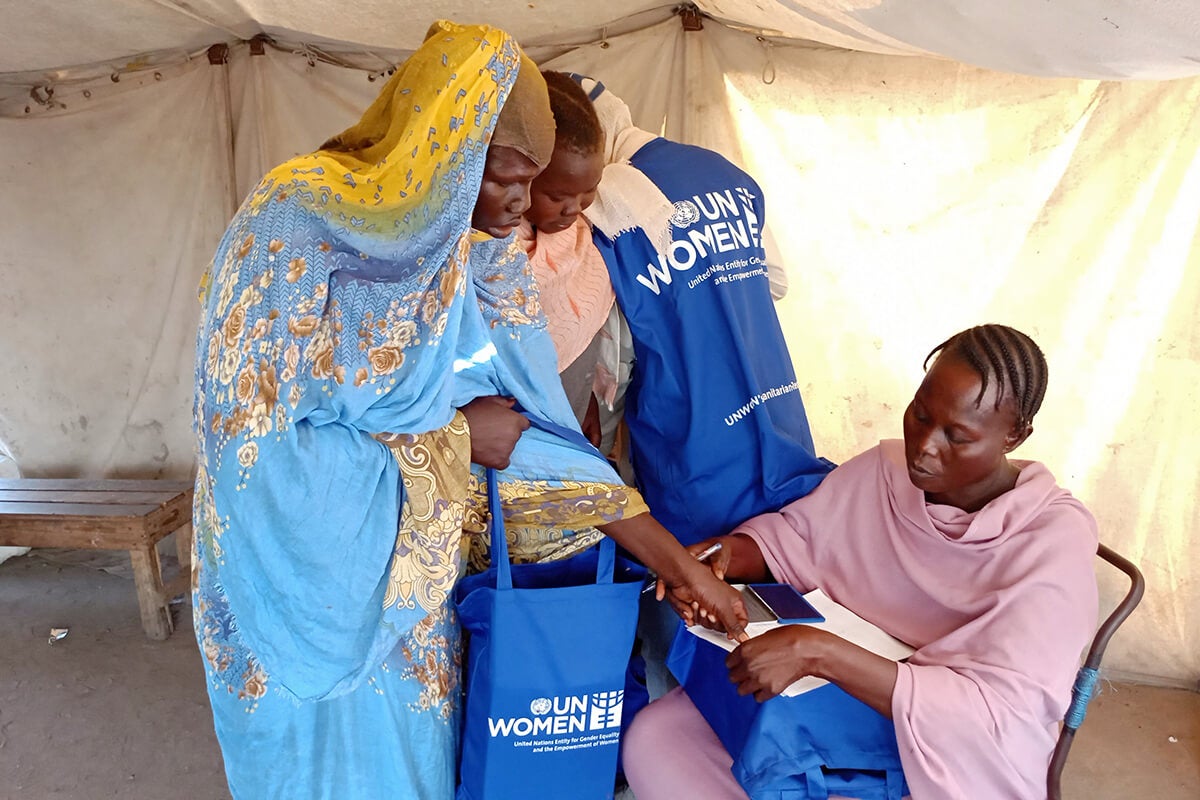
Internally displaced women are seen receiving hygiene kits from a volunteer at a shelter in Port Sudan.
Internally displaced women are seen receiving hygiene kits from a volunteer at a shelter in Port Sudan. Photo: Awoon Organization.

“I fled the town with my mother, my sister, and my little son after the town was attacked by RSF and there was fighting”, said Manal Adam Yousif, a young woman in her twenties from the town of Nyala, in South Darfur state. 

“We left my husband and little brothers behind”, she said through tears. “We travelled overland for two days until we reached the town of El Daein in South Darfur. I felt very ill there because I had recently given birth by caesarean surgery.”

Yousif and her family stayed in El Daein for about three months to recuperate, but as life there became more difficult, they were forced to move again, first to the eastern city of Port Sudan and then to Jabait. She is travelling with her newborn son, whom she continues to breastfeed. From the relative safety of Jabait, Yousif remains deeply concerned for the wellbeing of her family, including her sister who returned to Nyala to convince their brothers to join them.

“My last contact with her was two months ago and I do not know anything about her or my husband”, she said. “We received news that two of my cousins had been killed after a grenade fell in their house. My neighbour was also killed, and her daughter’s hand was cut off.”

“Unfortunately, our house and all other houses in the neighbourhoods were robbed. So, I am very afraid for the rest of my family”, Yousif said.

Sudan has the largest number of displaced people in the world, including the world’s biggest child displacement crisis. Through a partnership with UN Women, the WCDA has supplied Yousif and other displaced women and children with hygiene kits, water, household items, and other forms of humanitarian aid. Yousif said the aid has gone a long way in making their lives a little better, but they still lack many essentials.

“We just fled with the clothes we are wearing...winter brings many diseases”, she said, saying that her son and many other children were ill. “I do not have the money to take him to the hospital…I hope the war will stop and there will be safety and stability so that we can return to our homes and families.”
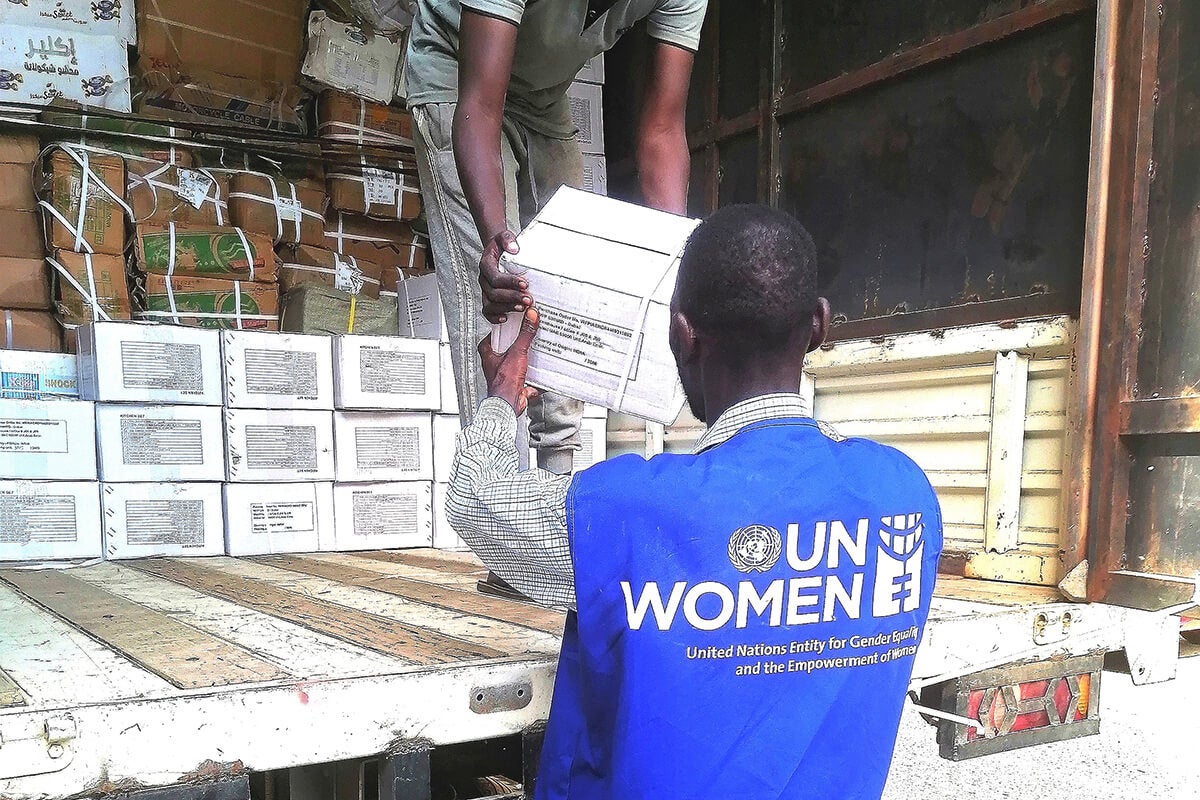
Image
UN Women staff load humanitarian supplies to be distributed to women in Sudan.
UN Women staff load humanitarian supplies to be distributed to women in Sudan. Photo: Muna Elsadaty.

Asmaa Hassan Ali also fled from Darfur, arriving in Port Sudan with some of her relatives including her two daughters, but laments those she was forced to leave behind. She is staying at the Mohamed Shaybah shelter, which hosts services provided by UN Women.

“We were given hygiene kits from the organization, and that was one of the few moments when I felt temporary happiness”, she said. “My daughters and I desperately need these personal and necessary things for us as women.”

Nevertheless, Ali lamented how she struggled to provide her daughters with “the most basic personal needs”.

UN Women has partnered with five major women’s organizations implementing an emergency humanitarian plan in Sudan, in collaboration with local women’s groups. Between 15 April and 15 November 2023, 163 local humanitarian partners provided about 4.9 million people across Sudan with life-saving assistance, and 5.7 million people received agricultural and livelihood support. In one project, UN Women has worked with the Red Sea State Emergency Room to deliver aid to those most in need.

“One thousand hygiene kits were distributed to the internally displaced women during the month of December”, said Samira Muhammad Suleiman, a volunteer lawyer with the Women Awareness Raising ‘Awoon’ group, which works with the emergency room programme. “The women are in dire need of these items due to the sensitivity and specificity of the situation”.

While aid has reached millions, the situation remains dire. Insecurity, looting, bureaucratic impediments, poor phone connectivity, lack of cash, and limited technical and humanitarian staff are some of the various challenges affecting the delivery of humanitarian assistance. Fuel and power shortages also affect the movement of humanitarian staff and supplies.

At the Mohamed Shaybah shelter, after reflecting on how much she still needed further aid to live safely with her daughters, Ali added, “but above all, how much I want this war to end so that we can return safely to our homes and families”.

Names have been changed in this article to ensure the safety of the women featured.

Topics

  • Humanitarian action
  • Crisis response and recovery
  • Peace and security
  • Conflict, war
  • Africa
  • Sudan

Related content

Image
A woman looks out at rubble from inside a ruined building.
Press release

Women head one in four households in Gaza as war tears families apart and reshapes household structures

8 September 2026
Women head one in four households in Gaza as war tears families apart and reshapes household structures
Image
UNWomen_Placeholder
Press briefing

Killing of Palestinians in Gaza has been so widespread that women now head one in four households, double the pre-October 2023 rate

8 September 2026
Killing of Palestinians in Gaza has been so widespread that women now head one in four households, double the pre-October 2023 rate
Image
 A woman sits amid the ruins of a building.
Feature

No homes and no support: The women in Gaza trying to rebuild their lives

8 September 2026
No homes and no support: The women in Gaza trying to rebuild their lives

Footer menu-HQ

  • News and stories
  • Resources
  • What we do
  • How we work
  • Where we are
  • Partnerships
  • Employment
  • Procurement
  • Contact us
  • Executive Board
  • Commission on the Status of Women

Donate button menu [Footer tablet]

  • Donate

Donate button menu [Footer]

  • Donate

Social media menu

  • Facebook
  • Twitter
  • LinkedIn
  • Flickr
  • YouTube
  • Instagram
UN Women - For all women and girls

Footer bottom [Menu]

  • Copyright
  • Information security
  • Privacy notice
  • Report wrongdoing
  • Terms of use
Share this page
  • Share to Facebook
  • Share to Twitter
  • Share to LinkedIn
  • Share to E-mail

Or copy link