Universal menu

  • Global
  • Regions
    • Africa
    • Americas and the Caribbean
    • Arab States
    • Asia and the Pacific
    • Europe and Central Asia
  • Knowledge
  • Data
  • Training
  • Transparency
UN Women - For all women and girls

Main Navigation-HQ

  • Who we are
    • About us
      • About UN Women
      • Business model
      • Guiding documents
      • Worldwide presence
    • Leadership
      • Governance structure
      • Executive leadership
      • Executive Board
      • Accountability
    • Work with us
      • Employment
      • Procurement
      • Calls for proposals
      • Contact us
      • UN Women Strategic Plan 2026–2029
      • UN Women Strategic Plan 2026–2029 - social media image
        UN Women Strategic Plan 2026–2029
  • What we do
    • Focus areas
      • Ending violence against women
      • Peace and security
      • Humanitarian action
      • Leadership and governance
      • Economic empowerment
      • Innovation and technology
      • Women with disabilities
      • Youth
      • HIV and AIDS
    • How we work
      • 2030 Agenda for Sustainable Development
      • Commission on the Status of Women
      • Gender parity in the UN system
      • Intergovernmental support
      • Partnerships
      • Research and data
      • Training Centre
      • Trust funds
      • UN system coordination
      • Gender Equality Accelerators
      • Gender Equality Accelerators artwork
        Gender Equality Accelerators
  • News and stories
    • Latest
      • News
      • Articles and explainers
      • In focus
    • Media center
      • Press materials
      • Media contacts
      • Explainer: Why are women so exhausted? Care work and the mental load
      • Two adults stand at a table changing diapers on baby dolls, with laundry hanging on a clothesline behind them in a home setting.
        Explainer: Why are women so exhausted? Care work and the mental load
      • Press release: Aid cuts dismantle women’s organizations working in humanitarian crises
      • A young Ugandan woman sits with another local woman to talk
        Press release: Aid cuts dismantle women’s organizations working in humanitarian crises
  • Digital library
    • Resources
      • Publications
      • Annual reports
      • Progress of the world’s women
      • World survey on the role of women in development
      • The gender snapshot
    • GenderTerm
      • GenderTerm
      • Reprint permissions
      • UN Women Highlights 2025–2026
      • A smiling woman.
        UN Women Highlights 2025–2026
      • The gender snapshot 2025
      • gender snapshot thumbnail transparent
        The gender snapshot 2025
  • Get involved
    • How to get involved
      • For ALL Women and Girls
      • International Women's Day
      • 16 Days of Activism to End Violence against Women and Girls
      • UNiTE! Campaign to End Violence against Women
      • Generation Equality
      • He for She
Ask AI
https://84e5cfacd5c7e99f9825edf344450c.1b.environment.api.powerplatform.com/powervirtualagents/botsbyschema/crad4_websiteQA/directline/token?api-version=2022-03-01-preview
1
-
Ask your question here
AI website assistant

Hello, how can I assist you?

AI chatbot responses may be incorrect. Always verify important information.

Donate button menu

Donate

Breadcrumb

  1. Home
  2. Resources
  3. Gender Snapshot

Website survey

We want to know how we can improve your experience on this website. Completing this survey takes less than 5 minutes.

TAKE THE SURVEY

Breadcrumb

  1. Home
  2. Resources
  3. Gender Snapshot
14 Total indicators
1
Gender-specific indicators
SDG 10 icon

SDG 10 – Reduced inequalities 

Only 1 per cent of countries have quotas for women with disabilities in local deliberative bodies. 

Income and social inequalities, reflecting and exacerbating stigma and discriminatory practices, disproportionately affect men and women with disabilities. Yet women and girls experience a double burden, confronting both gender and disability-based discrimination. For instance, in 14 countries or territories in Asia and the Pacific, women with disabilities hold only 6 per cent of positions in national coordination mechanisms on disability compared to 15 per cent occupied by men with disabilities. Women and girls with disabilities face challenges in reproductive health. Among those aged 15–49 who do not wish to become pregnant, only 46 per cent have their need for family planning met through modern contraception, compared to 77.6 per cent of all women aged 15-49. Women with disabilities are less than half as likely to use the Internet than women overall (26 and 65 per cent, respectively). They are not prioritized for representation in local deliberative bodies – only 1 per cent of countries have quotas for women with disabilities in local government.

Just 46%

of women and girls with disabilities have their family planning needs met compared to 77.6% of women who do not have any disability.


Read the report

Targeted policies and investments must address intersecting inequalities faced by women with disabilities across sectors and the life cycle. Essential measures include developing legislation to protect their rights, raising public awareness, guaranteeing their right to vote, ensuring access to health services and making public spaces accessible. In Tajikistan, for instance, during COVID-19, the National Association of Persons with Disabilities collaborated with the Ministry of Health to build rooms in local reproductive health centres that were accessible to women with disabilities. UN Women’s unique Women with Disabilities Stigma Survey, piloted in Moldova, Pakistan, Samoa and the State of Palestine, helps countries develop policy advocacy to reduce stigma and violence against women with disabilities, based on their perspectives and first-hand experiences.

Select SDG outcomes for women and girls by disability status, 2021 or latest available year (percentage)

Image
SDG 11 icon

SDG 11 – Sustainable cities and communities

Next

Related resources

18
The United Nations Inter-Agency Network on Women and Gender Equality (IANWGE) intersectionality-informed gender analysis toolkit

The United Nations Inter-Agency Network on Women and Gender Equality (IANWGE) intersectionality-informed gender analysis toolkit

28 July 2025
Publication cover.

Women belonging to communities discriminated against based on work and descent: Advancing intersectional rights and justice

16 July 2025
Measuring gender-based violence: Data collection and evidence on violence based on sexual orientation, gender identity, gender expression and sex characteristics

Measuring gender-based violence: Data collection and evidence on violence based on sexual orientation, gender identity, gender expression and sex characteristics

26 June 2025
Reflections on gender and disability inclusion in the implementation of the Beijing Platform for Action

Knowledge compendium: Reflections on gender and disability inclusion in the implementation of the Beijing Platform for Action

1 April 2025
30 years of Beijing Platform for Action: An intersectional approach to gender and disability inclusion

30 years of Beijing Platform for Action: An intersectional approach to gender and disability inclusion

1 April 2025
UN Women’s approach to disability inclusion and intersectionality

UN Women’s approach to disability inclusion and intersectionality

29 November 2023
Strengthening migration programming from a gender perspective: Lessons learned

Strengthening migration programming from a gender perspective: Lessons learned

27 June 2023
UN Women submission on electoral participation and sexual orientation and gender identity: To the UN Independent Expert on protection against violence and discrimination based on sexual orientation and gender identity

UN Women submission on electoral participation and sexual orientation and gender identity: To the UN Independent Expert on protection against violence and discrimination based on sexual orientation and gender identity

21 June 2024
From evidence to action: Tackling gender-based violence against migrant women and girls

From evidence to action: Tackling gender-based violence against migrant women and girls

13 October 2021
Developing a survey instrument on the situation of migrant women at the country level

Developing a survey instrument on the situation of migrant women at the country level

30 June 2023
Migration experiences of people with diverse SOGIESC

Migration experiences of people with diverse SOGIESC

8 December 2023
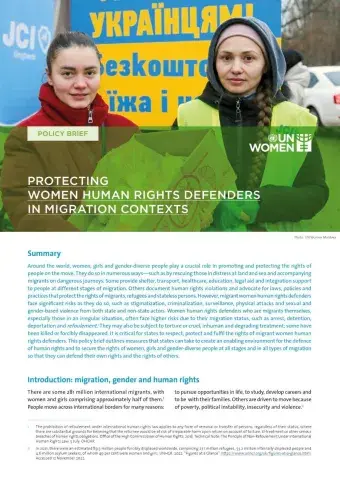
Policy brief: Protecting women human rights defenders in migration contexts

Protecting women human rights defenders in migration contexts

1 June 2023
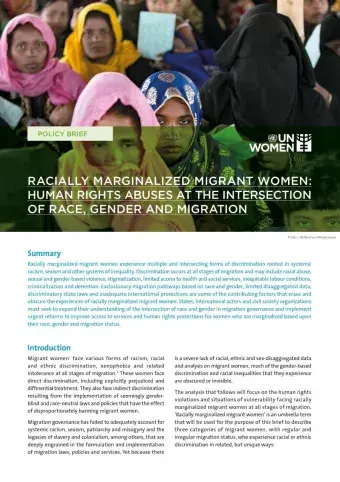
Racially marginalized migrant women: Human rights abuses at the intersection of race, gender, and migration

Racially marginalized migrant women: Human rights abuses at the intersection of race, gender, and migration

11 January 2022
Drawing on a selection of country experiences, this policy brief identifies emerging practices on gender and disability-inclusive budgeting.

Gender- and disability-inclusive budgeting: Issues and policy options

7 December 2023
Women with disabilities stigma inventory (WDSI)

Women with disabilities stigma inventory (WDSI)

31 August 2024
Disability inclusion markers

Disability inclusion markers

6 January 2022
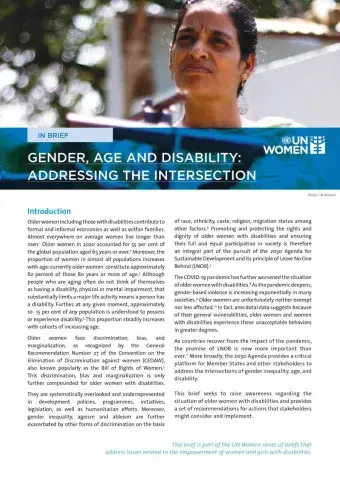
Gender, age, and disability: Addressing the intersection

Gender, age, and disability: Addressing the intersection

11 May 2022
LGBTIQ+ equality and rights: Internal resource guide

LGBTIQ+ equality and rights: Internal resource guide

1 June 2022

Footer menu-HQ

  • News and stories
  • Resources
  • What we do
  • How we work
  • Where we are
  • Partnerships
  • Employment
  • Procurement
  • Contact us
  • Executive Board
  • Commission on the Status of Women

Donate button menu [Footer tablet]

  • Donate

Donate button menu [Footer]

  • Donate

Social media menu

  • Facebook
  • Twitter
  • LinkedIn
  • Flickr
  • YouTube
  • Instagram
UN Women - For all women and girls

Footer bottom [Menu]

  • Copyright
  • Information security
  • Privacy notice
  • Report wrongdoing
  • Terms of use
Share this page
  • Share to Facebook
  • Share to Twitter
  • Share to LinkedIn
  • Share to E-mail

Or copy link