
Universal menu

  • Global
  • Regions
    • Africa
    • Americas and the Caribbean
    • Arab States
    • Asia and the Pacific
    • Europe and Central Asia
  • Knowledge
  • Data
  • Training
  • Transparency
UN Women - For all women and girls

Main Navigation-HQ

  • Who we are
    • About us
      • About UN Women
      • Business model
      • Guiding documents
      • Worldwide presence
    • Leadership
      • Governance structure
      • Executive leadership
      • Executive Board
      • Accountability
    • Work with us
      • Employment
      • Procurement
      • Calls for proposals
      • Contact us
      • UN Women Strategic Plan 2026–2029
      • UN Women Strategic Plan 2026–2029 - social media image
        UN Women Strategic Plan 2026–2029
  • What we do
    • Focus areas
      • Ending violence against women
      • Peace and security
      • Humanitarian action
      • Leadership and governance
      • Economic empowerment
      • Innovation and technology
      • Women with disabilities
      • Youth
      • HIV and AIDS
    • How we work
      • 2030 Agenda for Sustainable Development
      • Commission on the Status of Women
      • Gender parity in the UN system
      • Intergovernmental support
      • Partnerships
      • Research and data
      • Training Centre
      • Trust funds
      • UN system coordination
      • Gender Equality Accelerators
      • Gender Equality Accelerators artwork
        Gender Equality Accelerators
  • News and stories
    • Latest
      • News
      • Articles and explainers
      • In focus
    • Media center
      • Press materials
      • Media contacts
      • Explainer: Why are women so exhausted? Care work and the mental load
      • Two adults stand at a table changing diapers on baby dolls, with laundry hanging on a clothesline behind them in a home setting.
        Explainer: Why are women so exhausted? Care work and the mental load
      • Press release: Aid cuts dismantle women’s organizations working in humanitarian crises
      • A young Ugandan woman sits with another local woman to talk
        Press release: Aid cuts dismantle women’s organizations working in humanitarian crises
  • Digital library
    • Resources
      • Publications
      • Annual reports
      • Progress of the world’s women
      • World survey on the role of women in development
      • The gender snapshot
    • GenderTerm
      • GenderTerm
      • Reprint permissions
      • UN Women Highlights 2025–2026
      • A smiling woman.
        UN Women Highlights 2025–2026
      • The gender snapshot 2025
      • gender snapshot thumbnail transparent
        The gender snapshot 2025
  • Get involved
    • How to get involved
      • For ALL Women and Girls
      • International Women's Day
      • 16 Days of Activism to End Violence against Women and Girls
      • UNiTE! Campaign to End Violence against Women
      • Generation Equality
      • He for She
Ask AI
https://84e5cfacd5c7e99f9825edf344450c.1b.environment.api.powerplatform.com/powervirtualagents/botsbyschema/crad4_websiteQA/directline/token?api-version=2022-03-01-preview
1
-
Ask your question here
AI website assistant

Hello, how can I assist you?

AI chatbot responses may be incorrect. Always verify important information.

Donate button menu

Donate

Breadcrumb

  1. Home
  2. Explore Our Latest News
  3. Explore Our Latest News

Website survey

We want to know how we can improve your experience on this website. Completing this survey takes less than 5 minutes.

TAKE THE SURVEY
Impact story

Mainstreaming gender in climate change adaptation in Côte d'Ivoire and Ghana

3 July 2023
  • Share to Facebook
  • Share to Twitter
  • Share to LinkedIn
  • Share to E-mail

As the impacts of climate change intensify around the world, adaptation efforts are crucial to ensuring that communities, ecosystems and economies are able to survive. National Adaptation Plan (NAP) processes are a way for governments to direct resources to such efforts, focusing particularly on vulnerable sectors such as agriculture, water resources and infrastructure, and enhancing coordination and collaboration among different stakeholders involved in adaptation planning and implementation. 

But for adaptation efforts to truly be effective, they must consider the unique ways in which women and girls are impacted by climate change. Through its commitment to the Generation Equality Action Coalition on Feminist Action for Climate Justice, the International Institute for Sustainable Development (IISD) is working to ensure that such efforts provide equitable benefits for people of all genders. Through the NAP Global Network and working closely with government partners, IISD is advancing the implementation of its commitment by ensuring the integration of gender considerations in NAP processes, including in Côte d'Ivoire and Ghana.  
Image
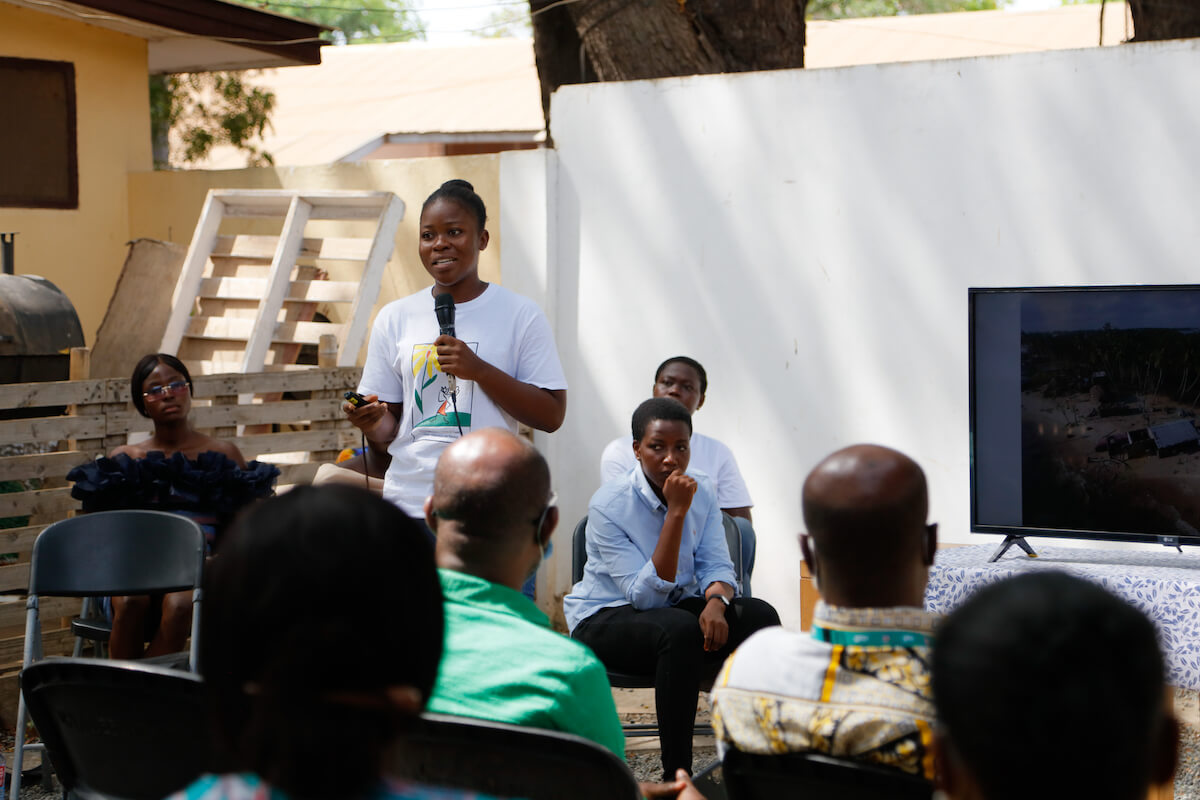
A participant of the Envisioning Resilience initiative in Ghana tells the story behind a photo she captured showing the impacts of climate change on her life. Photo: Dennis Nipah

A gender-responsive approach to adaptation planning is grounded in an understanding of how climate change disparately affects people of different genders—including their access to clean water, sanitation and job opportunities, their care and domestic burdens, and their role in the crisis response. 

To help capture the gendered impacts of climate change, the NAP Global Network worked with a group of young women in Ghana to build their skills in visual storytelling, partnering with social enterprise Lensational. “I feel inspired to document stories about women and how climate change is affecting them. From now to 2030, what is the change, what would be the effect?” said Emefa Toklo, a participant of the workshop. “I want women’s voices to be heard about how climate change is affecting their livelihoods, how they take care of their families, how they are being displaced. Because in Africa, it’s the women that hold the family”.  

The trainees’ stories were shared with adaptation decision makers at a national policy dialogue, and policymakers were moved by the accounts. Antwi-Boasiako Amoah, Acting Director (Climate Vulnerability and Adaptation), Environmental Protection Agency, Ghana, noted that "adding this element of empowering women to be part of this initiative is spectacular. We see a value in bringing on board women in adaptation planning, especially young girls, through telling stories to depict what climate change has meant for their lives."  

Learn more about Ghana’s efforts to amplify the voices of women on the frontlines of climate change in the NAP process: https://youtu.be/G1o9PLlWENY  
Image
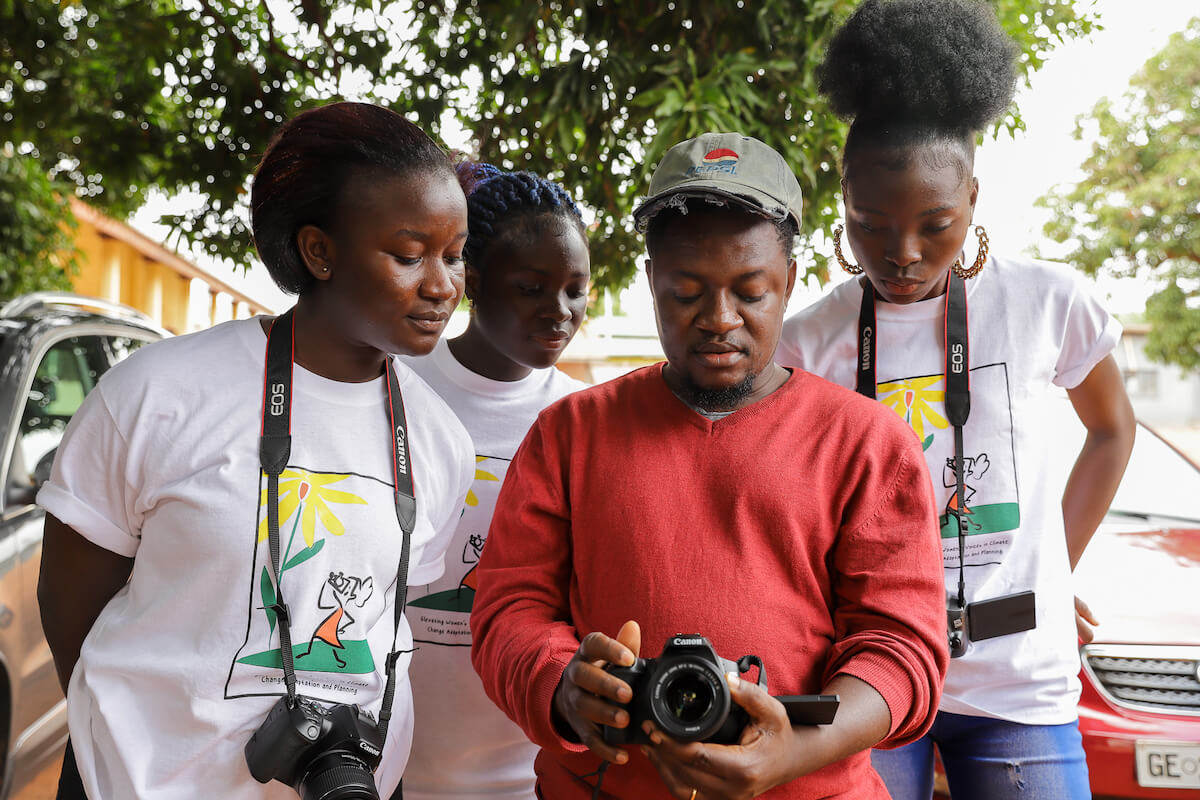
Photographer and Envisioning Resilience facilitator Francis Kokoroko in a hands-on session with participants at a workshop on photography and climate change adaptation in Tamale, Ghana (from left to right: Jennifer Atinyo, Dorcas Abban, Francis Kokoroko, Belinda Alhassan). Photo: Dennis Nipah

But in gender-responsive adaptation planning, understanding the impacts is only half the battle. It also requires forming gender-equitable decision-making processes around adaptation, including at the national level. Since 2018, IISD has been helping to drive steady progress in integrating gender considerations in NAP processes.  Among the NAPs submitted to the United Nations Framework Convention on Climate Change (UNFCCC) as of March 2023, 98% mention gender and approximately half recognize women as agents of change in climate change adaptation. 

Learn more about gender-responsive NAP processes: https://napglobalnetwork.org/resource/gender-responsive-nap-processes-progress-promising-examples/    

As part of its commitments to Generation Equality, IISD is also supporting Ghana in promoting gender-responsive climate action. The Environmental Protection Agency (EPA), which leads the NAP process in Ghana, has committed to a gender-responsive NAP approach, working closely with the Ministry of Gender, Children and Social Protection. The NAP Global Network has supported these efforts by facilitating the development of a concrete strategy for integrating gender considerations in the NAP process. 

Florence Tanoh, Director of Gender and Equity at Côte d'Ivoire’s Ministry of Women, recognizes the importance of capacity building to better tackle the linkages between gender and climate change. “Talking about the gender-climate nexus makes the issue of gender equality more tangible. The Ministry of Women is a ministry of key importance, but gender issues are often tackled in a relatively theoretical, even mechanical way, like ’We need eight women and eight men’, so that nobody really pays attention,” says Florence. 

In Côte d'Ivoire, a concerted effort has been made to build capacities to integrate gender in climate action, in line with a Memorandum of Understanding signed by the ministers in charge of the environment and gender issues in October 2021. As part of its commitments to Generation Equality, IISD organized a series of training sessions, and gender advisors have been providing ongoing support to the Ministry of the Environment, which leads the NAP process.  

Since July 2020, the existence of the national platform for gender and climate change (PNGCC) has created a framework for exchanges and synergies between multiple actors with a view to transferring gender and climate skills at the national level. Having more actors involved in adaptation make these links is essential for gender-responsive NAP processes. So far, the work is paying off:  “Some gender units, like the one in the Ministry of Hydraulics, have started to organize activities about the gender–climate nexus that relates to their sector,” says Florence. “Interest in climate change is growing rapidly among experts working on gender issues.”

Generation Equality is the world’s leading initiative to accelerate investment and implementation of gender equality. It brings together organizations from every part of society to catalyze progress, advocate for change and take bold actions together. 

The Generation Equality Feminist Action for Climate Justice Action Coalition is a platform that promotes the creation of more equitable economic and political systems under the gender and climate lens. 

IISD, in its role as the Secretariat of the National Adaptation Plan (NAP) Global Network, presented a Generation Equality commitment to work with interested government partners to advance gender-responsive adaptation action. NAP processes represent a key policy entry point for gender-responsive climate action – they will drive investments in adaptation in the coming years, making them an essential vehicle to build capacities and channel resources to build the resilience of women and girls to the impacts of climate change. IISD made this commitment to drive gender-responsive adaptation action in partnership with two governments who are already showing leadership in this area: Côte d'Ivoire and Ghana. 

Learn more about Generation Equality here: https://forum.generationequality.org/  

Explore more commitments like this one using the Commitments Dashboard: https://dashboard.commitments.generationequality.org/  

Topics

  • Climate change
  • Environmental protection
  • Generation Equality
  • Governance and national planning

Related content

Image
Women sit together on the floor inside an indoor space, with a woman wearing a purple headscarf seated in the foreground.
Feature

Aid cuts, employment bans, movement restrictions: The triple threat to Afghan women

16 July 2026
Aid cuts, employment bans, movement restrictions: The triple threat to Afghan women
Image
A young Ugandan woman sits with another local woman to talk
Press release

At least one million women and girls lose access to critical support as aid cuts dismantle women’s organizations working in humanitarian crises

10 July 2026
At least one million women and girls lose access to critical support as aid cuts dismantle women’s organizations working in humanitarian crises
Image
UNWomen_Placeholder
Press briefing

Aid cuts decimate services for women and girls as women’s organizations struggle to stay afloat

10 July 2026
Aid cuts decimate services for women and girls as women’s organizations struggle to stay afloat

Footer menu-HQ

  • News and stories
  • Resources
  • What we do
  • How we work
  • Where we are
  • Partnerships
  • Employment
  • Procurement
  • Contact us
  • Executive Board
  • Commission on the Status of Women

Donate button menu [Footer tablet]

  • Donate

Donate button menu [Footer]

  • Donate

Social media menu

  • Facebook
  • Twitter
  • LinkedIn
  • Flickr
  • YouTube
  • Instagram
UN Women - For all women and girls

Footer bottom [Menu]

  • Copyright
  • Information security
  • Privacy notice
  • Report wrongdoing
  • Terms of use
Share this page
  • Share to Facebook
  • Share to Twitter
  • Share to LinkedIn
  • Share to E-mail

Or copy link