
Pasar al contenido principal

Universal menu

  • Global
  • Regiones
    • África
    • Américas y el Caribe
    • Estados árabes
    • Asia y el Pacífico
    • Europa y Asia Central
  • Conocimiento
  • Datos
  • Capacitación
  • Transparencia
ONU Mujeres - Por y para todas las mujeres y niñas

Main Navigation-HQ

  • Quiénes somos
    • Sobre nosotras
      • Acerca de ONU Mujeres
      • Modelo institucional
      • Documentos orientativos
      • Presencia mundial
    • Liderazgo
      • Estructura de gobernanza
      • Liderazgo ejecutivo
      • Junta Ejecutiva
      • Responsabilidad
    • Trabaja con nosotras
      • Empleo
      • Obtención
      • Contacta con nosotras
      • Plan Estratégico de ONU Mujeres 2026–2029
      • UN Women Strategic Plan 2026–2029 - social media image
        Plan Estratégico de ONU Mujeres 2026–2029
  • Qué hacemos
    • como trabajamos
      • Agenda 2030 para el Desarrollo Sostenible
      • Comisión de la Condición Jurídica y Social de la Mujer
      • La paridad de género en el sistema de las Naciones Unidas
      • Apoyo intergubernamental
      • Asociaciones
      • Investigación y datos
      • Centro de formación
      • Fondos fiduciarios
      • Coordinación del sistema de la ONU
    • Áreas de enfoque
      • Poner fin a la violencia contra las mujeres
      • Paix et sécurité
      • Acción humanitaria
      • Liderazgo y gobernanza
      • Empoderamiento económico
      • Innovación y tecnología
      • Mujeres con discapacidad
      • VIH y SIDA
  • Noticias
    • centro de medios
      • Contenidos para la prensa
      • Contactos con los medios
      • ¿Por qué las mujeres están tan agotadas? El trabajo de cuidados y la carga mental
      • Two adults stand at a table changing diapers on baby dolls, with laundry hanging on a clothesline behind them in a home setting.
        ¿Por qué las mujeres están tan agotadas? El trabajo de cuidados y la carga mental
      • Al menos un millón de mujeres y niñas pierden el acceso a asistencia esencial
      • A young Ugandan woman sits with another local woman to talk
        Al menos un millón de mujeres y niñas pierden el acceso a asistencia esencial
    • Últimas
      • Noticias
      • Artículos explicativos
      • En foco
  • Digiteca
    • Resources
      • Publicaciones
      • Informe anual
      • Progress of the world’s women
      • World survey on the role of women in development
    • Término de género
      • Término de género
      • Permisos de reimpresión
  • Participa
    • Cómo involucrarse
      • Para TODAS las mujeres y las niñas
      • Día Internacional de la Mujer
      • 16 días de activismo para poner fin a la violencia contra las mujeres y las niñas
      • ¡ÚNETE! Campaña para erradicar la violencia contra las mujeres
      • Él para ella
Pregúntale a la IA
https://84e5cfacd5c7e99f9825edf344450c.1b.environment.api.powerplatform.com/powervirtualagents/botsbyschema/crad4_websiteQA/directline/token?api-version=2022-03-01-preview
1
-
Haz tu pregunta aquí
Asistente de sitio web de IA

Hola ¿Cómo puedo ayudarte?

Las respuestas del chatbot de IA pueden ser incorrectas. Verifique siempre la información importante.

Donate button menu

Donar

Sobrescribir enlaces de ayuda a la navegación

  1. Inicio
  2. Explore Nuestras Noticias Más Recientes

Website survey

We want to know how we can improve your experience on this website. Completing this survey takes less than 5 minutes.

TAKE THE SURVEY
Reportaje

Cómo las mujeres migrantes de Tailandia están poniendo fin a la trata de personas y la violencia de género en sus comunidades

15 de noviembre de 2021
  • Share to Facebook
  • Share to Twitter
  • Share to LinkedIn
  • Share to E-mail

La migración puede ser una experiencia transformadora, pero las trabajadoras migrantes están especialmente expuestas a la trata de personas y la violencia de género. San May Khine, una trabajadora social de Tailandia que alguna vez fue migrante, ayuda a otras trabajadoras migrantes a dejar atrás las situaciones de violencia y construir un futuro estable y brillante en un mundo golpeado por la pandemia de COVID-19.

This story was originally published by UN Women Asia Pacific and has been edited for this website.
Image
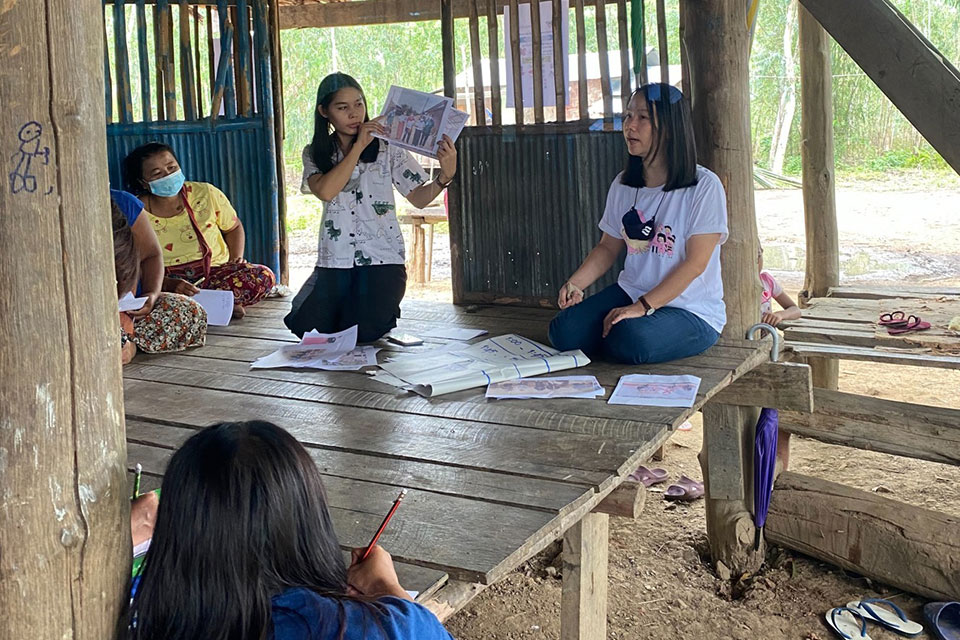
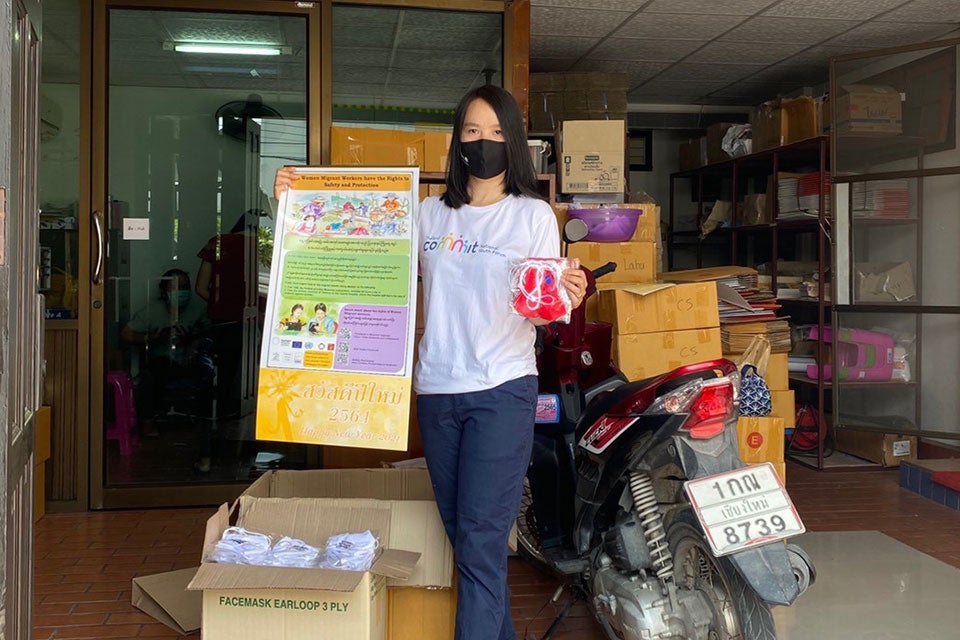
•   San May Khine  presents resources for coping with COVID-19 and personal protection equipment to women migrant workers  All Photos Courtesy San May Khine

“Migration empowered me and made me who I am today,” explains San May Khine, a Project Officer with the “Education and Identify Project” at the MAP Foundation in Thailand. Born and raised in Myanmar, Khine became a domestic worker in Thailand at the age of 14.

“I was the youngest child in my family, and I wanted to help my parents. Back then, I earned 3,500 Thai Baht (about USD 100) per month. I was excited to have that money for me and my family in Myanmar,” she explains.

“However, the working environment was exploitative. I had to work for a whole day without any leave or proper care as a child. But I did not know I had rights, so I did not even think of claiming them.”

After being a domestic worker for two years, Khine worked in various jobs, including in an orchid farm and at a construction site. “I gained more freedom as I earned more money. This would not be possible without the support of the good people that I met in Thailand.”

Finding strength in adversity

Migration can empower female migrant workers financially and help build their confidence. But, away from family and established community networks, many women struggle to find support when they need it. Once Khine found the strength to leave her abusive husband, she she wanted to support others in her migrant community to also break free of gender-based violence.
Image
San May Khine organizies a session on violence against women migrant workers, trafficking in persons and the rights of women migrant workers in Chiang Mai, Thailand. Photo courtesy of San May Khine

“I thought only men could do things like protect the family and earn money – the traditional roles of the father. My daughter was very little, and I was terrified to leave my husband, so I endured his abusive words and acts. But, one day, I realized that I was working like he did, earning money like he did, and I was protecting my daughter, probably better than he did.”

“I had no doubt that I could be the best parent for my daughter without him. It was all thanks to financial independence and the belief I had in myself, which I gained throughout my migration experience. When women are confident and know more about their rights, they will be more prepared to break out from the cycle of violence. My role is guiding them to realize their potential and supporting their brave journey to walk away from violence,” enthuses Khine.

Khine is now a social worker, and she is part of a multi-disciplinary team in Chiang Mai province that has a large migrant population from Myanmar. She works with migrant women and their children who have experienced violence and trafficking.

“I see my past in them. I know they have unlimited, yet unrealized, potential because of what women are ‘supposed to be’. While the COVID-19 pandemic is a difficult time for everyone, it is extremely difficult for women who have had to stay within abusive relationships. I’ve seen an increase in the number of cases of violence, and also an increase in the intensity of violence.”

Migrant communities support their own

Khine’s social work is supported by the Safe and Fair Programme, jointly implemented by UN Women and ILO, in collaboration with UNODC, as part of the multi-year EU-UN Spotlight Initiative to Eliminate Violence Against Women and Girls. In Thailand, the programme is working with local civil society organizations in Mae Sot, Chiang Mai and Bangkok to strengthen coordination systems by developing local standard operating procedures.

Image
San May Khine, in a traditional Shan dress, in front of Royal Park Rajapruek in Chiang Mai, Thailand after hosting a programme on the rights of the child and women. Photo courtesy of San May Khine

“Working with women like Ms. Khine is critical,” explains Kohnwilai Teppunkoonngam, the National Programme Coordinator of UN Women in Thailand. “Having experienced that life firsthand, they know the reality that women migrant workers are living and how best to help them.”

The programme has also been supporting peer network groups and civil society organizations across the ASEAN region to better support women migrant workers. “Research shows that women migrant workers who are survivors of violence seek immediate support and help from friends, fellow women migrant workers or local civil society organizations,” notes Valentina Volpe, the Ending Violence against Women Specialist at the UN Women Regional Office for Asia and the Pacific.

“The Safe and Fair Programme encourages and supports the establishment of migrant women’s networks in countries of origin, transit and destination, and across countries, for peer support and information sharing.”

Khine says her work will not stop as long as there is someone who needs her. “I work to make the referral processes safer and more gender-responsive for women migrant workers and their children. I also provide interpretation support for women from Myanmar who do not speak Thai. My job is to make them more comfortable, confident, and safer. Their courage always inspires me. It is what keeps me moving… until the day every woman and girl is free from violence and trafficking.”

Temas

  • Empoderamiento económico
  • Trabajadoras/es migrantes
  • Migración
  • Eliminación de la violencia contra las mujeres y las niñas
  • Trata, explotación sexual
  • Asia y el Pacífico
  • Unión Europea
  • Tailandia

Contenido destacado

Image
Collage with photo and illustration. A young woman with a serious expression opens a laptop. From inside it, aggressive, broken lines come off the device. By her side, there's a smartphone with the same white and orange lines on its screen. Pop-ups of messages suggest she's receiving violent texts.
Comunicado de prensa

Las denuncias policiales por violencia digital contra mujeres periodistas se duplican desde 2020; una de cada cuatro sufre ansiedad o depresión a causa de ello

30 de abril de 2026
Las denuncias policiales por violencia digital contra mujeres periodistas se duplican desde 2020; una de cada cuatro sufre ansiedad o depresión a causa de ello
Image
Six women standing closely together against a blue-to-purple gradient background, facing the camera with serious expressions. They are positioned in two rows, with a metallic UN Women logo displayed behind them. The women have diverse appearances and wear dark and neutral-toned clothing, creating a strong, unified group portrait.
Comunicado de prensa

Ningún país del mundo ha alcanzado la plena igualdad jurídica para las mujeres y niñas

4 de marzo de 2026
Ningún país del mundo ha alcanzado la plena igualdad jurídica para las mujeres y niñas
Image
Un grupo de hombres sostiene carteles contra la MGF en las sesiones de sensibilización. Foto: cortesía de Men End FGM.
Reportaje

¿Cómo es la vida de las mujeres que sobreviven a la mutilación genital femenina (MGF)?

30 de enero de 2026
¿Cómo es la vida de las mujeres que sobreviven a la mutilación genital femenina (MGF)?

Footer menu-HQ

  • Noticias
  • Recursos
  • Qué hacemos
  • Cómo trabajamos
  • Dónde estamos
  • Socios
  • Empleo
  • Adquisiciones
  • Comunícate
  • Junta Ejecutiva
  • Comisión de la Condición Jurídica y Social de la Mujer

Donate button menu [Footer tablet]

  • Donar

Donate button menu [Footer]

  • Donar

Social media menu

  • Facebook
  • Twitter
  • LinkedIn
  • Flickr
  • YouTube
  • Instagram
ONU Mujeres - Por todas las mujeres y niñas

Footer bottom [Menu]

  • Seguridad informática
  • Privacidad
  • Investigaciones
  • Condiciones de uso
Share this page
  • Share to Facebook
  • Share to Twitter
  • Share to LinkedIn
  • Share to E-mail

Or copy link